

 Veselin Stoyanov12 min read
How to Use an AI Content Planner to Dominate Your Niche
Learn how to use an AI content planner to find content gaps, build a topical map, create an SEO content calendar, and turn strategy into published articles.

How to Use an AI Content Planner to Dominate Your Niche
Publishing more blog posts does not automatically create more organic traffic. If your topics are disconnected, your keyword targets are vague, or your content ignores search intent, a larger publishing schedule can simply produce more pages that fail to support your goals.
An AI content planner helps solve the strategy problem before it becomes a writing problem. It can organize keyword targets, identify gaps in your existing coverage, group related topics, and turn a broad niche into a practical publishing plan.
The key is to use AI as a planning partner, not as a replacement for judgment. You still need to decide which audiences matter, which topics fit your business, and what level of expertise your content should demonstrate. AI is most useful when it helps you make those decisions faster and execute them consistently.
What Is an AI Content Planner?
An AI content planner is a tool that uses artificial intelligence to help you decide what to publish, when to publish it, and how each piece should support your broader SEO strategy.
Depending on the tool, it may help you:
- Organize target keywords by topic and intent
- Find gaps in your existing content coverage
- Group related subjects into topic clusters
- Suggest article ideas for different stages of the buyer journey
- Build a monthly SEO content calendar
- Connect planned topics to article briefs or generation workflows
A traditional spreadsheet can store ideas, but it usually cannot evaluate the relationships between topics or keep a large content operation moving. An AI content planner can help turn raw inputs into a structured plan that is easier to review and act on.
The best output is not a long list of generic titles. It is a clear map showing how individual articles contribute to a recognizable area of topical authority.
Why Content Gaps Matter
A content gap is an important question or subtopic that your audience searches for but your website does not answer well enough.
Content gaps can appear in several ways:
- Missing topics: You have articles about advanced solutions but nothing that explains the basics.
- Missing intent: You target informational searches but ignore comparison, commercial, or implementation queries.
- Weak coverage: You mention an important subject briefly but do not provide a useful dedicated resource.
- Audience gaps: Your content serves experts but not beginners, or buyers but not existing users.
- Journey gaps: Readers cannot move naturally from learning about a problem to evaluating solutions.
For example, a project management software blog might publish an article about workflow automation but omit supporting topics such as task dependencies, team handoffs, project templates, and workflow reporting. Each missing topic represents an opportunity to make the main subject more useful and easier to understand.
AI can speed up gap analysis by comparing your existing topics with keyword lists, competitor themes, customer questions, and related searches. However, suggestions should be treated as inputs for review. A keyword can look relevant while being too broad, too competitive, commercially irrelevant, or poorly aligned with your product.
Step 1: Define Your Niche and Business Focus
Before asking AI for content ideas, establish the boundaries of your strategy.
Write down:
- Your primary audience
- The problems you help solve
- Your products, services, or expertise
- The topics you want to be known for
- The topics you do not want to cover
- Your preferred content style and level of detail
This context prevents the planner from producing a disconnected collection of popular subjects. It also gives you a standard for filtering ideas.
A useful test is to complete this sentence:
We want to become a trusted resource for [audience] looking for help with [problem] so they can [desired outcome].
The more specific the answer, the more useful your topical map is likely to be.
Step 2: Build a Reliable Keyword Set
An AI content planner works best when it starts with meaningful keyword targets rather than a vague instruction such as “write about marketing.”
Collect keywords from:
- Search Console and analytics data
- Customer conversations and support tickets
- Sales calls and product demos
- Forums and industry communities
- Keyword research tools
- Existing pages that already attract impressions
- Competitor content used for research, not copying
Then classify each keyword by search intent. Common intent categories include:
- Informational: The searcher wants to learn something.
- Commercial investigation: The searcher is comparing options.
- Transactional: The searcher is ready to take action.
- Navigational: The searcher is looking for a specific brand or page.
Also record the topic, audience level, funnel stage, and business relevance. This makes it easier to prioritize ideas that support both search visibility and conversions.
If you want a more structured workflow, keyword targeting can help connect target terms to focused article ideas and content plans. Use the keyword list as strategic direction, then let the planner expand it into related coverage rather than replacing the original research.
Step 3: Ask AI to Create a Topical Map
A topical map is a structured view of the subjects your website should cover and the relationship between them.
Start with one broad pillar topic. Then build supporting clusters around it.
For example:
- Pillar: Email marketing automation
- Foundational cluster: What it is, how it works, and who needs it
- Implementation cluster: Campaign setup, segmentation, workflows, and templates
- Optimization cluster: Deliverability, testing, personalization, and reporting
- Commercial cluster: Tools, alternatives, pricing considerations, and use cases
Ask the AI planner to identify:
- Core themes in the niche
- Supporting subtopics for each theme
- Questions beginners and advanced readers ask
- Search intent for each proposed article
- The recommended role of every article in the cluster
- Potential overlaps or cannibalization risks
- Internal linking opportunities
The goal is not to publish every suggestion. The goal is to see the shape of the niche so you can select the topics that best match your expertise and priorities.
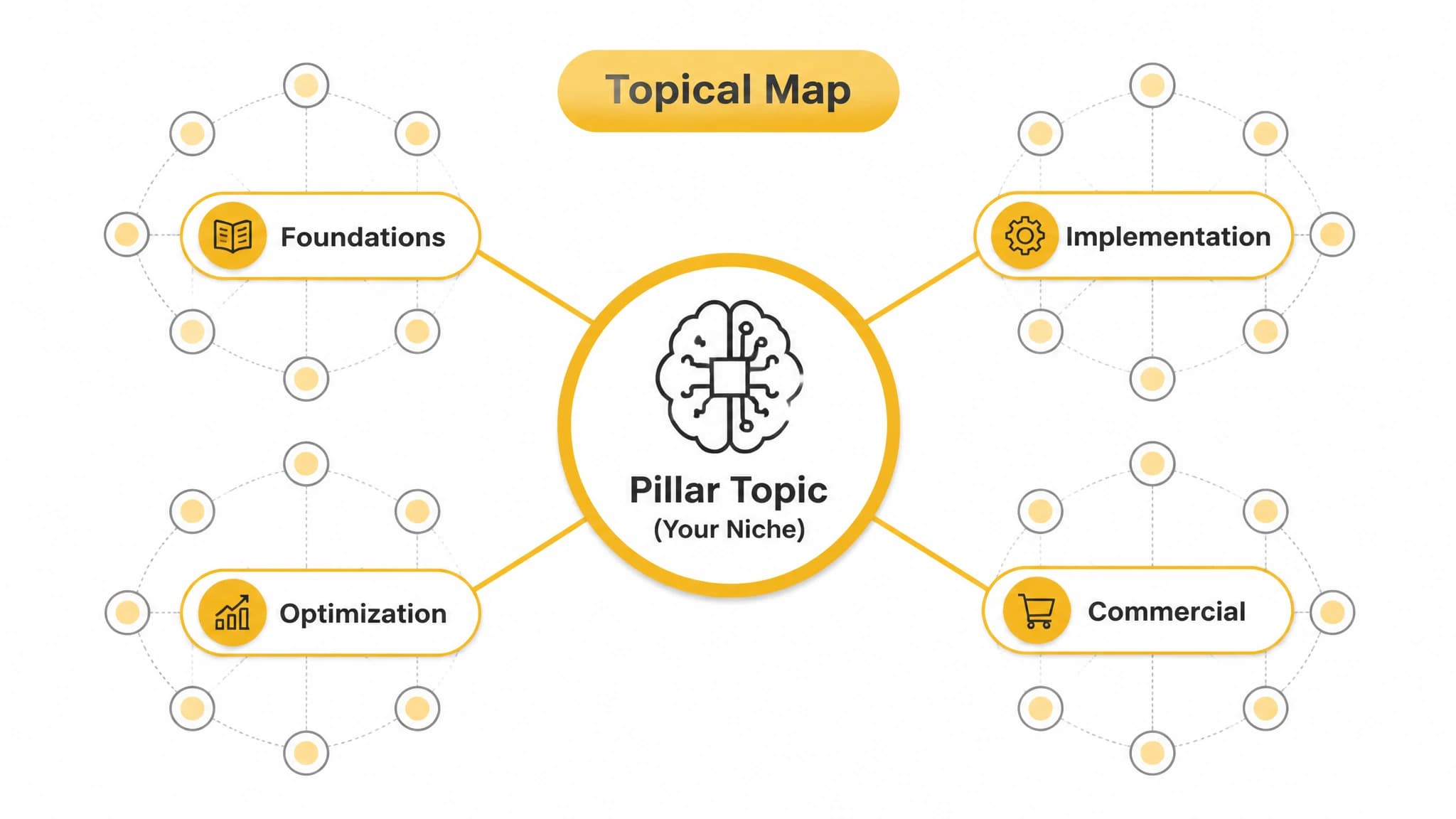
A topical map organizes related articles around a central pillar topic.
Step 4: Turn the Topical Map Into an SEO Content Calendar
Once you have a topical map, convert it into an SEO content calendar that your team can actually maintain.
For every planned article, define:
- Working title
- Primary keyword
- Secondary terms
- Search intent
- Target reader
- Funnel stage
- Content format
- Related pillar or cluster
- Internal links to add
- Desired next step for the reader
- Owner and planned publishing date
Prioritize topics using a simple scoring system. You might rate each idea from one to five for business relevance, audience demand, topical importance, and production effort. The exact formula matters less than applying the same logic across the plan.
A practical publishing sequence often looks like this:
- Publish foundational resources that explain the subject clearly.
- Add supporting articles that answer specific questions.
- Create implementation and use-case content.
- Add comparison and decision-stage content.
- Refresh and connect the cluster as new insights emerge.
This approach gives readers multiple entry points while helping search engines understand the depth and structure of your coverage.
Step 5: Review AI Suggestions Before Approval
AI-generated plans require editorial review. A good plan should be filtered before it becomes a writing queue.
Remove ideas that are:
- Outside your actual expertise
- Too similar to an existing article
- Unrelated to your business goals
- Based on a keyword with unclear intent
- Too broad to answer well in one article
- Dependent on unsupported claims or outdated information
- Unlikely to provide a meaningful next step for readers
Then improve the strongest ideas. Make titles more specific, adjust the audience level, clarify the intended outcome, and add unique angles based on your experience.
This review step is where strategy becomes defensible. AI can recognize patterns, but your editorial judgment determines whether a topic deserves a place in the plan.
Step 6: Move From Planning to Execution
Planning and production should be connected, but they should not be confused.
A plan answers questions such as:
- What should we publish?
- Why does the topic matter?
- Which keyword and intent should guide it?
- How does it support the wider cluster?
Execution answers different questions:
- What should the outline include?
- What evidence or examples are needed?
- Which internal links belong in the draft?
- How should the article be edited, optimized, and published?
The transition works best when the approved plan carries its context into the article brief. Each article should begin with its target keyword, audience, intent, role in the topical map, and content requirements already defined.
This reduces the risk of generating attractive but strategically disconnected articles. It also makes it easier to delegate, automate, or repeat the workflow each month.
How RankWorker Connects Planning and Generation
RankWorker places a planning layer before article generation. Its Content Plans workflow creates monthly SEO article ideas from project context, settings, and keyword targets, then lets you review, remove, or adjust ideas before generation begins. Approved ideas can then move into article generation, so drafts start from a plan you have already reviewed. (rankworker.com)
You can learn more about RankWorker content plans if you want a workflow that connects keyword-guided planning with content production. The important principle is broader than any single tool: approve the strategy first, then generate against that strategy.
Step 7: Measure Whether the Plan Is Working
An AI content planner should support a learning loop, not a set-and-forget calendar.
Review performance at the page and cluster level. Useful questions include:
- Are impressions increasing for the target topic?
- Which articles attract the most qualified visits?
- Are readers moving between related pages?
- Are articles generating leads, signups, or other meaningful actions?
- Which topics consistently require major revisions?
- Are multiple pages competing for the same intent?
Do not judge a new plan only by early rankings. Search performance can take time, and a page may contribute value through assisted conversions, internal links, or increased visibility across related queries.
At the same time, do not keep publishing blindly. Refresh pages that are close to performing well, consolidate overlapping articles, and remove weak ideas from future calendars. A smaller plan with stronger alignment is usually easier to maintain than an endless queue of marginal topics.
Common Mistakes to Avoid
Treating AI ideas as final decisions
AI can suggest plausible topics that do not fit your audience or offer a clear business benefit. Review every idea against your niche, expertise, and search intent.
Chasing volume instead of coverage
A large number of articles is not the same as topical authority. Build connected coverage around important themes before expanding into unrelated subjects.
Ignoring existing content
A planner should account for pages you already have. Otherwise, you may create duplicates, split authority, or overlook opportunities to refresh useful content.
Separating planning from writing
If article generation does not receive the original keyword, intent, and cluster context, the final draft can drift away from the strategy. Keep the planning information attached to the production brief.
Forgetting the reader’s next step
Every article should help the reader do something next, whether that means reading a foundational guide, comparing approaches, trying a process, or evaluating a solution. This creates a more useful journey than isolated traffic pages.
Final Takeaway
An AI content planner is most valuable when it helps you build a focused system, not when it produces the largest possible list of blog titles.
Start with a clear niche and business focus. Feed the planner meaningful keyword targets. Use AI to identify gaps and organize a topical map, then turn the strongest opportunities into a realistic SEO content calendar. Review the plan before production, carry its context into every article, and use performance data to improve the next cycle.
That is how content planning becomes a competitive advantage: not through automation alone, but through better decisions repeated consistently.