

 Veselin Stoyanov12 min read
How to Choose the Best AI SEO Tools for Traffic Growth
Learn how to compare the best AI SEO tools for content quality, keyword targeting, workflow automation, integrations, and long-term traffic growth.

How to Choose the Best AI SEO Tools for Traffic Growth
AI SEO tools can help businesses research topics, plan content, generate drafts, optimize metadata, and keep publishing workflows moving. But choosing the right platform is not as simple as finding the tool with the longest feature list.
The best AI SEO tool for your business depends on what is slowing your growth today. If you need help finding worthwhile topics, keyword research may be the priority. If you already have a strategy but struggle to publish consistently, workflow automation and integrations may matter more than writing quality alone.
This guide explains how to evaluate AI SEO software, which capabilities to compare, and how to choose a tool that supports traffic growth without turning your website into a stream of generic content.
What makes an AI SEO tool useful?
An AI SEO tool combines artificial intelligence with search-focused workflows. Depending on the platform, it may help with keyword targeting, content briefs, article generation, on-page optimization, internal processes, publishing, or performance analysis.
However, automation by itself does not create organic growth. A useful platform should help you make better decisions and execute them consistently. That means it should connect strategy, content production, review, and publishing instead of treating article generation as an isolated task.
When comparing tools, evaluate them across four areas:
- SEO strategy: Can the tool help you choose relevant keywords and topics?
- Content quality: Can it produce useful, accurate, on-brand drafts?
- Workflow automation: Can it reduce repetitive planning and publishing work?
- Integrations: Can it fit into the systems your business already uses?
A tool that performs well in only one area may still leave your biggest operational problem unsolved.

Start by identifying the biggest bottleneck in your current SEO process.
1. Start with your SEO bottleneck
Before comparing vendors, document your current content workflow. Write down what happens from the moment you identify a topic to the moment the article is published and reviewed.
For example, your process may include:
- Finding keywords manually
- Selecting topics from a spreadsheet
- Creating briefs
- Assigning or writing articles
- Reviewing accuracy and brand voice
- Preparing images and metadata
- Uploading content to your website
- Scheduling publication
- Updating the editorial calendar
Then identify the most expensive or inconsistent step. A small business with limited time may not need an advanced enterprise analytics platform. It may need a reliable way to turn keyword targets into approved articles and publish them without repeated manual work.
Similarly, a marketing team that already has writers may benefit more from content planning, approval, and publishing automation than from another AI writing assistant.
The right AI SEO software should solve a defined problem rather than add another disconnected dashboard to your stack.
2. Evaluate keyword targeting and content planning
Strong SEO content starts before the first paragraph is written. The tool should help you connect target keywords with realistic article topics and a broader content strategy.
Look for capabilities such as:
- Adding and organizing target keywords
- Turning keywords into focused article ideas
- Grouping related topics into a content plan
- Mapping content to different stages of the buyer journey
- Reviewing and editing ideas before generation
- Maintaining a repeatable publishing calendar
The important question is not whether a platform can produce hundreds of topic suggestions. Ask whether those suggestions are useful for your audience and connected to your business goals.
A good planning workflow gives you control. You should be able to reject weak ideas, refine promising ones, and decide what gets produced. This prevents the common problem of generating content simply because a tool can generate it.
It is also worth checking whether the platform remembers your project context. Audience information, brand positioning, content preferences, and custom instructions can make planning and drafting more consistent across multiple articles.
3. Assess content generation quality
Content generation is often the first feature people compare, but it should not be the only one. An AI-generated draft is valuable only when it gives the reader a clear, accurate, and useful answer.
When testing an AI SEO tool, review a sample article for:
Search intent alignment
Does the draft answer what the searcher is actually trying to accomplish? A page targeting “how to choose accounting software” should help readers compare options and make a decision—not merely define accounting software.
Original usefulness
Does the article provide practical steps, examples, trade-offs, or decision criteria? Generic summaries rarely give readers a reason to trust or remember a page.
Brand consistency
Can the tool follow your preferred tone, audience, terminology, and editorial rules? Consistent brand voice becomes increasingly important when several people review or publish AI-assisted content.
Factual control
Does the workflow make it easy to review claims before publication? AI can produce confident-sounding errors, so a responsible process should include human review for facts, product details, legal statements, medical information, and other high-risk topics.
Metadata and formatting
Can the platform organize the title, meta description, keywords, headings, and article content together? Keeping these elements in one reviewable output can reduce production errors.
The best AI SEO tools support editors rather than encouraging blind publishing. Look for preview and approval steps that let you inspect the article before it reaches your website.
4. Compare workflow automation features
For many businesses, the main value of AI SEO software is not writing one article. It is making the entire publishing process repeatable.
Workflow automation may include:
- Automatic content plan generation
- Editorial calendar management
- Article scheduling
- Draft generation from approved plans
- Image generation or image preparation
- Metadata creation
- Email notifications
- Automated publishing workflows
These features matter because consistency is difficult when every article requires a separate sequence of manual tasks. A workflow tool can help turn SEO from an occasional project into a regular operating process.
Still, automation should not remove necessary checkpoints. Look for a balance between speed and control. You may want the system to generate a monthly plan automatically, while keeping final approval in your hands. You may want articles scheduled in advance, while still being able to reorder or pause upcoming content.
Ask these practical questions during evaluation:
- Can I approve topics before articles are generated?
- Can I edit the content calendar?
- Can I preview the article and metadata together?
- Can I schedule content for future publication?
- Can I pause or adjust the workflow when priorities change?
- What happens when an article needs human review?
A tool that answers these questions clearly is more likely to support a sustainable process.
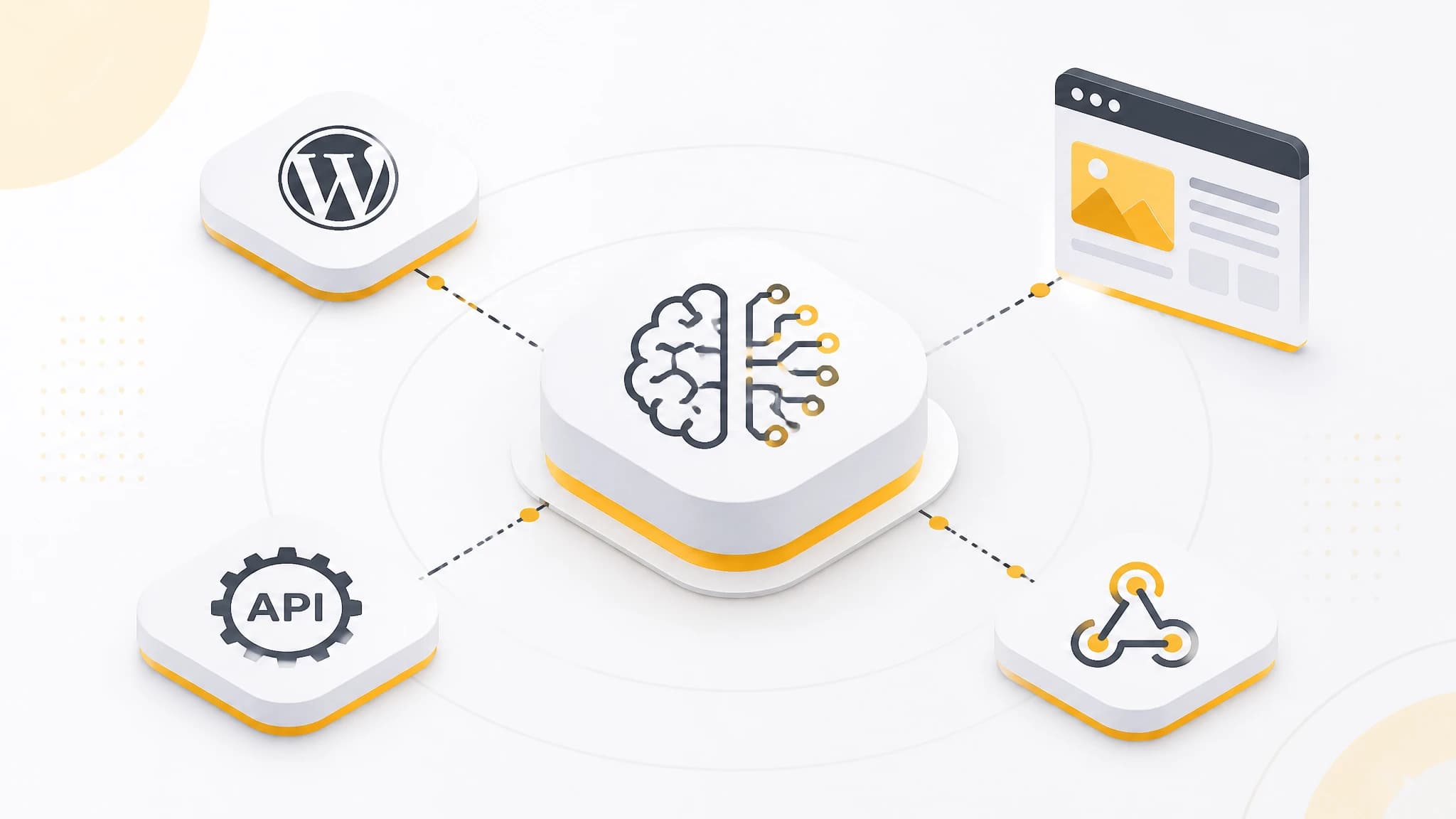
The right integration can reduce manual work between content creation and publication.
5. Check integrations before you commit
Integrations determine whether an AI SEO tool fits your business or creates more work. A platform may have excellent content features, but if you still need to copy and paste every article into your CMS, a significant part of the workflow remains manual.
Start by listing your publishing environment. Common requirements include:
- WordPress publishing
- A custom website or Next.js application
- Direct API access
- Webhooks for connecting other systems
- Compatibility with existing editorial or marketing workflows
Then check what the integration actually supports. “Integration available” can mean very different things. You need to know whether it supports draft creation, scheduled publishing, metadata, images, categories, tags, status changes, and other fields relevant to your process.
For technical teams, API and webhook support may be more important than a ready-made CMS connector. For a solo founder, a native WordPress workflow may be the simplest choice. The best option depends on how much flexibility and implementation effort your organization can support.
RankWorker is designed for businesses that want to connect planning and production with publishing. Its feature set includes keyword targeting, content plans, a content calendar, article previews, SEO metadata, image generation, scheduling, and API-based publishing workflows. The platform lists WordPress, Next.js, Direct API, and Webhooks among its integration options. You can review the current capabilities on the RankWorker features page. (rankworker.com)
The key evaluation point is not the number of integrations. It is whether the available integration can remove a real bottleneck in your publishing process.
6. Consider review, governance, and control
AI-assisted SEO requires an editorial system. Even if a tool produces a strong first draft, your business remains responsible for what it publishes.
A practical governance process should define:
- Which topics require subject-matter review
- Who approves content before publication
- How factual claims are checked
- Which brand and legal rules the tool must follow
- How corrections and updates are handled
- When content should be refreshed, merged, or removed
Project-level settings can help standardize some of this work. For example, a platform may allow you to specify your audience, brand voice, positioning, and custom instructions once, then apply them across future content. This reduces repeated setup, but it does not replace editorial judgment.
Also check whether you can preview the complete output before publishing. A useful preview should make it easy to review the article, SEO metadata, keywords, images, and formatting in context.
The more automated the workflow, the more important these controls become. Speed without review can multiply mistakes just as efficiently as it multiplies good content.
7. Look beyond article volume
Many AI SEO platforms emphasize how much content they can generate. Volume can be useful, but it is a poor standalone measure of value.
Publishing more pages may help only when those pages are relevant, differentiated, accurate, and maintained. A smaller library of well-planned articles can be more useful than a large collection of overlapping pages that target the same intent.
When comparing plans and capabilities, consider:
- How many projects you need to manage
- How many articles you can realistically review each month
- Whether images are included in the workflow
- Whether the tool supports a content calendar
- How much manual publishing work remains
- Whether the platform can scale with your process
Choose capacity based on your actual editorial system, not an abstract maximum. If your team can responsibly review ten articles per month, a plan built around much higher output may not improve results.
8. Test the tool with a realistic use case
A free trial or demonstration is most useful when you test a complete workflow instead of generating a random article.
Use one real business topic and evaluate the following sequence:
- Add or define a target keyword.
- Generate or create a topic idea.
- Review the proposed content direction.
- Produce an article draft.
- Check the article, metadata, images, and formatting.
- Schedule or publish it in your actual environment.
- Record which steps still require manual work.
During the test, involve the people who will use the platform. A tool that looks impressive to a manager may be frustrating for the editor or developer responsible for daily execution.
You should also measure setup effort. If configuring the platform requires extensive maintenance for every article, the automation may not deliver meaningful time savings.
A practical checklist for choosing the best AI SEO tool
Use this checklist when comparing options:
- Does the tool support the SEO topics and audiences that matter to my business?
- Can it connect keywords to focused content ideas?
- Can I review and approve a content plan?
- Does it follow project-level brand and audience instructions?
- Can I inspect the article and SEO metadata before publication?
- Does it support useful images or image workflows?
- Can I manage a content calendar?
- Can I schedule articles?
- Does it integrate with my CMS or website stack?
- Can it use APIs or webhooks if needed?
- What manual work remains after generation?
- Can I pause, edit, or change the workflow when priorities shift?
- Does the pricing match the amount of content I can responsibly review?
The strongest choice is usually the tool that fits your complete process—not the one with the most impressive isolated AI feature.
Final thoughts
The best AI SEO tools help businesses make SEO more consistent without removing strategic control. When choosing an AI SEO tool, evaluate the full workflow: keyword targeting, content planning, generation, review, scheduling, and publishing.
Prioritize usefulness over volume, integrations over isolated features, and repeatability over one-off speed. A platform that supports your real publishing process can help you spend less time coordinating tasks and more time improving the content that attracts and converts the right audience.