

 Veselin Stoyanov12 min read
Programmatic SEO Workflow: Using APIs to Scale Content
Learn how to build an automated content workflow with APIs, from keyword planning and generation to review, publishing, and ongoing SEO improvements.

Programmatic SEO is not simply publishing thousands of pages. It is the process of creating a repeatable system that identifies search opportunities, produces useful content, publishes it correctly, and improves it over time.
For a small website, these tasks can be handled manually. As the content operation grows, however, repetitive work becomes a bottleneck. Briefs must be created, articles reviewed, images prepared, metadata entered, and pages published across one or more websites. An API can connect these steps into an automated content workflow without requiring every task to happen inside the same dashboard.
This guide explains how programmatic SEO works, where APIs fit, and how to design an SEO workflow automation system that can scale without sacrificing quality.
What is programmatic SEO?
Programmatic SEO uses structured data, templates, rules, and automation to create and manage many search-focused pages efficiently. The goal is not to generate generic pages at random. The goal is to serve a clearly defined search need with consistent, useful information.
A programmatic SEO system may use inputs such as:
- Target keywords and topic clusters
- Locations, categories, products, or use cases
- Search intent and page type
- Internal linking rules
- Content templates and editorial instructions
- Metadata fields and publishing settings
For example, a business could create a set of location pages, comparison pages, glossary entries, or use-case pages from a structured content plan. Each page still needs a distinct purpose, accurate information, and enough value to deserve its place in search results.
Automation helps with the repeatable operations around content. It does not remove the need for strategy, quality control, or technical SEO.
Why APIs matter in an automated content workflow
An API allows software systems to exchange data directly. Instead of downloading an article, copying it into a CMS, uploading images, and entering metadata by hand, your application can request the required content and pass it into the publishing workflow.
That creates several advantages:
- Less manual data entry: Content, images, metadata, and publishing data can move between systems programmatically.
- Consistent execution: The same validation and formatting rules can run every time.
- Flexible architecture: Teams can keep their existing frontend, CMS, or deployment process.
- Better scalability: Adding more topics or websites does not necessarily require adding the same amount of administrative work.
- Clearer monitoring: API requests, validation results, failures, and publication status can be logged.
A content management API can be particularly useful when the website is custom-built, headless, statically generated, or connected to a deployment pipeline. For a broader look at API-driven publishing models, see this guide to automated SEO publishing.
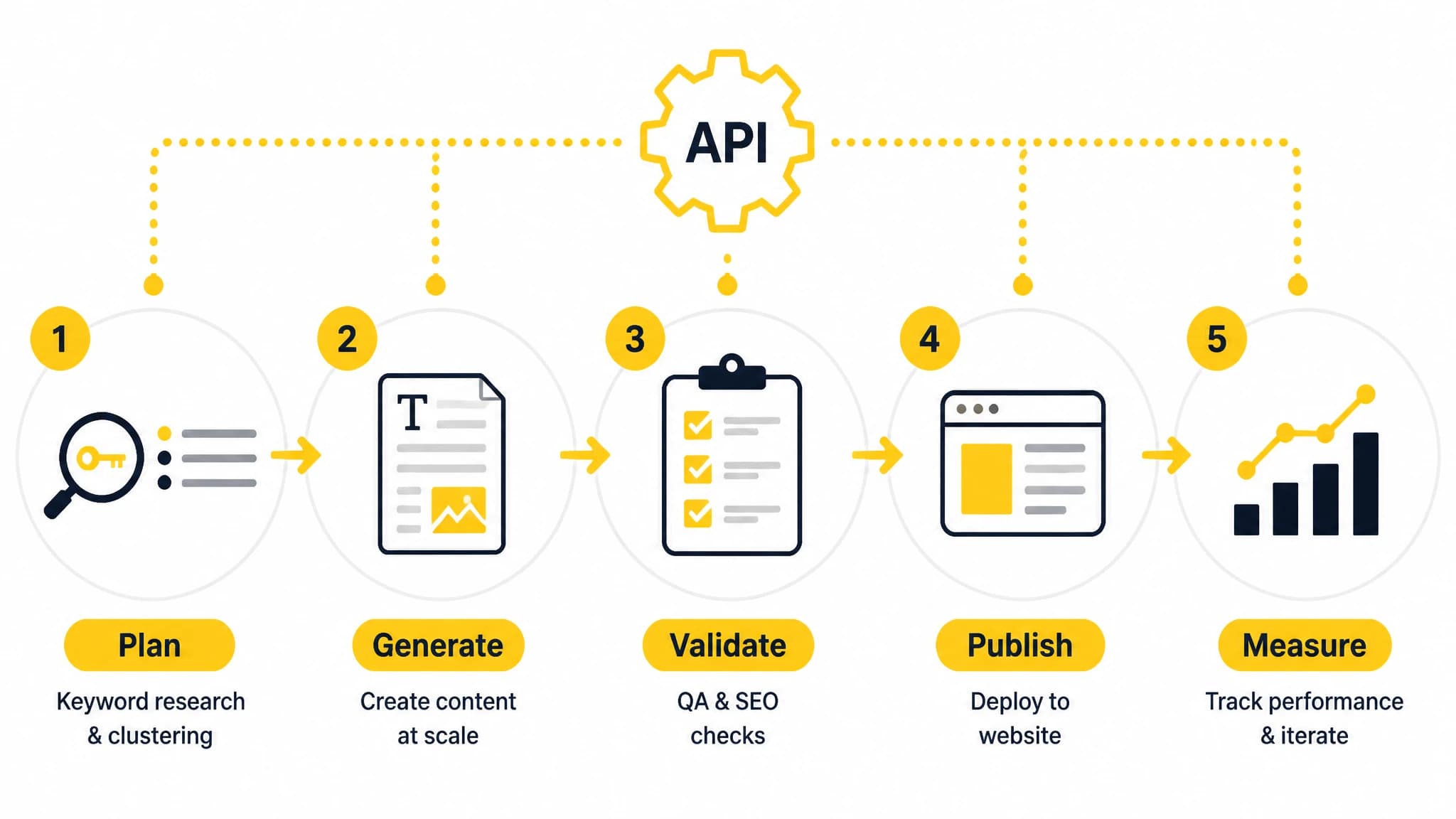
A scalable workflow connects planning, generation, validation, publishing, and measurement.
The core stages of a programmatic SEO workflow
A reliable system usually has more than one generation step. It connects planning, production, quality control, delivery, and measurement.
1. Define the content model
Start by deciding what types of pages you want to produce. A content model describes the fields, rules, and relationships each page needs.
A page record might include:
- Primary keyword
- Search intent
- Page title and slug
- Introduction and main sections
- Supporting keywords
- Featured image or inline assets
- Meta title and meta description
- Author or editorial information
- Publication status
- Canonical URL
- Related pages
The model should match the needs of your website. Do not create fields merely because they could be automated. Every field should support the reader, the editor, the search engine, or the publishing system.
2. Build a keyword and topic plan
Programmatic SEO begins with a defined set of opportunities. Group keywords by topic, intent, audience, and page type. Then identify which pages should be created, which should be combined, and which should be excluded.
Useful controls include:
- One clear primary intent per page
- A rule against creating near-duplicate pages
- Minimum information requirements for each page type
- A process for checking keyword overlap
- A review of whether the topic is relevant to the business
A large keyword list is not the same as a strong SEO strategy. Quality planning prevents automation from producing pages that compete with one another or provide little value.
3. Generate the content and supporting assets
Once the content plan is approved, the production system can create articles, images, metadata, and other structured fields according to the project rules.
Generation should be constrained by useful instructions. Specify the audience, tone, article purpose, required sections, formatting rules, internal-linking expectations, and factual boundaries. If pages are based on structured data, pass only verified values into the generation process.
Keep generated content separate from publishing at first. A draft should be identifiable as a draft, with enough metadata for an editor or automated validator to inspect it before it reaches the website.
4. Validate before publication
Validation is one of the most important parts of SEO workflow automation. Before publishing, check both the content and the technical payload.
Content checks may include:
- Does the page answer the intended query?
- Is the information specific enough to be useful?
- Are claims supported by trusted sources where necessary?
- Is the page distinct from existing content?
- Are headings, links, and calls to action appropriate?
Technical checks may include:
- Required fields are present
- Slugs are unique and correctly formatted
- Metadata stays within the project’s editorial rules
- Images have usable formats and alt text
- Internal links resolve correctly
- The publication status is valid
- The content is assigned to the correct website or section
A validation failure should stop publication and create an actionable error. Silent failures are especially dangerous in a high-volume workflow.
5. Publish through your own application
After validation, your application can transform the content into the format your website expects. A headless frontend may render structured content at runtime. A static site may fetch content during a build. A deployment workflow may publish new pages after a successful content update.
The important principle is separation of concerns:
- The content system manages content production and delivery.
- Your application manages presentation and website behavior.
- Your validation layer protects quality and consistency.
- Your analytics and SEO tools measure outcomes.
This approach makes it easier to change the frontend without rebuilding the entire content operation.
How to design the API layer
A practical API workflow needs clear boundaries between requests, responses, and publication actions.
Use authentication and environment separation
Store API keys securely and keep them out of frontend code, public repositories, and client-side requests. Use separate environments for development, staging, and production when possible.
A staging environment lets you inspect generated pages before they are exposed publicly. It also provides a safe place to test field mappings, image handling, redirects, and rendering changes.
Make requests repeatable
Your workflow should be safe to retry. If a network request fails after the server has processed it, the next attempt should not create duplicate pages.
Use a stable content identifier or idempotency strategy in your application. Record the source item, requested action, response status, destination URL, and timestamp. This creates an audit trail and simplifies recovery.
Handle errors deliberately
Common API workflow failures include authentication errors, missing fields, invalid content states, rate limits, timeouts, and conflicts caused by duplicate slugs.
For each error, define an action:
- Retry temporary network failures
- Pause and alert on repeated failures
- Send invalid records to a review queue
- Log the response without exposing sensitive credentials
- Prevent partial publication when required fields are missing
Automation is only dependable when the workflow knows what to do when something goes wrong.
Keep publishing separate from generation
It is often safer to use distinct states such as planned, generated, needs review, approved, published, and archived. This allows content to move through the system predictably and prevents every generated record from becoming a live page automatically.
Fully automated publishing may be appropriate for tightly controlled page types and verified data. For sensitive subjects, new templates, or unfamiliar topics, add human review before publication.
Using RankWorker in an API-driven workflow
RankWorker’s Direct API integration is designed for connecting generated content to a custom website or application. According to RankWorker’s integration documentation, the API can be used to fetch generated articles, assets, metadata, and publishing data directly from your application. The documented workflow is to create an API key, authenticate requests, retrieve the content, and render it in your application at build time or runtime. (rankworker.com)
That makes the integration relevant for several architectures, including custom websites, static site generation, dynamic publishing, CI/CD pipelines, and headless content setups. The website remains responsible for how content is presented, while the API provides a way to retrieve the content and related data needed by the publishing process. (rankworker.com)
A simple implementation could look like this:
- Create and approve a content plan.
- Retrieve available article and asset data through the API.
- Map the response to your website’s content model.
- Validate required fields, URLs, metadata, and page status.
- Publish during a build or through your application’s runtime logic.
- Store the returned identifiers and publication status.
- Monitor indexed pages and update the workflow when content changes.
The exact implementation depends on your application architecture. The key benefit is that your team can preserve control over the website while connecting it to a repeatable SEO content workflow.
Measuring a programmatic SEO system
Do not judge the workflow only by the number of pages it creates. Measure whether the system produces useful pages and business results.
Track operational metrics such as:
- Time from approved topic to published page
- Validation failure rate
- Number of pages published successfully
- Duplicate or conflicting records
- Manual review time per page
- API errors and retry volume
Track SEO and business outcomes such as:
- Indexed pages
- Impressions and clicks by page type
- Rankings for target topics
- Organic conversions
- Assisted conversions
- Pages that receive traffic versus pages that remain inactive
These measurements help you identify whether the bottleneck is planning, generation, quality control, publishing, indexing, or demand. They also help prevent the common mistake of treating output volume as the primary success metric.
Common programmatic SEO mistakes
Creating pages without distinct intent
If two pages answer the same question for the same audience, automation may increase duplication rather than coverage. Combine overlapping topics or differentiate them with a meaningful purpose.
Publishing thin variations
Changing a location, product name, or keyword inside the same paragraph does not automatically create a valuable page. Each page should provide information that is genuinely useful for its specific context.
Skipping review and validation
A generated page can contain incorrect claims, broken links, unsuitable metadata, or formatting errors. Use automated checks and human review where the risk justifies it.
Ignoring the website architecture
Programmatic pages still need logical navigation, internal links, clean URLs, canonical handling, and a crawlable structure. Content production cannot compensate for a confusing or inaccessible website.
Failing to refresh content
Search intent, products, policies, and business priorities can change. Build update and archive states into the system so that old pages can be reviewed instead of remaining live indefinitely.
A practical rollout plan
Start with a narrow page type and a limited batch. Define the content model, generate a small set of pages, inspect the output, and test the complete path from API request to rendered page.
Next, add validation, logging, retry behavior, and a staging environment. Only after the workflow is stable should you expand the number of topics, websites, or publishing destinations.
Finally, create a refresh cycle. Review performance by page type, improve prompts and templates, merge overlapping content, and remove pages that no longer serve a clear purpose.
Programmatic SEO works best as a controlled operating system for content, not as a shortcut around editorial judgment. APIs provide the connection layer, but strategy and quality standards determine whether the resulting pages are worth finding.
Conclusion
An API-driven programmatic SEO workflow can connect keyword planning, content generation, metadata, assets, validation, publishing, and measurement into one repeatable process. This reduces manual handoffs and gives businesses a practical way to scale content across custom websites and modern publishing architectures.
The safest approach is to begin with a clearly defined content model, publish a controlled batch, validate every important field, and monitor both technical performance and business outcomes. With those safeguards in place, automation can increase production capacity while keeping the website, editorial team, and SEO strategy in control.