

 Veselin Stoyanov13 min read
AI SEO Software: How to Choose the Right Tool for Your Content Workflow
Compare AI SEO software by research, planning, content creation, review, metadata, scheduling, and publishing capabilities.

AI SEO Software: How to Choose the Right Tool for Your Content Workflow
The best AI SEO software is not simply the tool that produces the most words in the shortest time. It is the system that helps you move from search opportunity to published, useful content with fewer manual handoffs.
For busy founders and website owners, that distinction matters. A writing tool may help you create a draft, but you may still need separate tools for keyword research, clustering, content briefs, metadata, images, scheduling, and publishing. The result is often a fragmented workflow that saves time in one step while creating more work elsewhere.
This guide explains what to compare when evaluating AI SEO software and how to decide whether an end-to-end platform fits your business.
What should AI SEO software do?
AI SEO software should support more than article generation. A practical platform should help with the main stages of an SEO content workflow:
- Discover relevant keywords and content opportunities.
- Group related terms into useful topic clusters.
- Decide which pages to create first.
- Build content that matches search intent.
- Prepare titles, descriptions, images, and other metadata.
- Review and improve the output before publication.
- Schedule and publish content consistently.
- Connect with the website or CMS where the content lives.
Not every business needs every capability on day one. However, comparing tools across the full workflow helps reveal where hidden manual work remains.
A useful way to frame an AI SEO software comparison is this: does the tool help you make better content decisions, or does it only help you produce content faster?
1. Start with keyword discovery and opportunity research
Keyword discovery is the foundation of an SEO content system. The software should help you identify topics that relate to your audience, products, services, and existing website content.
Look for tools that can help you:
- Generate keyword ideas from a seed topic.
- Find related questions and subtopics.
- Identify content gaps in your current library.
- Separate broad topics from more specific search needs.
- Connect keywords to realistic content opportunities.
The output should be more useful than a long list of phrases. You need enough context to decide whether a topic deserves an article, landing page, comparison, tutorial, or update to an existing page.
For example, a founder selling accounting software might begin with “cash flow management.” A useful research process could reveal different intents behind searches such as cash flow forecasting, cash flow templates, cash flow problems, and cash flow management for small businesses. These are related, but they should not automatically become one generic article.
The right tool helps you distinguish between opportunities instead of encouraging you to publish disconnected posts.
2. Evaluate clustering, not just keyword volume
Keyword clustering groups related searches into broader themes. This can help you avoid creating several pages that compete for the same intent, while also showing where supporting content may be needed.
When comparing AI SEO software, ask whether clustering is:
- Automatic, manual, or a combination of both.
- Based only on keyword similarity or also on search intent.
- Connected to content planning.
- Easy to revise when your strategy changes.
- Visible in a format your team can actually use.
Clustering should lead to decisions. A cluster might become a pillar page supported by several narrower articles. Another cluster may be better served by a single comprehensive guide. A third may reveal that your existing pages need consolidation rather than expansion.
This is one area where a content-focused platform can be more useful than a standalone writing assistant. The goal is not to produce more pages. The goal is to build a coherent information structure that helps readers and search engines understand your site.
For a broader look at how AI can support topic planning, explore our AI content guidance.
3. Look for content planning features
A keyword list is not a publishing strategy. Content planning turns research into an ordered set of actions.
A good plan should help you answer questions such as:
- Which topic should we publish first?
- Which pages are foundational?
- Which articles support our commercial pages?
- What format best matches the search intent?
- Which topics can be assigned to the same content series?
- How often can we publish without overwhelming our review process?
The planning interface does not need to be complicated. It does need to make priorities visible and reduce the risk of publishing whatever idea happens to appear that day.
For busy founders, planning is especially valuable because it separates strategic work from daily production. You can decide on themes and priorities in advance, then use automation to keep execution moving.
4. Compare the quality of content creation
Content generation is usually the most visible AI SEO feature, but it should not be the only one you evaluate.
When reviewing generated content, check whether the software can help you create:
- Clear introductions that answer the query quickly.
- Logical heading structures.
- Practical examples and explanations.
- Content that reflects the intended audience.
- Useful summaries, checklists, or next steps.
- Original angles instead of repetitive generalities.
You should also examine how much control you have over the result. Can you provide a topic, audience, tone, key points, and desired format? Can you edit the draft before publication? Can you prevent unsupported claims from entering the final article?
AI can accelerate drafting, but human review remains important. You are responsible for confirming product details, technical statements, legal or financial guidance, and claims about your market. A tool should make review easier, not encourage you to skip it.
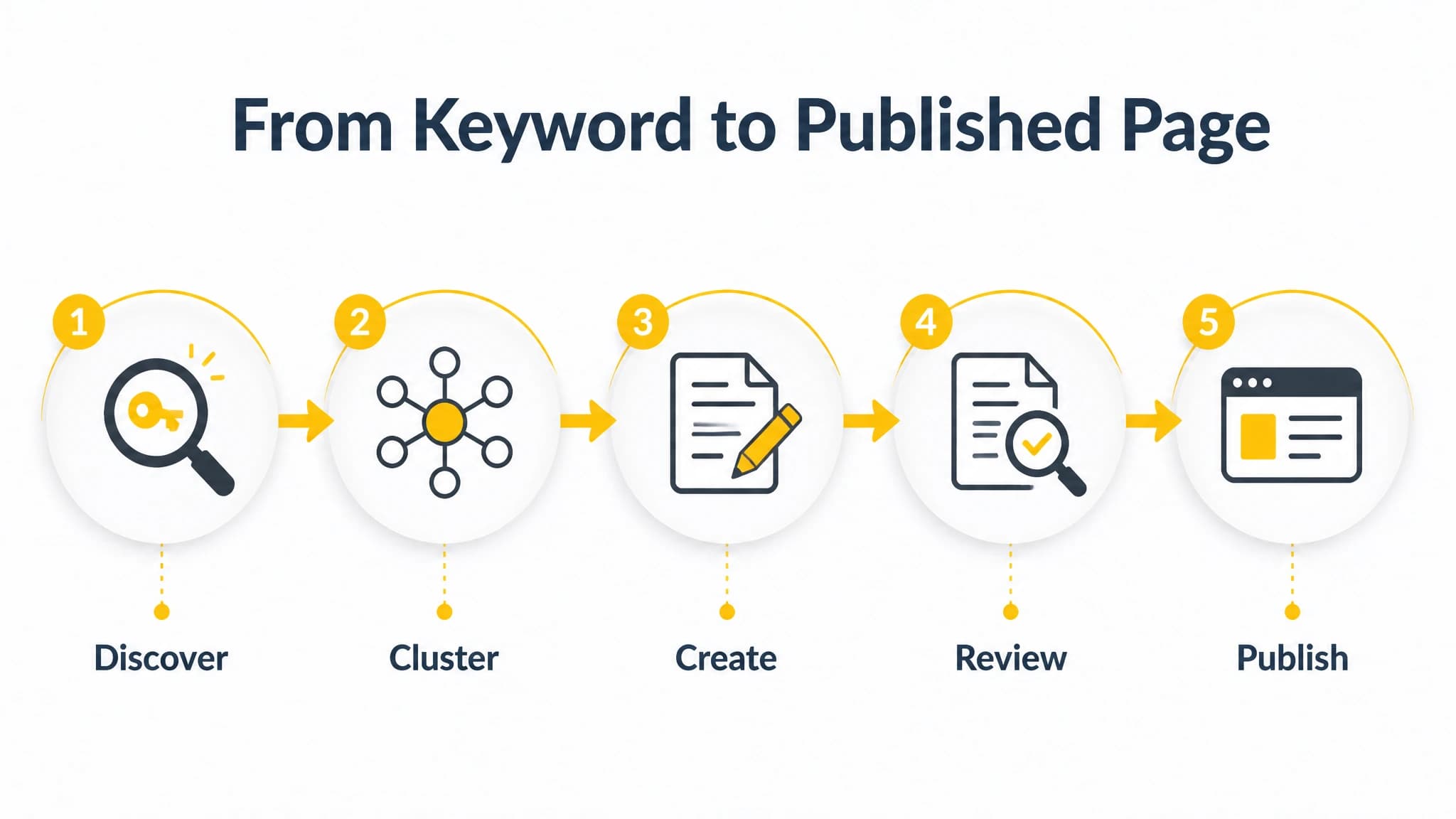
Evaluate AI SEO software by how well it connects discovery, planning, creation, review, and publishing.
5. Check whether review is part of the workflow
A strong workflow makes review explicit. This is where you confirm that an article is accurate, useful, aligned with your business, and ready for readers.
Your review checklist might include:
- Does the article answer the target query directly?
- Is the search intent clear throughout the page?
- Are the examples relevant to the audience?
- Are claims supported by reliable information?
- Are headings, links, and calls to action appropriate?
- Does the article overlap with an existing page?
- Is the content ready for the intended CMS?
When comparing tools, look for editable drafts, clear status tracking, and a workflow that allows content to move from planning to review to publishing. Even a simple status system can help you avoid losing track of what is drafted, approved, scheduled, or already live.
The important question is not whether AI SEO software can remove every review step. It should help you spend review time where judgment matters most.
6. Assess SEO metadata and on-page preparation
A complete SEO content workflow should prepare more than the article body. Look for support for elements such as:
- SEO titles.
- Meta descriptions.
- Suggested slugs.
- Image prompts or featured images.
- Internal linking opportunities.
- Structured content fields required by your CMS.
Metadata should describe the page accurately and give searchers a clear reason to choose it. It should not be treated as a place to repeat the target keyword unnaturally.
Image support can also reduce friction. If your publishing process requires a cover image or supporting visuals, generating or organizing those assets alongside the article may be more efficient than handling them in a separate system.
With RankWorker, we support article image generation and SEO metadata as part of the content workflow, so these tasks can be handled alongside planning and article creation rather than added at the last minute.
7. Prioritize scheduling and publishing automation
Many content systems stop at the draft. That leaves you with another manual process: copying content into your CMS, formatting it, adding metadata, uploading images, selecting a date, and publishing the page.
When evaluating SEO automation software, ask:
- Can content be scheduled in advance?
- Can it publish directly to your website?
- Does it preserve the required structure and formatting?
- Can you connect it to WordPress or another publishing environment?
- Is there an option for API-based or headless workflows?
- Can you control whether content is drafted, scheduled, or published?
Publishing automation should not mean publishing without oversight. A sensible process may include approval before scheduling, especially for regulated industries, technical topics, or articles containing important business claims.
The value is consistency. Once your strategy and review process are defined, automation can reduce the repetitive work required to keep your editorial calendar active.
8. Consider integrations and technical fit
The right AI SEO software must fit the way your website is built.
A WordPress site may need a direct publishing connection. A headless website may require an API or webhook workflow. A larger technical setup may benefit from tools that can work with multiple systems instead of forcing a complete change in architecture.
Before choosing a platform, document your current process:
- Where do you research keywords?
- Where do you store content plans?
- Where are drafts reviewed?
- How are images and metadata prepared?
- How does approved content reach your website?
- Who owns the final publishing decision?
Then compare each tool against that process. A platform with fewer features but a better operational fit may be more useful than a platform with a longer feature list and a disconnected implementation.
If your site uses WordPress, our WordPress SEO workflow guide can help you think through publishing and automation requirements. If you use a custom or headless setup, our SEO automation resources cover related workflow considerations.
9. Compare tools by workflow coverage
A simple comparison matrix can make your decision clearer. Score each candidate from one to five across the capabilities that matter to your business.
| Capability | What to evaluate |
|---|---|
| Keyword discovery | Does it uncover relevant opportunities? |
| Clustering | Does it organize related topics into useful groups? |
| Planning | Can you prioritize and structure a content calendar? |
| Content creation | Can you control the brief and revise the draft? |
| Review | Are approval and editing practical? |
| Metadata | Does it prepare titles, descriptions, slugs, and images? |
| Scheduling | Can you plan publication dates? |
| Publishing | Does it connect to your website or CMS? |
| Integrations | Does it fit your technical setup? |
Do not give every row equal weight. If publishing is your biggest bottleneck, scheduling and integrations should carry more importance than a small difference in writing features. If your strategy is unclear, keyword research and planning may matter most.
This approach also helps expose partial automation. A tool may score highly for content creation but poorly for planning and publishing. That can still be the right choice if you already have those systems, but it is not an end-to-end solution.
Where RankWorker fits
We built RankWorker for businesses that want a connected SEO content workflow instead of a collection of disconnected tasks. With RankWorker, you can use keyword planning, keyword research, content opportunity discovery, content clustering, content planning, article generation, article image generation, SEO metadata, scheduling, and automated publishing where those capabilities fit your process.
Our integrations include WordPress, Next.js, Direct API, webhooks, IndexNow, and an MCP Server. The right setup depends on your website and how much control you want over review and publication.
The practical benefit is workflow continuity. You can start with a search opportunity, turn it into a plan, create the article and supporting assets, prepare the metadata, and move approved content toward publication without rebuilding the process in several separate tools.
That does not remove the need for editorial judgment. It gives you a more organized system for applying it consistently.
A practical decision process
Use this five-step process before committing to AI SEO software:
Step 1: Identify your biggest bottleneck
Is the problem finding topics, creating drafts, reviewing content, or publishing it? Start with the stage that consumes the most time or causes the most inconsistency.
Step 2: Define your minimum workflow
Choose the capabilities you need now. For many businesses, this includes research, clustering, planning, content creation, metadata, and publishing.
Step 3: Test with a real topic
Do not evaluate a tool only with a generic demo. Use a topic your business actually wants to cover and inspect the entire process from research through publication preparation.
Step 4: Measure manual handoffs
Count how many times you must export, copy, reformat, rename, upload, or re-enter information. Every handoff is a potential source of delay or error.
Step 5: Keep quality checks visible
Confirm that your process includes review for accuracy, intent, originality, internal links, metadata, and brand fit. Automation is most useful when it makes these checks repeatable.
Final takeaway
The right AI SEO software should help you make better SEO decisions and execute them with less repetitive work. Look beyond article generation and compare the complete workflow: keyword discovery, clustering, planning, content creation, review, metadata, scheduling, publishing, and technical fit.
For a small business or busy founder, the best choice is usually the platform that reduces the most disconnected steps without weakening editorial control. If you want one system for building and operating an SEO content workflow, we can help you connect those stages with RankWorker.