

 Veselin Stoyanov9 min read
AI SEO Writers With Human Review: A Practical Checklist
Choose an AI SEO writer with human review. Use this practical checklist to assess accuracy, usefulness, brand fit, search intent, metadata, and workflow.

An AI SEO writer with human review can speed up article production without asking you to trust every generated sentence. The key is to treat AI as a drafting and workflow aid, then give a person clear responsibility for checking the facts, reader value, brand fit, search intent, and publishing details.
That distinction matters: a tool can help produce a review-ready draft, but human review is a practice, not a guarantee or an approval permission. Before choosing an AI article review tool or SEO content approval software, check how well it supports the work before and after the draft - and decide who is accountable for the final version.
What human review should do
Human review is more than proofreading. A reviewer should decide whether the article deserves to be published, whether its claims are supported, and whether it answers the right reader question. Fixing typos is useful, but it will not rescue an article built around the wrong intent or filled with unverified claims.
A practical review process has two parts:
- Editorial judgment: A person checks accuracy, usefulness, audience fit, and whether the article is ready to represent the business.
- Workflow support: The tool helps people move from a topic and draft to a reviewable article with its relevant content and SEO details in view.
Do not assume that the presence of a review screen means a platform has formal approval permissions, multiple required sign-offs, or automatic quality assurance. Ask what the product actually does, then define your own review responsibilities.
The evaluation checklist
Use these checks on a sample article, not just in a product demo. Give the tool a real topic your business might publish, review the resulting draft, and note where human judgment or editing is still needed.
1. Accuracy and verifiability
Check each factual statement that could affect a reader’s decision. Look for named products, dates, definitions, technical details, legal or medical implications, statistics, and claims about what a company provides. Ask:
- Can we confirm this claim from a source we trust?
- Is the wording more certain than the evidence allows?
- Does the article distinguish known facts from recommendations or assumptions?
- Are any sources, quotations, or examples invented or presented without enough context?
Remove unsupported claims instead of polishing them. When a fact is important, assign someone to verify it against an authoritative source before publication. A well-written sentence is not evidence that it is true.
2. Usefulness to the reader
Read the article as someone arriving with the query, not as someone evaluating the writing tool. Does it answer the likely question promptly? Does it explain what to do, how to do it, or how to make a decision? Look for repeated advice, vague generalities, missing steps, and examples that sound specific but provide no usable detail.
A useful edit often adds context the model could not know: the constraints your customers face, a clear decision rule, a realistic example, or a limitation that changes the recommendation. If the draft could be published unchanged on dozens of unrelated sites, it probably needs more original perspective.
3. Search intent and topic fit
Write down the searcher’s likely goal in one sentence before assessing the draft. Then compare the article’s introduction, headings, examples, and conclusion with that goal. For example, a reader searching for an evaluation checklist needs criteria they can apply, not an extended introduction to AI writing.
Check that the draft:
- Addresses the main question early.
- Covers the subquestions needed to make the answer useful.
- Uses headings that describe the actual content below them.
- Avoids detours that belong in a separate article.
- Does not repeat a keyword unnaturally to signal relevance.
A content generator can assist with topic planning and article structure, but a human should verify that the proposed angle matches what the audience needs from this specific page.
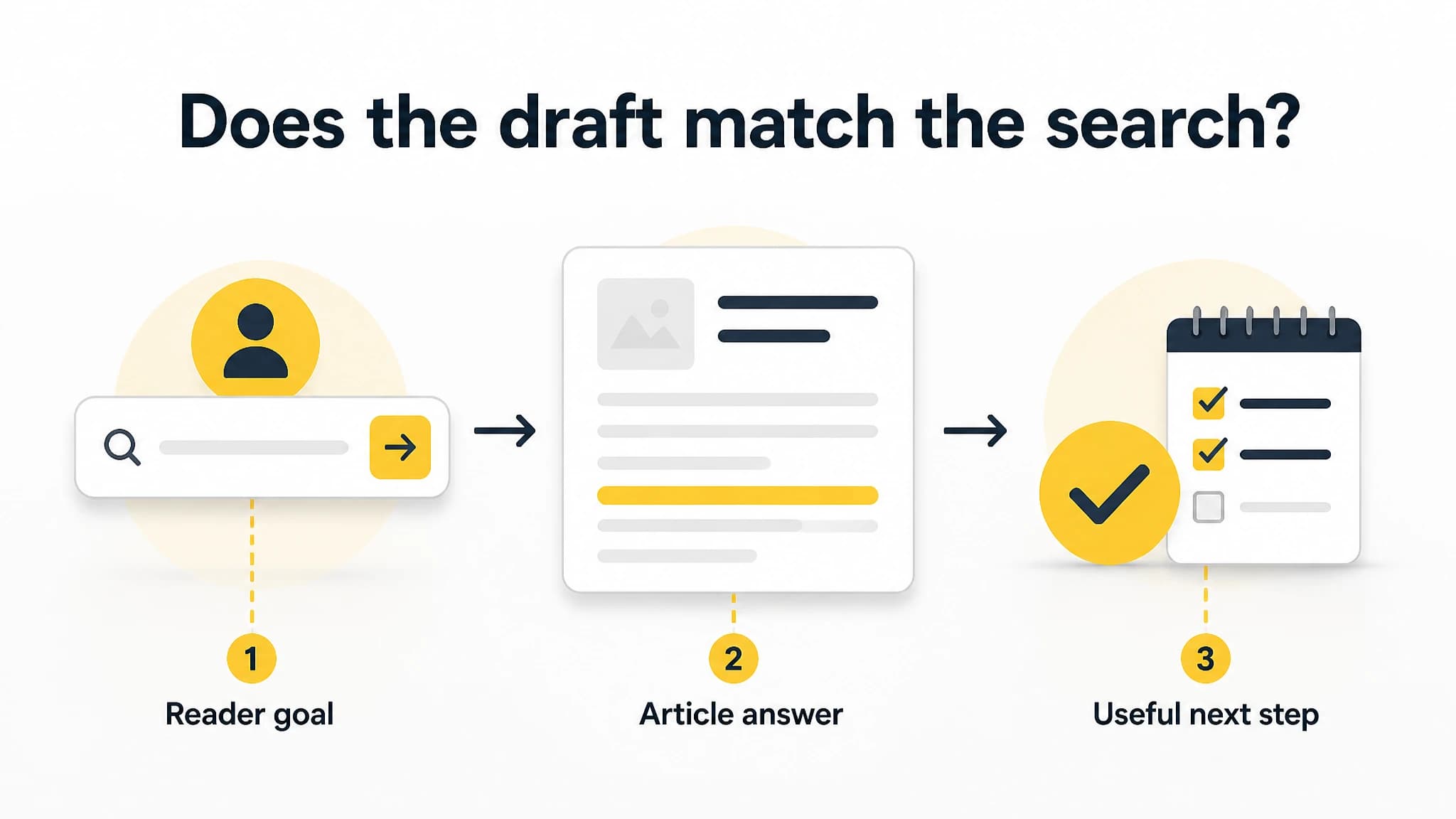
Check whether the article answers the query and gives the reader a useful next step.
4. Brand voice and fit
A strong AI writing tool with brand voice should let you provide useful context, but you still need to judge the output. Check whether it uses the right level of formality, explains ideas the way your business would, and avoids unsupported promises or sales language. Also check names, preferred terms, and any claims your team must not make.
Do not settle for a draft that merely includes your company name or repeats a list of brand adjectives. Test with an example that requires the writer to explain a real customer problem in your preferred style. Edit the instructions or the draft where the result misses the mark, and record recurring corrections so future content starts from clearer guidance.
5. Structure, metadata, and publishing readiness
Review the whole deliverable, not only the body copy. Check the title, headings, summary or excerpt, SEO metadata, links, images, and formatting. Confirm that each element fits the article and can be edited before publishing.
For metadata, ask whether the title accurately describes the page and whether the description gives a searcher a useful reason to visit. Check internal links for relevance and destination accuracy. Review image choices and alt text for a genuine connection to the section. Finally, inspect the rendered article for broken formatting, duplicated headings, or stray instructions that belong in a draft rather than a published page.
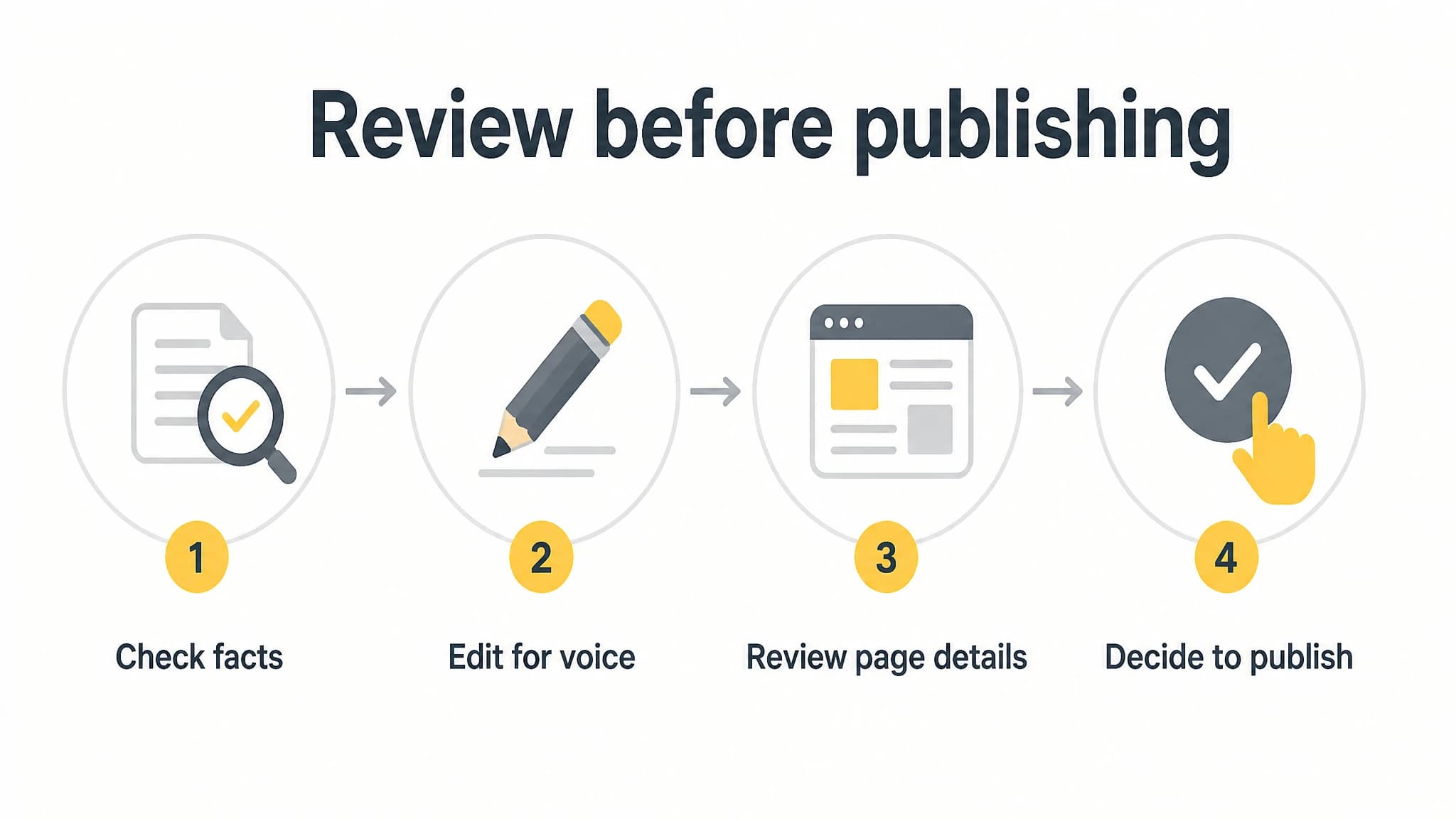
A repeatable review sequence keeps editorial judgment in the publishing workflow.
6. A clear human review handoff
Before adopting a tool, map who does what. One person might check facts and another might edit for brand voice, or a founder might own both checks for a small site. Either way, name the person responsible for the final publish decision and specify what happens when a draft fails a check.
A lightweight checklist can use three outcomes:
- Ready: Claims, intent, voice, and page details have been checked.
- Revise: The draft has a fixable gap, with a named editor and a clear task.
- Hold: A significant claim, missing expertise, or intent mismatch needs resolution before publication.
These labels are a team practice, not proof that software includes approval permissions. If you need formal roles, required sign-offs, or a record of approvals, verify those capabilities separately rather than inferring them from an article preview or editing interface.
A practical review workflow, from topic to publish
- Set the target. Record the audience, primary query, likely intent, and the action or understanding the page should support.
- Review the outline. Remove irrelevant sections and add missing reader questions before generating or heavily editing the article.
- Generate and inspect the draft. Treat it as editable working content. Check the central answer and flag claims that need sources.
- Verify facts and usefulness. Confirm material claims and improve thin sections with reliable information, practical detail, or appropriate expertise.
- Edit voice and intent. Make the draft sound like your business and keep every section aligned with the reader’s purpose.
- Check page details. Review metadata, headings, links, images, and formatting alongside the article text.
- Make the publish decision. The designated human reviewer resolves open issues and decides whether the final version is ready.
Use the same checklist every time, but scale the depth of review to the subject. An article with low-stakes general advice may need a different level of verification from one that discusses regulated, financial, health, or safety-sensitive decisions. Where specialist expertise is necessary, involve a qualified reviewer rather than expecting a writing tool to supply it.
How to compare AI SEO writing tools
Use the checklist as a small evaluation scorecard. For each category, note whether the tool supports the task, whether a person can inspect and change the output, and what work remains outside the platform. Avoid judging a tool only by how quickly it generates a first draft.
For a closer look at the broader process, see our guide to a content approval workflow. If you are comparing writing-focused products, our overview of SEO content writing tools can help you assess the workflow around the draft. For the generation step itself, read how to use an AI SEO content generator.
With RankWorker, we support keyword planning, content planning, article generation, SEO metadata, scheduling, and automated publishing. You can review editable content before publishing. That makes us a strong fit for founders and teams who want AI-assisted SEO article creation connected to a repeatable content workflow, while keeping a person responsible for the final editorial decision.
The practical test is straightforward: create or review one representative article, then walk through the checklist. Note which checks the workflow makes easy and which still require your expertise, research, or separate team process. If you want to try that approach, use the Start Free Trial button to explore whether RankWorker fits your content workflow. Keep human review in place either way.