

 Veselin Stoyanov14 min read
Content Approval Workflow for AI-Assisted SEO Content
Build a practical content approval workflow for AI-assisted SEO articles, including fact checks, intent review, links, metadata, images, and publishing.

AI-assisted SEO content can reduce the time it takes to move from a keyword idea to a finished article. But a generated draft is not the same as an approved publication.
A reliable content approval workflow gives people clear checkpoints before an article goes live. It helps your team verify facts, match search intent, protect the brand voice, review links and metadata, and confirm that the final page is ready for readers and search engines.
The most practical model is human-in-the-loop: software handles repetitive production work, while a person remains responsible for judgment and final approval.
What is a content approval workflow?
A content approval workflow is a repeatable process for reviewing, revising, and approving content before publication. For AI-assisted SEO content, it should connect the entire path from content brief to final publishing decision.
A basic workflow looks like this:
- Define the target keyword and search intent.
- Generate or assemble the article draft.
- Review the article for accuracy and usefulness.
- Check originality, brand voice, links, metadata, and images.
- Make revisions and complete a final quality check.
- Approve, schedule, and publish the article.
- Monitor performance and improve the process over time.
The goal is not to review every sentence with the same level of effort. The goal is to identify the checks that protect readers, your reputation, and the article's ability to satisfy its search intent.
Why AI-assisted content needs human review
AI can produce a coherent article quickly, but it may still make errors that are difficult to spot at a glance. A draft can include outdated information, unsupported claims, vague explanations, incorrect terminology, or examples that do not fit your audience.
AI may also interpret a keyword too broadly. An article can be well written and still fail because it answers the wrong question, targets the wrong audience, or does not provide the practical information searchers expect.
Human review adds context that automated generation cannot reliably supply on its own. A reviewer can ask:
- Is this claim accurate and supported?
- Does the article answer the main question early enough?
- Does the advice fit our audience and offer a realistic next step?
- Does the wording sound like our business?
- Would a knowledgeable reader consider this genuinely useful?
This is why the best approach is not AI without oversight or manual writing for every task. It is a controlled workflow that automates production steps while reserving important decisions for people.
Step 1: Review the brief before reviewing the draft
The approval process should begin before anyone evaluates individual paragraphs. First, confirm that the article was created from a useful brief.
The brief should define:
- The primary keyword
- Related keywords and questions
- The intended audience
- The dominant search intent
- The article's main promise
- Important points to cover
- Topics, claims, or recommendations to avoid
- The desired call to action
- Relevant internal pages to reference
If the brief is weak, editing the article may not solve the underlying problem. A reviewer could polish an article that should have targeted a different query entirely.
For example, a keyword such as "content approval workflow" may attract readers who want a process, checklist, or software evaluation. Your article should make an intentional choice about the primary intent and then support it with clear steps, examples, and decision guidance.
Our automated content workflow guide explains how keyword targeting, planning, generation, review, scheduling, and publishing can fit into one connected system.
Step 2: Check search intent and article usefulness
The next checkpoint is search intent. Review the article as if you had just searched for the target keyword.
Ask these questions:
Does the introduction answer the query directly?
Readers should understand within the opening section what the article covers and why it matters. Avoid long background sections that delay the practical answer.
Does the structure match the reader's likely task?
A reader looking for a workflow usually needs an ordered process, responsibilities, checkpoints, and examples. A general discussion of AI writing will not be enough.
Does every major section support the promise?
Remove sections that exist only to include keywords or increase length. Each heading should help the reader make a decision, complete a task, or understand an important trade-off.
Is the advice specific enough to use?
Replace vague instructions such as "make sure the content is good" with checks a reviewer can perform. For example, ask the reviewer to verify every statistic, confirm each product claim, and test every important link.
A useful article does not need to answer every possible question. It does need to answer its main question clearly and provide an obvious next step.
Step 3: Complete a factual review
Factual review is one of the most important stages when you are deciding how to review AI generated content. The reviewer should identify claims that require verification instead of assuming that fluent writing is accurate.
Create a list of high-risk claims, including:
- Statistics and percentages
- Dates and timelines
- Legal, financial, health, or safety guidance
- Product specifications
- Pricing or availability
- Statements about companies, people, or organizations
- Technical instructions that could cause errors
- Comparisons and performance claims
Then verify those claims against reliable sources or remove them. If a statement cannot be supported, rewrite it as a qualified explanation or leave it out.
Factual review should also check for misleading certainty. Words such as "always," "never," "guaranteed," and "best" can turn a reasonable observation into an unsupported claim.
For practical business content, the reviewer should confirm that examples are clearly presented as examples. Do not imply that a hypothetical result, workflow, or scenario is a customer story or measured outcome.
Step 4: Review originality and depth
An AI-generated article may combine familiar ideas in a polished format, but that does not automatically make it distinctive. Review the draft for original usefulness rather than surface-level variation.
Look for:
- Explanations that add context instead of repeating common advice
- Examples that reflect the target audience's real decisions
- Clear trade-offs between speed, control, cost, and quality
- Practical checklists or review criteria
- Recommendations that are explained, not merely asserted
- Sections that answer likely follow-up questions
Search the existing content on your site before publishing. If the article overlaps heavily with another page, decide whether to revise, consolidate, or create a more specific angle. Multiple pages targeting the same intent can make your content library harder to manage.
Originality does not require unusual opinions. It can come from a better process, clearer examples, stronger organization, or a more useful explanation of a familiar problem.
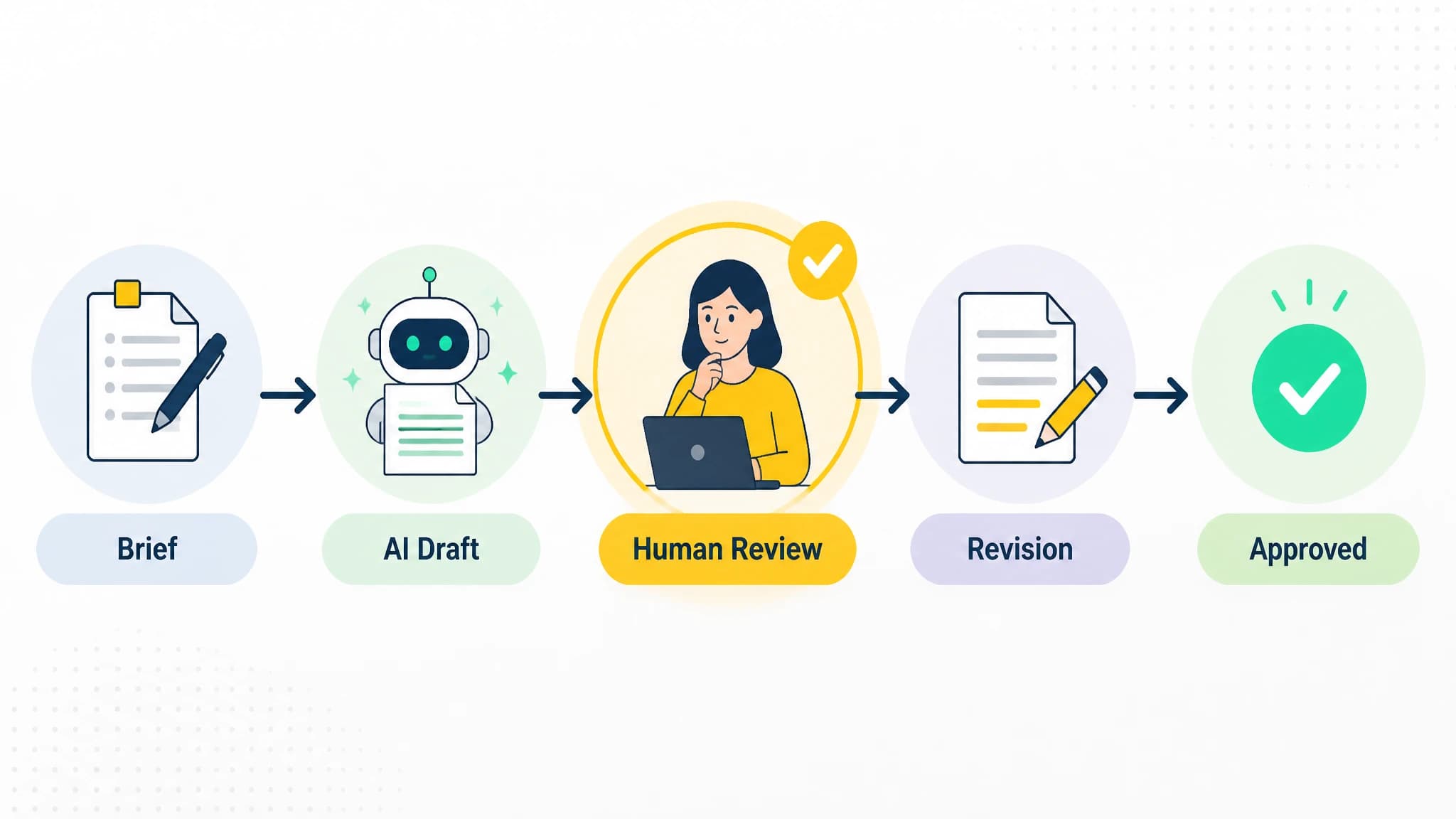
A staged workflow makes responsibility and approval checkpoints visible.
Step 5: Check brand voice and audience fit
A technically accurate article can still feel wrong if it does not sound like your business. Brand voice review should cover both wording and judgment.
Check whether the draft:
- Uses the vocabulary your audience understands
- Explains specialized terms when necessary
- Matches your preferred level of confidence
- Avoids exaggerated promises
- Uses consistent names for products, services, and concepts
- Reflects your actual point of view
- Gives advice that fits your customers' resources and constraints
Read the article aloud or review it paragraph by paragraph against a short brand voice guide. Mark phrases that sound generic, overly promotional, academic, or unlike your normal communication.
For RankWorker content, we use practical first-person language when explaining how our workflow helps. We do not rely on unsupported results or broad claims. We connect each product mention to a specific reader problem, such as planning content, generating an article, preparing metadata, or controlling publication timing.
Step 6: Review internal and external links
Links should help the reader continue learning or verify a specific claim. They should not be added simply to increase link count.
For internal links, check that:
- The destination is relevant to the surrounding paragraph
- The anchor text describes the destination accurately
- The page is not already linked elsewhere in the article
- The link supports a prerequisite, related task, or next step
- The destination is live and appropriate for the audience
For external links, use authoritative sources when a claim benefits from verification. Government agencies, standards bodies, official documentation, and original research are usually stronger choices than summaries or generic listicles.
Also review link wording. Avoid vague anchors such as "click here" and avoid forcing an exact-match keyword into a sentence where it does not sound natural.
Step 7: Review title, metadata, and headings
Metadata is part of the approval process because it shapes how the article appears in search results and how clearly the page communicates its topic.
Review the following elements:
- Title: includes the main topic and creates a clear reason to read
- Meta description: summarizes the benefit and sets an accurate expectation
- URL slug: short, readable, and focused on the primary topic
- H1: aligned with the page title and search intent
- H2 and H3 headings: organized logically and easy to scan
- Introduction: delivers a direct answer quickly
- Calls to action: relevant to the article and not repeated excessively
Do not promise something in the title or metadata that the article does not deliver. A compelling title is useful only when the page fulfills the expectation it creates.
If your workflow generates metadata automatically, treat it as a draft for approval rather than a guaranteed final version. Small changes can improve clarity, accuracy, and alignment with the finished article.
Step 8: Review images and accessibility
Images should support understanding, not act as decoration added at the last minute. Review whether each image is relevant to the section where it appears and whether it adds context that text alone does not provide.
Check:
- The image matches the article's topic and audience
- The visual is not misleading or unrelated stock imagery
- The image has useful alternative text
- Captions are accurate and necessary
- File sizes and formats are appropriate for the site
- The visual does not contain invented claims or statistics
- Any text inside an infographic is short, readable, and proofread
For a workflow article, a process diagram or editorial illustration can help readers understand the movement from draft to approval. A decorative image of someone typing may be less useful if it does not clarify the process.

A final review should cover both editorial quality and publishing readiness.
Step 9: Use approval stages instead of one final review
A single review at the end can create bottlenecks and make errors more expensive to fix. A staged process is usually easier to manage.
A practical approval model includes four statuses:
Draft
The article is being generated or assembled. It should not be treated as publication-ready.
Editorial review
A reviewer checks intent, structure, usefulness, factual accuracy, originality, voice, links, metadata, and images.
Revision required
The article contains specific issues that must be resolved. Assign an owner and make the requested changes visible.
Approved for publishing
A responsible person confirms that the article meets the publication standard and can be scheduled or published.
You can add a separate subject-matter review for topics that require specialist knowledge. The important point is to make responsibility explicit. Automation should move work forward, not hide who has authority to approve it.
With RankWorker, we support a connected workflow for keyword research, content opportunities, clustering, planning, article generation, images, SEO metadata, scheduling, and automated publishing. That lets your team reduce repetitive handoffs while keeping review and approval as deliberate steps before publication.
Step 10: Complete a final publishing checklist
Before approving an article, use a short checklist that catches preventable problems.
Content
- The article matches the target keyword and search intent.
- The introduction provides a direct answer.
- The claims are accurate and appropriately qualified.
- The advice is useful for the intended audience.
- The article is original enough to justify its own URL.
SEO
- The title, H1, headings, metadata, and slug are aligned.
- Internal links are relevant and functional.
- External citations support claims that need verification.
- The article does not use keywords unnaturally.
- The page has a clear next step for the reader.
Brand and compliance
- The tone matches the brand.
- Product descriptions are accurate.
- No unsupported customer results, awards, guarantees, or certifications appear.
- Sensitive claims receive appropriate specialist review.
- The article does not present a hypothetical example as a factual story.
Publishing
- Images have accurate alternative text.
- Formatting is correct in the publishing system.
- Links open as expected.
- The author, category, and tags are correct.
- The publication date and status are correct.
- A responsible person has approved the final version.
This checklist should be short enough to use consistently. If reviewers regularly skip it, remove low-value items and keep the checks that catch the most important errors.
How to improve the workflow over time
A content approval workflow should become more efficient as your team learns where problems occur.
Track recurring revision reasons, such as inaccurate claims, weak introductions, missing links, unclear CTAs, or inconsistent terminology. Then improve the brief, prompts, templates, or automated checks that happen before human review.
You can also define different review levels. A low-risk article may need one editorial approval, while a technical or regulated topic may require a subject-matter expert. Matching review effort to risk prevents both careless publishing and unnecessary delays.
The best workflow is not the one with the most approval steps. It is the one that applies the right level of human judgment at the right point in the process.
Final takeaway
A strong content approval workflow makes AI-assisted SEO content safer, clearer, and more useful. It does not treat AI as an autonomous publisher. Instead, it uses automation for repetitive work and keeps people responsible for accuracy, intent, originality, brand voice, and the final publishing decision.
Start with a clear brief, review the draft against search intent, verify important claims, inspect links and metadata, evaluate images, and require explicit approval before publication. Once those checkpoints are consistent, you can automate more of the surrounding workflow without giving up editorial control.
With RankWorker, we help connect planning, content creation, optimization, scheduling, and publishing so your team can spend less time coordinating tasks and more time making confident editorial decisions.