

 Veselin Stoyanov10 min read
How to Analyze Competitor Organic Traffic: Find Pages and Topics to Investigate
Learn how to analyze competitor organic traffic estimates, find useful pages and topics, and validate opportunities for your own SEO plan.

How to Analyze Competitor Organic Traffic: Find Pages and Topics to Investigate
To analyze competitor organic traffic, use a third-party SEO tool to find the pages and search terms estimated to bring visitors to a competing site. Treat those figures as directional estimates, not verified traffic. Then check whether the pages match your audience, inspect the search results, and validate promising phrases before adding them to your content plan.
The goal is not to copy a competitor’s traffic numbers or publish every keyword in a report. It is to find a short list of relevant pages and topics that merit closer investigation.
1. Choose competitors that share your search market
Start with two or three businesses that compete for the same audience and search intent. A company does not have to sell the same product to be a useful SEO competitor. A publisher, directory, or service provider may rank for the same informational searches as your business.
For each possible competitor, ask:
- Do we serve similar customers or answer similar questions?
- Do we target the same country, language, or market?
- Does the site appear in search results for topics we want to cover?
- Is the site active in organic search, rather than only a brand or paid-search competitor?
Use the full domain when beginning your research. If a competitor has distinct regional or product sections, investigate those areas separately afterward. Comparing a large marketplace with a small specialist site can produce a long list of irrelevant findings, so prioritize close matches first.
2. Read domain-level metrics as clues, not ground truth
A competitor report may estimate organic visits, ranking keywords, traffic value, and other metrics. These can help you compare sites and decide where to look next, but they are not the competitor’s internal analytics. Different tools may use different data sources, models, and update schedules, so their numbers can disagree.
Use domain metrics to form questions rather than conclusions. For example: Does the site appear to have visibility across many topics, or is most of its estimated traffic concentrated in a few sections? Are the pages worth investigating closely, or does the domain seem to rank mainly for branded searches unrelated to your audience?
Keep the market, date, and tool in your notes. Do not report an estimated figure as an exact visitor count, use it as proof of a competitor’s performance, or assume that a higher estimate means a better content opportunity for your business.
3. Find the pages behind the estimate
Next, sort or filter the report’s page data. Look for pages that appear relevant to your customers and that have enough estimated search visibility to justify a closer look. You are looking for leads, not a final publishing list.
For each page worth investigating, record:
- The URL and page type, such as guide, comparison, category, or product page
- The main topic and likely audience need
- The relevant search terms associated with the page
- Any available estimated traffic or ranking metrics, labeled as estimates
- Why the topic may fit your own site
Group similar URLs together. Several pages on one subject may indicate a broad topic area, while one standout page may suggest a narrower question worth exploring. A page can also look prominent in a report but be irrelevant to your business, so do not prioritize it based on a metric alone.
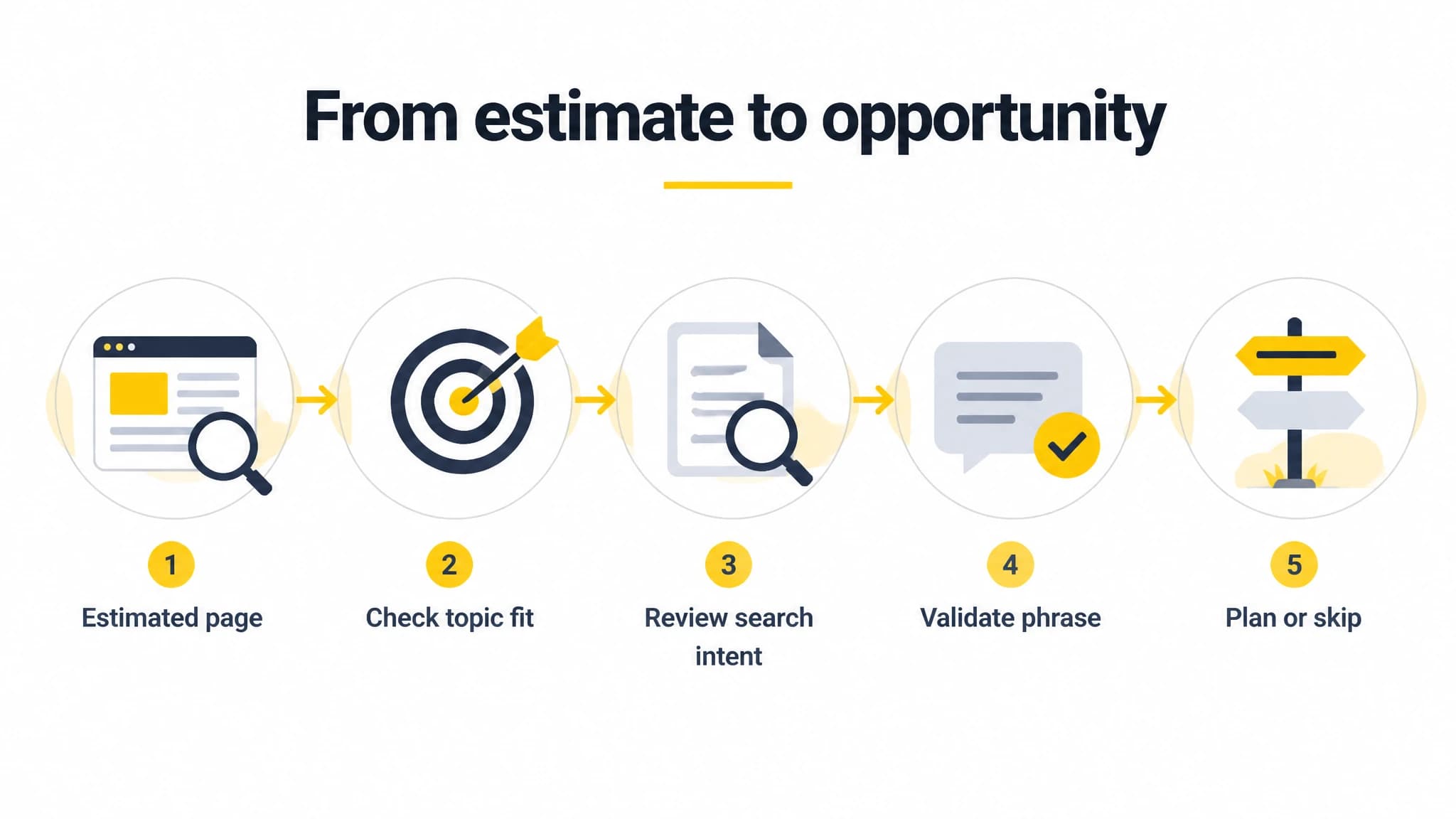
Move from estimated page data to a validated decision, not straight to copying a competitor.
4. Investigate the keywords and search intent
For each promising page, review the keywords associated with it. Group near-duplicates and variants by the need they appear to express. Then check the search results for the phrases you might target. Look at the types of pages ranking, the questions they answer, and whether the results match what you could credibly publish.
Ask:
- Is the search informational, commercial, navigational, or transactional?
- Does the phrase describe a problem our audience has?
- Do search results favor guides, product pages, tools, or another format?
- Could our page provide a distinct, useful answer rather than a thin imitation?
- Do we already have a page that serves the same need?
A competitor ranking for a phrase is evidence that the phrase may be relevant to that site. It is not proof that the phrase is attainable for you or that your audience will convert. The same keyword can be a poor fit if your offer, expertise, or content format does not match the intent.
If you are comparing research platforms as part of this process, our guide to SEO competitor analysis tools covers how to evaluate tools. This article focuses on the research workflow itself: finding pages and topics to investigate, not comparing tool features.
5. Score opportunities before choosing a target
Create a simple shortlist and rate each candidate using consistent criteria. A lightweight scoring approach helps keep an impressive-looking traffic estimate from outweighing business relevance.
| Check | What to consider |
|---|---|
| Audience fit | Does the topic matter to the people you want to reach? |
| Search intent | Can your site satisfy the need shown in search results? |
| Business fit | Is there a natural connection to your product, service, or expertise? |
| Existing coverage | Do you already have a page that should be improved instead? |
| Content potential | Can you make the page more useful, specific, or trustworthy? |
| Effort | Do you have the knowledge and resources to create a credible result? |
You can mark each check as strong, mixed, or weak rather than inventing a precise score. Prioritize candidates with clear audience and business fit, a search intent you can serve, and a realistic path to creating a useful page. Set aside topics that rely on a competitor’s brand, depend on expertise you do not have, or would duplicate an existing page without a clear improvement.
6. Validate selected phrases with keyword research
Before planning an article, take a handful of relevant phrases from the competitor report and research them in the context of your own website and target market. Check available demand, difficulty, intent, trends, and how the phrase relates to your current coverage. Metrics help inform the choice; they do not replace your judgment about the audience or the page you can create.
With RankWorker, our competitor research workflow collects competitor keywords, pages, and estimated metrics in a report. You can select relevant phrases from that report, submit them to keyword research, and use the resulting research to decide which opportunities deserve planning. This connects competitor discovery to your own site and content decisions instead of treating a rival’s keyword list as a ready-made editorial calendar.
For example, imagine a competing business has a guide about preparing for a common customer problem. The report may surface several related searches. Rather than copying the guide, select the phrases that fit your audience, research them for your site and market, inspect the search results, and decide whether your best response is a new article or an update to a page you already have.
Our keyword research workflow can help you move from a list of phrases to researched opportunities. If a topic passes your checks, add it to a plan with a clear page purpose, intended reader, and reason the page should exist.
7. Turn the shortlist into an action plan
For each approved topic, write down the next step. A useful plan might be to create a new guide, improve an existing page, combine overlapping coverage, or do nothing for now. Note the intended audience, search intent, proposed page format, and any competitor page you reviewed.
Keep the original estimate in your research notes, clearly labeled with its source and date. After publishing or updating content, assess your own page using your site’s analytics and search performance data. Those first-party measurements are the right place to evaluate your results; a competitor estimate cannot tell you whether your article earned traffic or conversions.
This is also where a repeatable workflow can save manual effort. With RankWorker, we help founders and website owners connect competitor research with keyword research and content planning. We recommend this approach for teams that want to investigate several competitors and turn selected opportunities into a consistent SEO content workflow. If you only have one competitor and a few candidate pages, a spreadsheet and a manual review may be enough to start.
A practical example of the full process
Suppose you run a small business website and want to publish more useful guides. Choose a close competitor that appears for the customer questions you care about. Review its estimated organic pages, and save only those that fit your audience. Group related search phrases, then inspect a few search results to understand what the query is asking.
Next, check each candidate against your existing content and business goals. Take the strongest phrases into keyword research for your own site and market. Decide whether each one merits a new page, an update, or no action. Finally, record the reason for the decision and revisit your own page’s performance after publication.
With RankWorker, you can start this process by researching one competitor domain, collecting relevant pages and phrases, and submitting a small selection to keyword research. Our competitor research workflow is designed to surface the pages and keywords to investigate. Begin with one competitor and one focused topic area, then expand only when the findings are useful.
Make competitor traffic research useful
The value of competitor organic traffic analysis is not a precise estimate of another site’s visitors. It is a more informed way to discover relevant pages, understand the topics behind them, and decide what deserves your own research.
Choose close competitors, label third-party figures as estimates, examine page-level topics and intent, and validate promising phrases against your site before planning content. If you want to make that process repeatable, start with one competitor, research the findings that genuinely fit your audience, and turn only validated opportunities into next steps.