

 Veselin Stoyanov13 min read
How to Build a Content Approval Workflow That Doesn't Slow You Down
Build a content approval workflow that protects quality without creating bottlenecks. Learn how to standardize reviews, automate handoffs, and publish faster.

How to Build a Content Approval Workflow That Doesn't Slow You Down
A content approval workflow should protect quality without turning every article into a waiting game.
When content moves through too many disconnected tools, approval becomes the slowest stage in the content production workflow. Drafts sit in inboxes, reviewers repeat the same checks, and nobody is sure whether an article is ready for publishing.
The solution is not to remove review. It is to make review more consistent, visible, and focused on the decisions that actually require human judgment.
This guide explains how to build a content approval workflow that keeps standards high while reducing unnecessary back-and-forth.
What is a content approval workflow?
A content approval workflow is the repeatable process an article follows from draft to publication. It defines who reviews the content, what they check, how feedback is handled, and what conditions must be met before publishing.
A simple workflow might include these stages:
- Brief approved - The topic, audience, keyword, search intent, and content goal are clear.
- Draft created - The article is written according to the brief and brand guidelines.
- Quality review - An editor checks accuracy, usefulness, structure, voice, and SEO basics.
- Revisions completed - Required changes are made and checked.
- Final approval - The responsible person confirms the article is ready.
- Scheduled or published - The approved version moves into the publishing process.
The exact stages can vary, but the important principle is to define the path before production begins. Without a defined path, every article becomes a custom project.
Why content approval workflows become bottlenecks
Approval delays usually come from process problems rather than from one slow reviewer. The most common causes are predictable.
1. Reviewers do not know what “good” means
If each reviewer uses a different standard, writers receive conflicting feedback. One person focuses on grammar, another questions the structure, and someone else asks for changes that should have been addressed in the brief.
The result is not better content. It is repeated discussion about expectations.
2. Feedback is scattered across tools
Comments may appear in email, chat, a document, a project management tool, and a CMS. Reviewers may not know which version is current, while writers spend time locating and reconciling feedback instead of improving the draft.
3. Too many people approve every article
A large approval group can feel safe, but it often creates predictable delays. If every person must review every article, the workflow moves at the speed of the least available participant.
4. The approval stage includes production work
Reviewers should not have to assemble metadata, search for images, fix formatting, or manually copy content between systems before they can evaluate the article. When preparation and approval are mixed together, the process becomes harder to manage.
5. Automation happens without clear checkpoints
Automating content generation does not eliminate the need for editorial control. If a system creates drafts but does not make the output easy to inspect, reviewers may spend more time checking the process than checking the content.
Start with a clear definition of approval
Before choosing tools or automating handoffs, define what approval actually means for your organization.
A useful approval definition might be:
An article is approved when it satisfies the agreed brief, meets the quality checklist, has no unresolved factual or editorial issues, and is ready for the intended publishing destination.
This definition separates approval from personal preference. A reviewer can still suggest improvements, but not every preference should block publication.
It also helps distinguish between must-fix issues and nice-to-have improvements.
Must-fix issues
- Incorrect or unsupported claims
- Missing information needed to satisfy search intent
- Serious clarity or readability problems
- Broken links or formatting
- Misleading titles or metadata
- Brand, legal, or compliance concerns
Nice-to-have improvements
- Alternative wording that does not improve meaning
- Minor stylistic preferences
- Optional examples outside the article's main purpose
- Changes that would require rewriting an already clear section
This distinction is one of the simplest ways to prevent endless review cycles.
Standardize your quality criteria
A content approval workflow becomes faster when the same checks are applied to every relevant article. Create a short checklist that reflects your actual publishing standards.
Content quality checklist
Ask whether the article:
- Answers the reader's primary question directly
- Matches the intended search intent
- Provides enough context to be useful
- Uses clear headings and logical sections
- Avoids repetition and unsupported claims
- Includes practical examples, steps, or explanations where appropriate
- Uses a consistent brand voice
SEO checklist
Check whether the article:
- Targets the approved primary keyword naturally
- Covers relevant secondary terms without keyword stuffing
- Has a clear title and meta description
- Uses a clean URL slug
- Includes descriptive internal links where useful
- Uses image alt text that describes the image accurately
Publishing checklist
Before publication, confirm that:
- The correct version is being reviewed
- The author or editor has resolved required comments
- Images and metadata are attached
- Formatting works in the publishing environment
- The article is assigned to the correct category or tag
- The publishing date and destination are correct
Keep the checklist short enough to use consistently. If it becomes a long audit document, reviewers may skip it or treat every item as equally important.
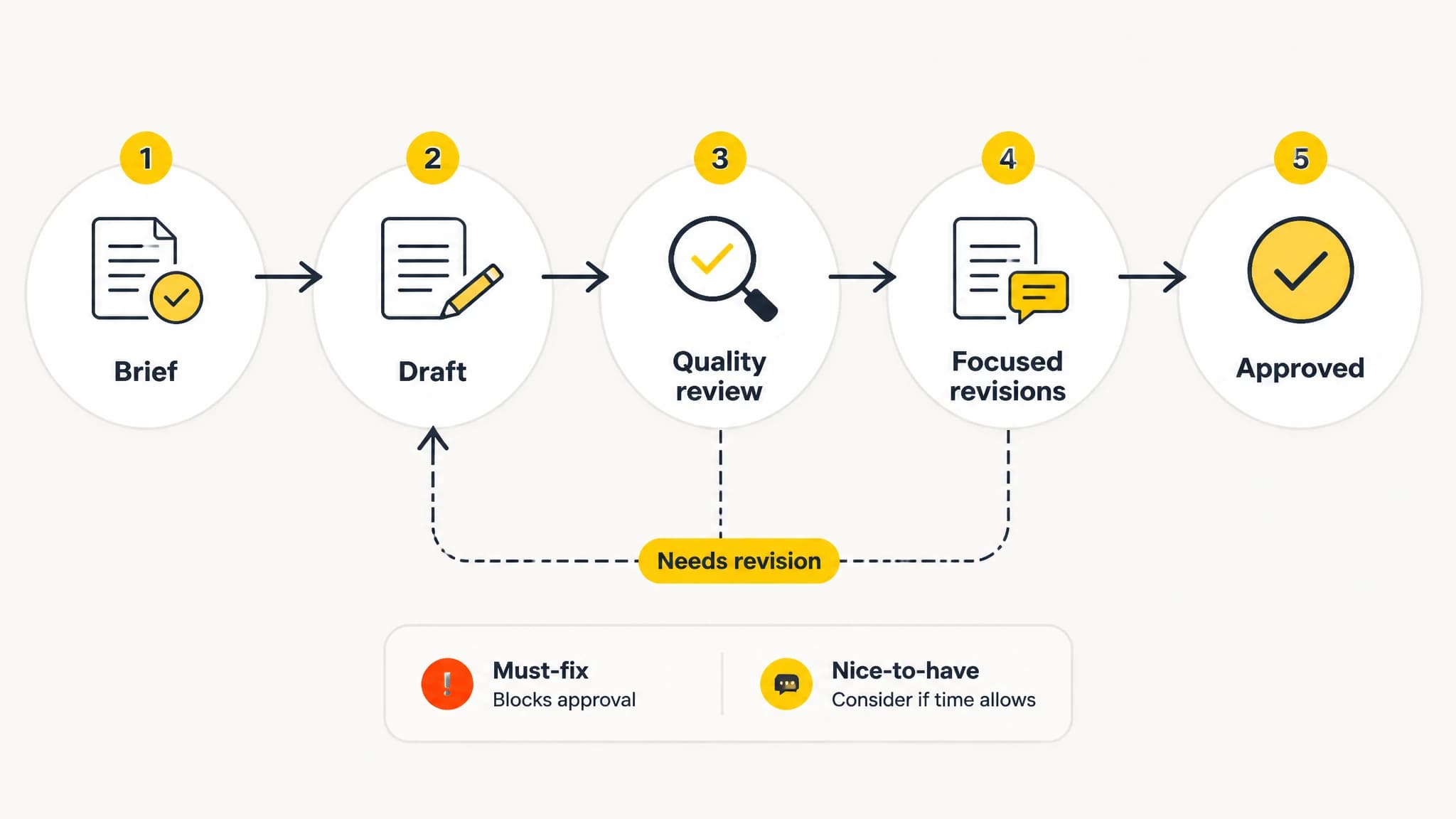
A defined sequence and clear issue priorities make approval easier to manage.
Design the workflow around decision points
A strong content production workflow does not require every participant to inspect every detail. It routes the right decision to the right person.
For example:
- A strategist approves the topic, audience, and search intent.
- A writer or content system produces the draft.
- An editor checks structure, usefulness, and voice.
- A subject matter expert reviews technical or specialized claims.
- A publisher verifies formatting, metadata, and scheduling.
Not every article needs all five roles. The goal is to assign ownership clearly and avoid duplicate approval.
A practical rule is to give each stage one directly responsible owner. Other people can provide input, but one person should know whether the stage is complete.
Use approval statuses that describe reality
Vague statuses such as “in progress” make it difficult to understand what is blocking an article. Use statuses that communicate the next action.
A useful set might include:
- Planned - The topic is accepted but production has not started.
- Brief ready - The content requirements are defined.
- Draft ready for review - The first version is available.
- Changes requested - Specific revisions are required.
- Approved - The article meets the agreed criteria.
- Scheduled - The article is approved and assigned a publishing time.
- Published - The article is live and ready for monitoring or maintenance.
Every status should answer two questions: who owns the next step, and what action is required?
If a status does not help answer either question, it may be unnecessary.
Set review deadlines and escalation rules
Approval workflows slow down when review is treated as an open-ended task. Set a reasonable review window based on the complexity of the content and the availability of your team.
The deadline should not force rushed approval. It should create visibility. If a review cannot be completed on time, the owner should be able to flag the delay and identify the cause.
Define escalation rules such as:
- What happens when a reviewer is unavailable?
- Who can approve routine content as a backup?
- Which issues require a subject matter expert?
- When should a draft return to the brief instead of receiving more edits?
- Who makes the final decision when reviewers disagree?
These rules prevent articles from waiting silently in a queue.
Automate handoffs, not judgment
Automation is most useful for repetitive coordination work. It can move an article to the next stage, notify the next owner, preserve the current version, and prepare content for publishing.
Human judgment remains important for decisions such as:
- Whether the article is accurate and genuinely useful
- Whether the claims are supported
- Whether the topic fits the audience and business goals
- Whether the tone is appropriate
- Whether the article is ready to represent the brand
This balance is the foundation of an effective automated content workflow. Automate the movement of work while keeping people responsible for quality and accountability.
If you are mapping the complete process from keyword targeting to publication, see this guide to an automated content workflow for SEO.
Give reviewers one complete view of the output
One of the easiest ways to reduce approval friction is to put the material reviewers need in one place. They should not have to switch between a writing document, an SEO tool, a folder of images, and a CMS preview just to understand what they are approving.
A complete review view should make it easy to inspect:
- The article content
- The title and metadata
- Target keywords
- Images and image details
- Markdown or publishing output
- The current version and approval status
RankWorker's article preview is designed for this type of review. It provides a single view of generated article content, SEO metadata, keywords, images, and Markdown output, which can make the handoff easier to inspect before the article moves into a publishing workflow.
The benefit is not that every article becomes automatically approved. The benefit is that reviewers can spend their time evaluating the output instead of assembling it.
Create a lightweight revision loop
Revisions should produce a better article, not restart the entire process. To keep the loop efficient, feedback should be specific, prioritized, and assigned.
Instead of writing “make this stronger,” identify:
- The exact section that needs work
- The problem with the current version
- The required change
- The person responsible for making it
- Whether the change blocks approval
For example:
Section 3 does not explain how the process works for a small team. Add two practical steps for a founder working without a dedicated editor. This is required before approval.
This type of feedback reduces interpretation and makes completion easier to verify.
When the revision is complete, the reviewer should check the requested changes first. A full second review may still be appropriate for major edits, but minor revisions should not trigger an entirely new approval cycle.
Measure the workflow by delay and rework
Do not evaluate a content approval workflow only by how many articles it publishes. Measure where time is being lost.
Useful operational questions include:
- How long does an article wait before its first review?
- How many revision rounds are typical?
- Which checklist items are most frequently missed?
- How often do articles return to the brief?
- How long does approved content take to reach publication?
- Which stage has the largest queue?
These observations help distinguish a writing problem from an approval problem. If drafts are strong but wait several days for review, add capacity or improve routing. If articles receive extensive structural feedback, improve the brief or content standards earlier in the process.
Review the workflow periodically and remove steps that no longer prevent meaningful errors. A process should become clearer over time, not heavier.
A practical content approval workflow template
You can adapt this structure for a solo founder, small marketing team, or larger content operation:
- Define the brief - Record the target keyword, search intent, audience, angle, format, and success criteria.
- Assign ownership - Name the person responsible for production, review, and final approval.
- Generate or write the draft - Follow the brief and apply the standard content guidelines.
- Run a self-check - Resolve obvious structure, clarity, SEO, and formatting issues before handoff.
- Submit one complete review package - Include the article, metadata, keywords, images, and publishing output.
- Review against the checklist - Separate blocking issues from optional suggestions.
- Request focused changes - Assign each required revision to an owner.
- Verify completion - Confirm that blocking issues are resolved.
- Approve and hand off - Move the article to scheduling or publishing.
- Review performance and process quality - Improve the workflow based on delays and recurring errors.
This system is simple enough to operate manually and structured enough to automate later.
Final thoughts
The best content approval workflow is not the one with the most checkpoints. It is the one that makes quality expectations clear, assigns ownership, keeps feedback focused, and moves approved work forward without unnecessary manual effort.
Start by standardizing your definition of quality. Then create clear statuses, one complete review view, practical escalation rules, and a revision process that distinguishes blockers from preferences.
Automation can take care of repetitive handoffs and content preparation, but approval should remain a deliberate editorial decision. When those responsibilities are separated, your team can publish faster without lowering the standard that makes the content worth publishing.