

 Veselin Stoyanov11 min read
How to Find Your SEO Competitors (They’re Not Always Business Competitors)
Learn how to find your SEO competitors with SERP checks, overlap tools, and Search Console. Build a focused list of sites worth analyzing.

The best way to find your SEO competitors is to look at who appears in search results for the topics you want to own, not just which companies sell similar products. Your business competitors and your search competitors can overlap, but they are not always the same.
A useful SEO competitor list is topic-specific. Start with the search results for a handful of target queries, compare the domains that repeatedly appear, then validate the list against keyword overlap and your own Search Console queries. Narrow it to three to five domains that can teach you something actionable.
Business competitors vs. search competitors
A business competitor competes for the same customers, budget, or purchase. A search competitor competes with your pages for visibility in Google results. They may be the same company, but search results often include publishers, directories, marketplaces, review sites, and other businesses that do not sell the same thing you do.
For example, imagine a small company that sells accounting software to independent contractors. Another accounting app is a direct business competitor. But for a search like “how to track freelance expenses,” the results might also include a tax-preparation company’s guide, a bookkeeping blog, or a software review site. Those sites compete for the search even if they are not direct alternatives to the software.
This distinction matters because competitor research has different goals. Business competitor research helps you understand products, positioning, and customer choices. SEO competitor research helps you understand which pages earn visibility for a topic, what search intent those pages serve, and where your own site may have a useful gap.
Do not assume one domain is your competitor for every keyword. A site may compete with you on a broad educational guide but have no meaningful overlap on product comparisons or local searches. Make your list by topic cluster, not by compiling a single universal roster.
Step 1: Define the topic cluster you want to research
Group related queries around the same audience need and page type. A cluster might include a main topic, supporting questions, comparisons, and practical how-to searches. Keep queries together when a strong page could reasonably serve the same search intent; separate them when the results call for a different kind of page.
For example, “freelance expense tracking,” “how to track freelance expenses,” and “freelance expense tracking software” may belong to a broader cluster, but the search intent can vary. One query may favor an educational guide, while another favors product pages or comparisons. Check before treating every phrase as one opportunity.
Write down a manageable set of target queries for each cluster. Include the main phrase and a few specific variations that represent different needs. This gives you a better sample than searching just one broad keyword, while keeping the research focused enough to interpret.
Step 2: Sample the search results manually
Search each target query and note which domains appear repeatedly. You do not need to record every result on every page. A consistent sample across a handful of queries is usually enough to reveal which sites deserve closer inspection.
For each query, capture:
- The domains that appear near the top of the results.
- The type of page ranking, such as a guide, product page, category page, or review.
- Whether the same domains recur across queries in the cluster.
- Any differences in intent, such as informational results versus product comparisons.
Look for repeated patterns rather than treating a single ranking as proof. Search results can vary by query and context, and one appearance may be incidental. If a domain shows up across several relevant queries with pages that serve the same audience need, it is a stronger search competitor for that cluster.
Also assess whether your site could realistically create a useful page for the same intent. A major publication may rank for an informational query, but that does not automatically make it your most useful competitor to study. Focus on pages whose subject, audience, and format give you a relevant point of comparison.
Step 3: Compare keyword overlap with a tool
A keyword-overlap or competitor-research tool can help expand and organize your manual observations. Enter your domain and a few plausible competitor domains, then compare the keywords or pages reported for each. Look for shared topics and queries where another site has visibility but your site has limited or no relevant coverage.
Treat third-party keyword and traffic figures as estimates. Use them to discover leads, not as verified analytics or a final measure of a competitor’s business. Check whether the suggested keywords fit your audience and whether the ranking pages match the intent you can serve.
This is where domain-level research can save time. With RankWorker, you can run competitor research per domain to see the pages and keywords that drive their traffic. Use the report to find candidates and topics to investigate, then verify the most promising ideas against the actual search results and your content goals. For a deeper audit after you have a shortlist, follow our competitor SEO audit.
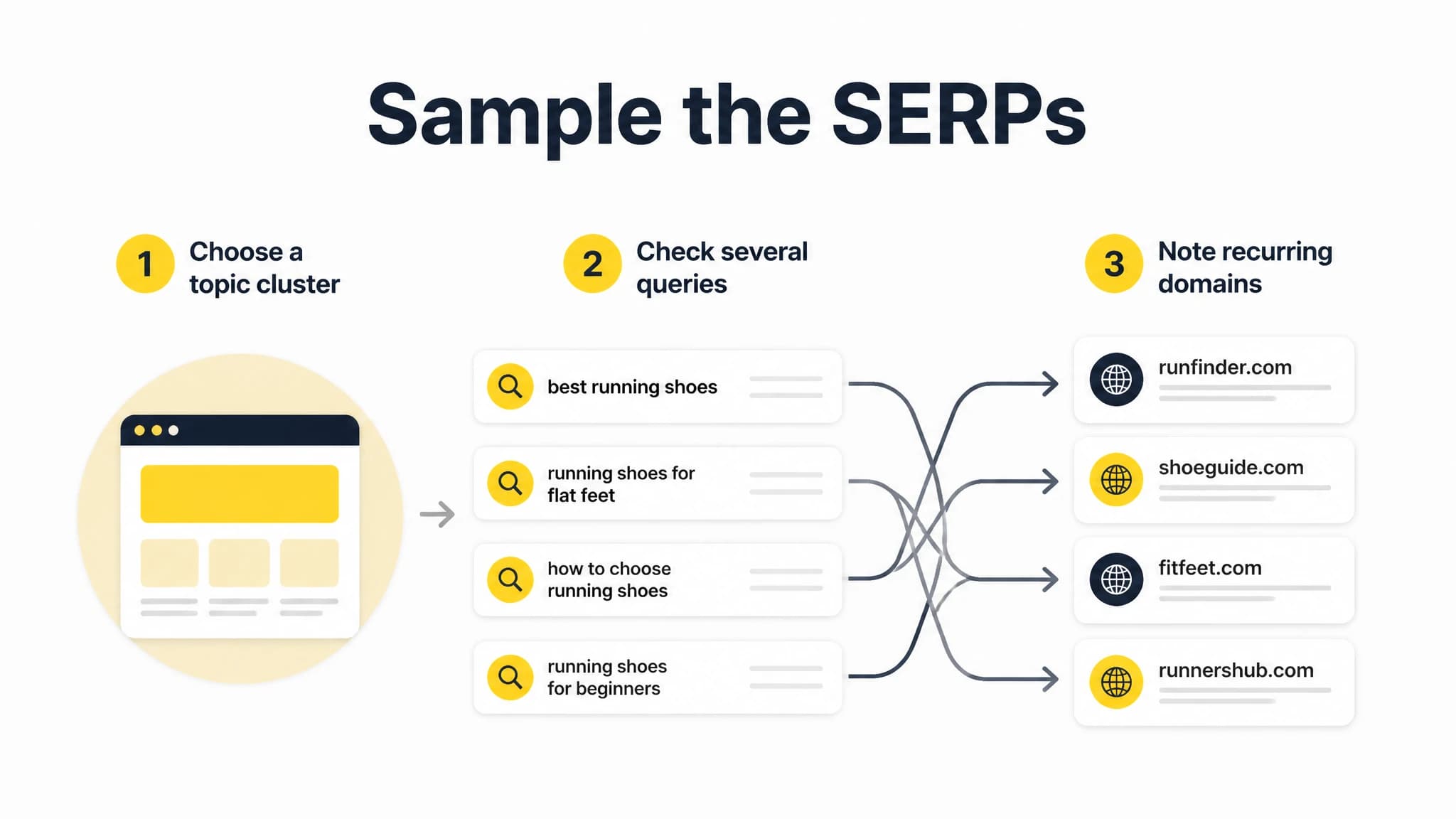
Compare several related queries to spot domains that repeatedly appear.
Step 4: Use your Search Console queries
Your own Google Search Console data is a valuable reality check. Review the queries that already bring impressions or clicks to your site, then look for themes you did not include in your initial list. Queries that surface your pages can reveal which topics Google already associates with your site and where you may be close to serving a search need.
In the Search results Performance report, use the Queries view to inspect the searches associated with your site. You can also select a query and review the Pages view to see which of your URLs appeared for it. Google explains the report’s query and page dimensions in its Search Console Performance report documentation. (support.google.com)
Use those queries to refine your competitor research:
- Group related queries into topic clusters.
- Pick a few representative queries from each cluster.
- Check the current search results for those queries.
- Compare the recurring domains with your manual and tool-based lists.
- Note where your pages already appear and where another page type or topic may be missing.
Search Console shows how your own site appears in Google Search; it does not reveal a competitor’s private analytics. Use it to ground your topic choices in your site’s actual search visibility, then use SERP checks and third-party tools to investigate other domains. Also, do not treat average position as the only decision metric. Review query relevance, impressions, clicks, and the page shown for a query together.
Step 5: Narrow the list to three to five useful competitors
A long list of domains is easy to collect and hard to use. Choose three to five search competitors per topic cluster by scoring each candidate against practical criteria:
| Check | What to look for |
|---|---|
| Relevance | Does the domain serve a similar audience or address the same topic? |
| SERP recurrence | Does it appear for multiple queries in the cluster? |
| Page similarity | Does it rank with a page type you could usefully compare against? |
| Opportunity | Is there a topic, format, or audience need your site could address better or more completely? |
| Actionability | Can you identify a lesson or next step from studying it? |
A domain does not need to match your business model to qualify. It does need to offer a meaningful comparison for the search task at hand. Exclude sites that appear only once for an unrelated result, pages that serve a different intent, and domains whose scale or purpose makes the comparison unhelpful for your decision.
Keep the shortlist flexible. If your research is about informational guides, the relevant domains may differ from those for product comparisons. Revisit the list when you start a new cluster or when the search results change substantially.
Turn your shortlist into an action plan
Competitor research is useful only when it changes what you do next. For each shortlisted domain, select a few pages that rank for relevant queries and note the page’s purpose, format, coverage, and apparent audience. Do not copy the page. Identify what the searcher needs, what the existing result addresses, and what your own site could contribute.
Create a simple research sheet with columns for topic cluster, query, competitor domain, ranking page, page type, observed intent, and your next action. Possible actions include improving an existing page, creating a genuinely distinct page, covering a missing subtopic, or deciding that the query is not a good fit.
Before choosing a keyword, validate that your site can serve the searcher well. Check the result types, assess how relevant the query is to your business, and decide whether you can produce a page with a clear reason to exist. Our competitor keyword research guide walks through evaluating and prioritizing keywords found on other sites.
If you want to build a repeatable research workflow, use RankWorker’s competitor research per domain to identify pages and keywords for further review, then connect the findings to your topic planning. The goal is not to publish a page for every competitor keyword. It is to select the relevant opportunities your site can serve and turn them into a realistic content plan.
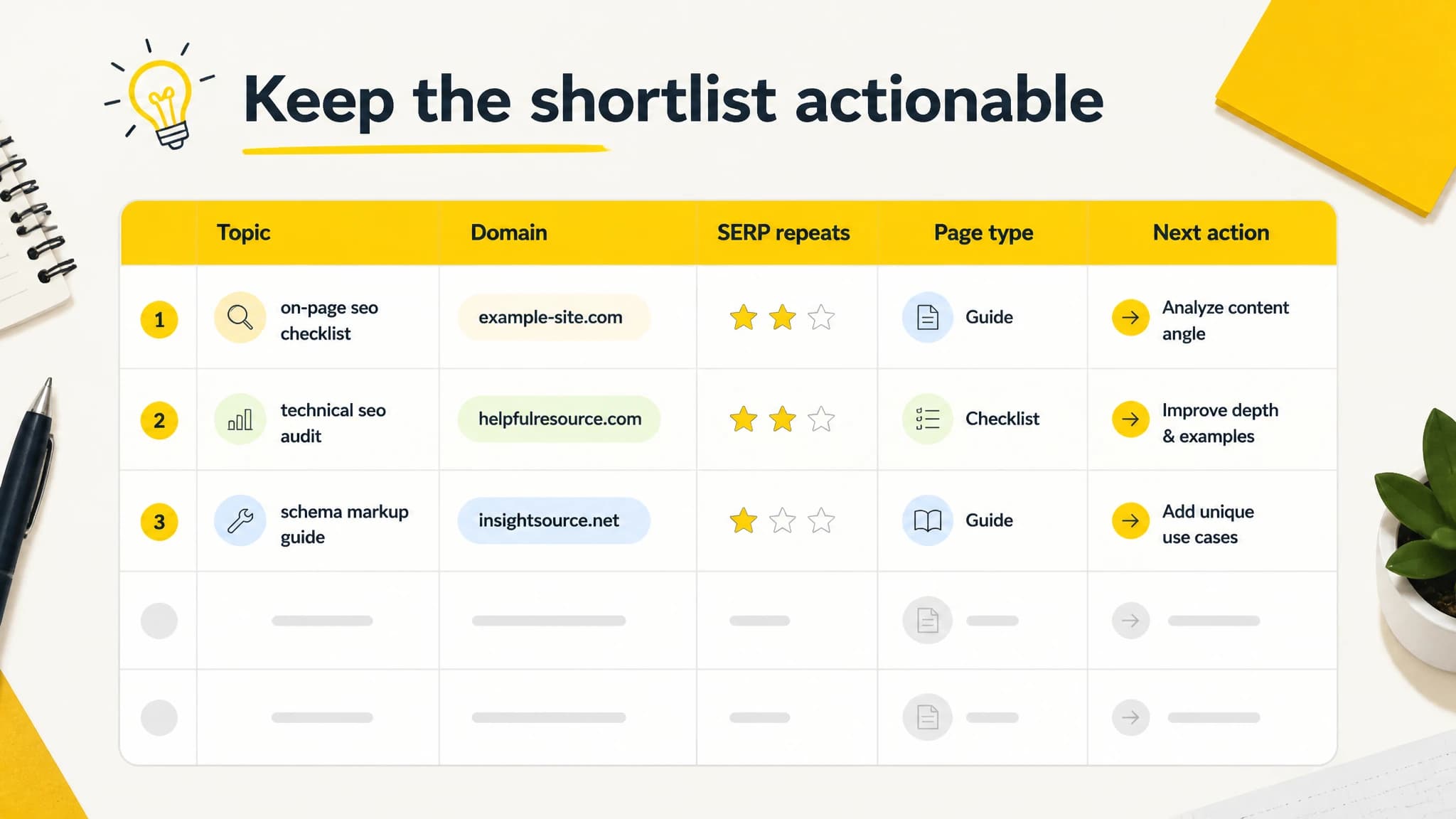
Keep only the competitors that support a clear research decision.
A quick checklist
Before you finalize a competitor list, make sure you can answer these questions:
- Have I defined the topic cluster and the audience need?
- Did I check several target queries rather than just one?
- Do the candidate domains recur in relevant results?
- Did I compare the page types and search intent?
- Have I used my own Search Console queries to refine the topic list?
- Did I treat third-party estimates as leads rather than verified traffic?
- Can I name a practical lesson or action for each shortlisted domain?
If you cannot identify a useful action from studying a candidate, remove it or replace it with a more relevant domain. A focused shortlist is more useful than a large competitor spreadsheet.
Frequently Asked Questions
Finding SEO competitors is a search-focused exercise, not just a list of companies in your market. Combine manual SERP sampling, keyword-overlap research, and your own Search Console queries to build a small, topic-specific shortlist. Then study only the pages that can help you make a concrete decision about what your site should create or improve.