

 Veselin Stoyanov12 min read
Using a Headless CMS API for Scalable SEO Content Management
Learn how a headless CMS API supports scalable SEO content management, flexible publishing workflows, structured content, and faster website iteration.
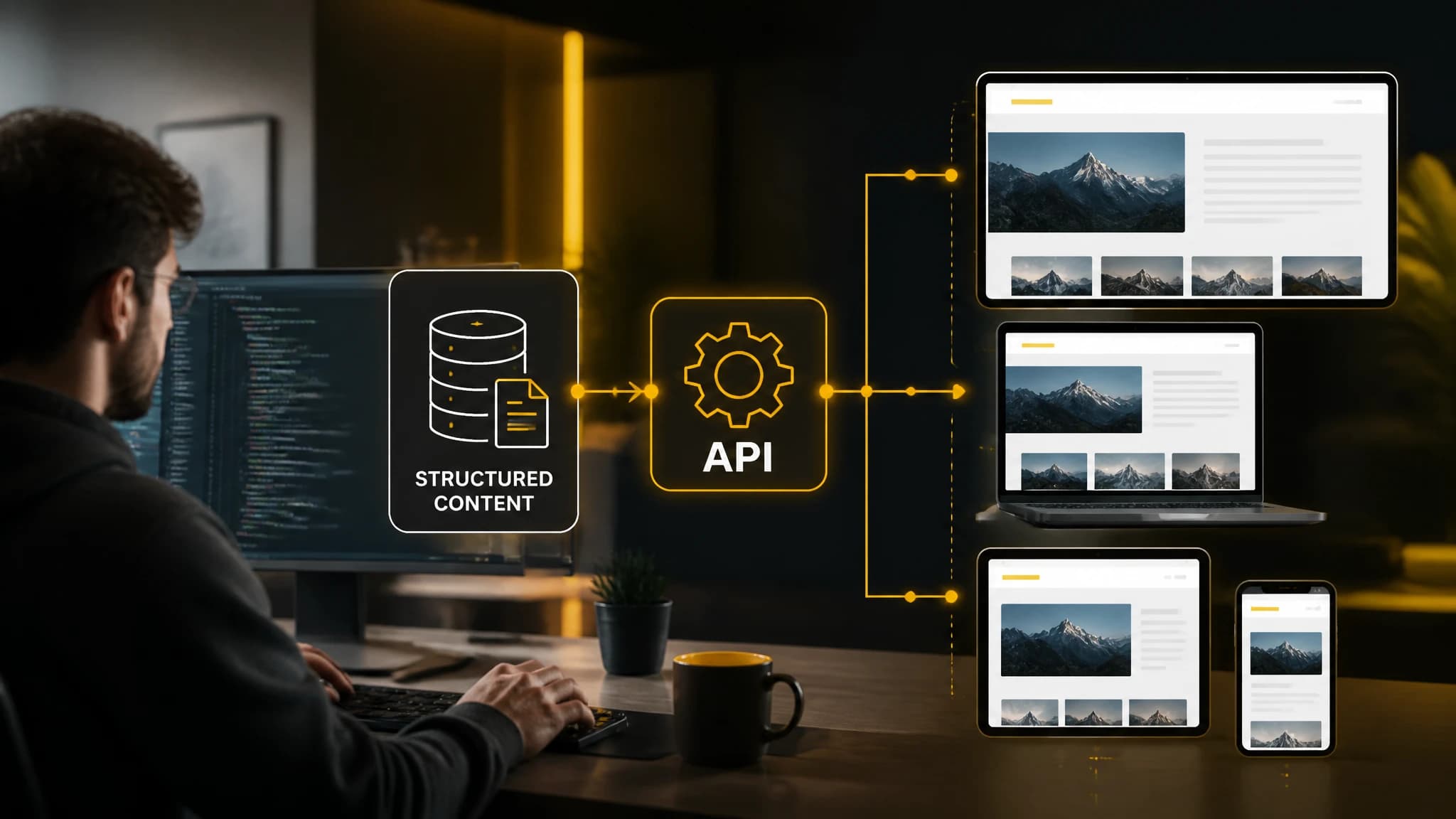
Using a Headless CMS API for Scalable SEO Content Management
SEO content becomes harder to manage as a website grows. More pages mean more briefs, drafts, images, metadata fields, reviews, publishing tasks, and technical dependencies. When all of those activities are tied to one website interface, even a small change can require coordination between content, marketing, and development teams.
A headless CMS API provides a different approach. It separates content creation and storage from the front end that presents the content to visitors. This gives teams more control over how content is created, delivered, optimized, and reused across websites or applications.
In this guide, you will learn what a headless CMS API is, how it supports SEO, which workflows to automate, and how to build a scalable content management system around APIs.
What is a headless CMS API?
A headless CMS is a content management system without a fixed presentation layer. Instead of sending content directly to one built-in website theme, it makes structured content available through an API.
The front end can then request that content and render it using the technology best suited to the project. That might be a JavaScript framework, a static site generator, a mobile application, or a custom website.
A headless CMS API typically handles operations such as:
- Creating and updating structured content
- Retrieving articles, authors, categories, and assets
- Managing drafts and publication states
- Returning metadata for search and social sharing
- Delivering content to different applications
- Connecting content workflows to custom tools
The key distinction is that the CMS manages content while the application manages presentation. This separation is why headless systems are often described as decoupled or API-first.
Why decouple content from the presentation layer?
Traditional content systems often combine the editorial interface, database, templates, plugins, and public website into one application. This can be convenient, especially for smaller websites, but it may create limitations as the organization becomes more complex.
Decoupling the two layers can improve SEO agility in several ways.
Faster front-end experimentation
SEO teams frequently need to test page templates, navigation structures, internal linking patterns, breadcrumbs, and content layouts. When the content layer is separate, developers can change the presentation layer without rebuilding the editorial workflow from scratch.
For example, a team could move from server-rendered templates to a static or hybrid rendering model while keeping its existing article records and editorial fields.
Content reuse across channels
A single article may need to appear on a primary website, a regional site, a product interface, or a mobile application. An API-driven content model makes reuse easier because each channel can request the same structured source content and format it for its own experience.
This is especially useful when the organization wants consistent titles, summaries, authorship data, or publication states across multiple properties.
More flexible technical architecture
A content management API allows teams to choose technologies based on performance, developer experience, and business requirements rather than being restricted to the CMS's default templates.
The front end can be optimized for page speed, dynamic personalization, static generation, or a combination of approaches. The CMS remains focused on managing content rather than controlling every part of the website.
Cleaner separation of responsibilities
Editors can focus on planning and reviewing content. Developers can focus on rendering, routing, caching, and technical SEO. Marketing teams can manage metadata and content requirements without needing access to the codebase for every update.
This separation does not remove the need for governance. It makes ownership clearer, which can reduce confusion in repeatable publishing workflows.
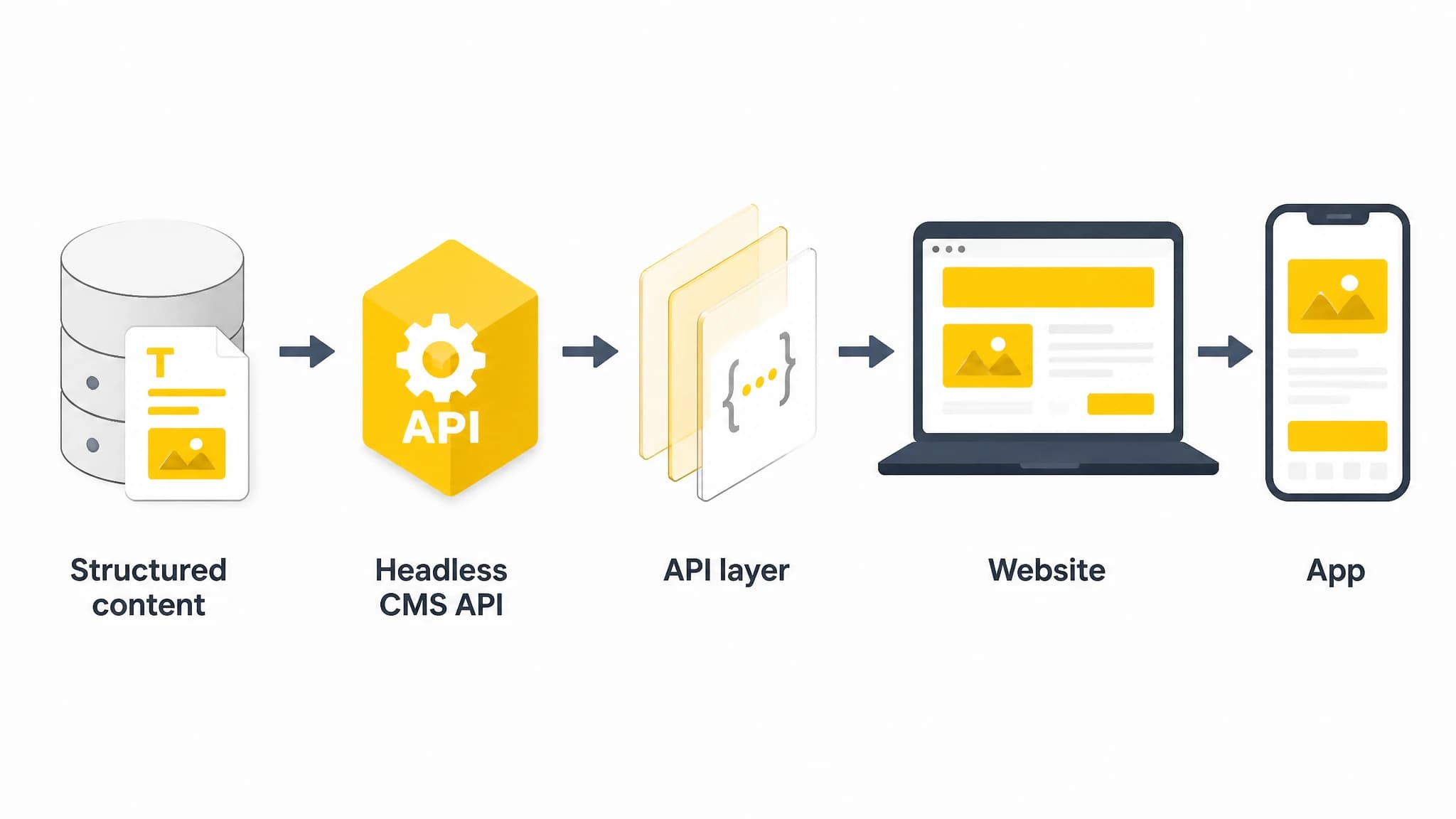
Decoupling lets one content source serve multiple presentation layers.
How a headless CMS API supports SEO
A headless CMS does not automatically improve search rankings. SEO results still depend on content quality, technical implementation, relevance, user experience, and ongoing maintenance. However, an API-based architecture can make important SEO processes easier to manage consistently.
Structured metadata
Content should be stored in clearly defined fields rather than as one unstructured block of text. Useful fields may include:
- SEO title
- Meta description
- Canonical URL
- URL slug
- Open Graph title and description
- Featured image
- Author
- Publish date
- Updated date
- Robots directives
- Related content
When these fields are available through an API, the front end can place them in the correct HTML and social metadata locations. This reduces the risk of inconsistent formatting across templates.
Consistent URL management
A scalable content system needs a predictable relationship between content records and URLs. The API should support stable slugs, publication states, redirects, and canonical URL logic where required.
Before changing a URL structure, define how old URLs will be handled. A headless architecture gives developers more control, but that control also creates responsibility for preserving search signals during migrations.
Flexible rendering strategies
Some SEO-focused websites benefit from static generation because pages can be prepared before a visitor requests them. Others need runtime rendering because content or user experiences change frequently. Some use a hybrid approach.
A content delivery API can support these models by supplying structured content during a build or at request time. The right choice depends on the website's content freshness requirements, infrastructure, and technical implementation.
Repeatable internal linking
Internal links help users and search engines discover related content. An API-driven system can expose relationships between articles, categories, products, and authors so that the front end can render related content modules consistently.
The editorial team should still control the relevance of important links. Automation is most useful when it supports a deliberate information architecture rather than adding links indiscriminately.
For a practical look at API-driven publishing workflows, see content publishing API workflows.
Core components of an API-driven SEO workflow
A headless CMS API is only one part of a scalable system. Strong results come from connecting the content, editorial, technical, and publishing layers.
1. Keyword and topic planning
Start with a content plan that maps search demand to business priorities and audience needs. Each planned page should have a defined search intent, primary topic, supporting topics, and a reason for existing.
Avoid treating the CMS as a place to store disconnected articles. Use content relationships to identify pillar pages, supporting guides, comparison pages, and updates.
2. Structured content modeling
Create content types that reflect how the website works. An article model might include fields for the title, slug, body, summary, author, category, featured image, SEO metadata, and publication status.
Keep fields specific enough to support consistent rendering. At the same time, avoid creating so many fields that editors struggle to maintain content.
3. Content generation and review
Content can be produced manually, with AI assistance, or through a combination of both. Regardless of the production method, establish review steps for factual accuracy, search intent, brand voice, links, formatting, and technical fields.
The API should make status visible. Common states include draft, in review, approved, scheduled, published, and archived.
4. Asset and metadata management
SEO content often includes images, captions, alt text, and social sharing data. Treat these as part of the publishing workflow instead of adding them as an afterthought.
A structured asset model can help the front end render images consistently and give editors a clear place to manage descriptive information.
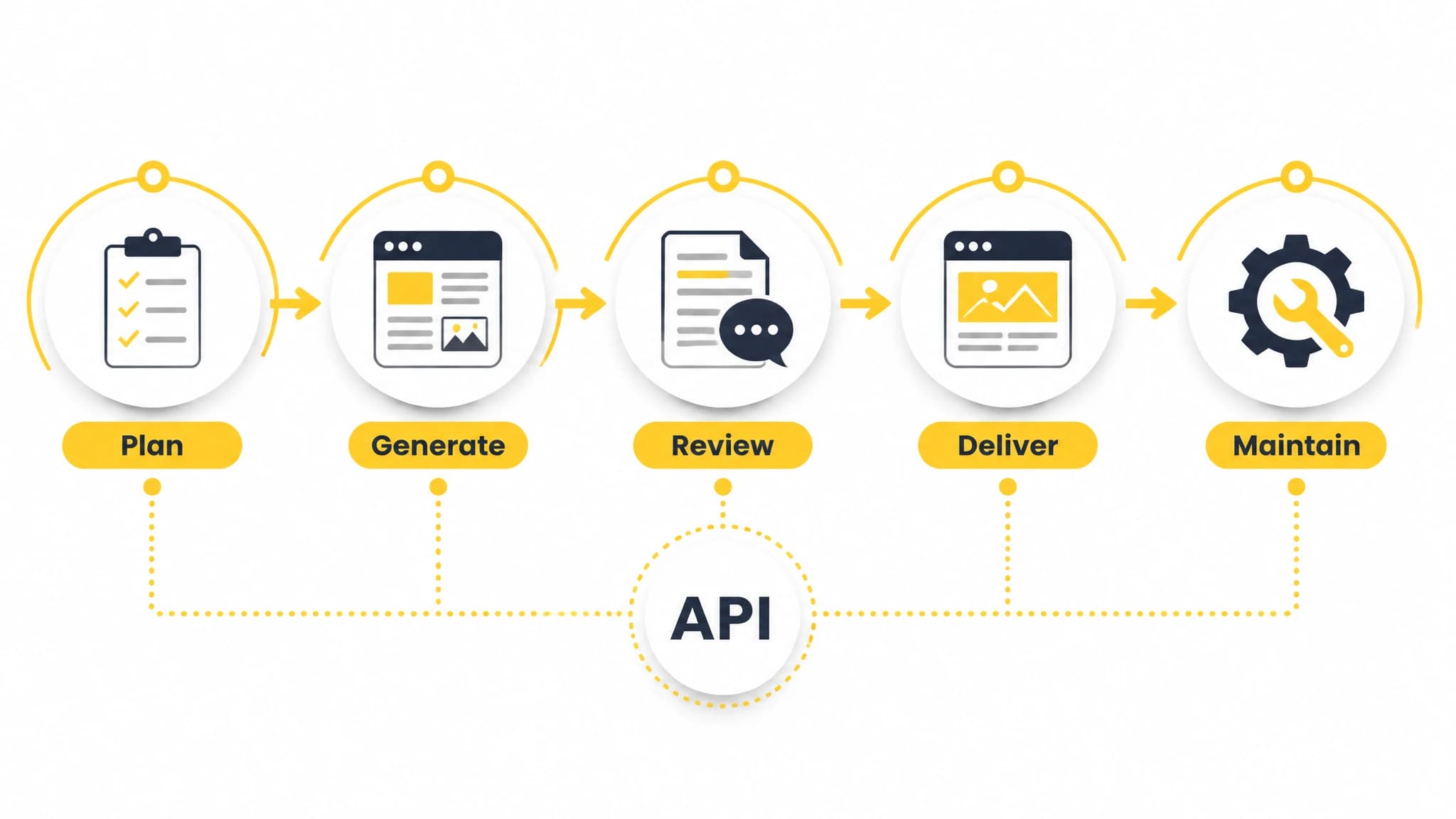
A reliable workflow connects planning, production, review, delivery, and maintenance.
5. Publishing and delivery
Once content is approved, the system needs a dependable way to deliver it to the website. This may happen through a build process, a content delivery API, a webhook, or direct application requests.
Publishing events should be observable. If an article fails to reach the website, the team should be able to identify the failure, retry the delivery, and confirm the final page state.
6. Search discovery and maintenance
Publishing is not the end of the workflow. Check that the page is accessible, linked from relevant areas, included in the correct sitemap, and rendered with the intended metadata.
Create a maintenance process for updating outdated information, consolidating overlapping pages, repairing broken links, and reviewing pages that no longer support the site's goals.
Using a content management API with a custom website
A typical integration follows a simple pattern:
- The editorial system stores structured content.
- The website requests content through an authenticated or public API endpoint.
- The application maps the response to a page template.
- The rendering layer outputs the article, metadata, links, and assets.
- A build or publishing process makes the page available to visitors.
The details vary by platform, but the architectural principle remains the same: the content source and the presentation system communicate through defined data contracts.
Those contracts should be documented. Specify field names, data types, required values, publication states, image behavior, error responses, and versioning rules. Clear contracts make it easier to change either side without unexpected breakage.
Using RankWorker as an upstream content source
If your website already uses a custom front end or headless CMS, RankWorker can fit upstream of that presentation layer through its Direct API integration. According to RankWorker's integration documentation, the Direct API can be used to fetch generated articles, assets, metadata, and publishing data directly from an application. It supports workflows such as custom websites, static site generation, dynamic publishing, and CI/CD pipelines.
The workflow is straightforward: create an API key in RankWorker, authenticate requests, retrieve generated content, and render or publish it through your own application workflow. This can help separate content production from the website code while keeping your team in control of presentation.
Learn more about the RankWorker Direct API when evaluating how an upstream content generator could connect to your headless CMS or custom publishing system.
Common implementation mistakes to avoid
Treating the API as a replacement for strategy
An API can move content efficiently, but it cannot decide whether a topic is valuable for your audience or whether two pages compete with each other. Keep keyword research, intent mapping, editorial judgment, and content maintenance in the process.
Ignoring preview and approval states
A direct connection between content generation and publication can create avoidable quality issues if every generated record is published immediately. Add review states, validation rules, and permissions appropriate to your team.
Forgetting technical SEO fields
If the content model includes only a title and body, important SEO controls may be difficult to manage later. Plan for slugs, canonical URLs, metadata, authorship, images, structured relationships, and publication dates.
Building without failure handling
APIs can return errors, time out, or provide incomplete data. Define what happens when content cannot be fetched, an image is missing, or a publishing event fails. Logging, retries, validation, and alerts are essential for a dependable system.
Over-automating internal links
Automated links should support clear topical relationships. Review high-value pages manually and use automation for predictable, well-defined patterns rather than inserting links based only on keyword matches.
A practical rollout plan
You do not need to rebuild an entire website before testing an API-driven SEO workflow. A phased rollout is usually easier to manage.
Phase one: Model one content type
Start with articles or landing pages. Define the fields required for publication, SEO metadata, images, authorship, and status management.
Phase two: Connect one template
Build one front-end template that retrieves the content and renders the complete page. Test title tags, headings, canonical URLs, structured data, links, images, and responsive behavior.
Phase three: Add publishing automation
Connect approved content to the build or publishing process. Add validation, error handling, logs, and a way to confirm that the final page matches the source record.
Phase four: Expand relationships and channels
Once the core workflow is reliable, add related content, categories, localization, additional templates, or other channels. Scale the system only after the basic data contract and publishing process are stable.
Final takeaway
A headless CMS API gives SEO teams more freedom to evolve the website without tying content operations to one presentation layer. It supports structured content, reusable data, flexible rendering, and repeatable publishing workflows.
The architecture works best when it is paired with clear content strategy, carefully designed models, editorial review, technical safeguards, and ongoing maintenance. For businesses that want to automate content production while keeping control of a custom website, an upstream API connection can provide a practical bridge between SEO operations and a headless publishing stack.