

 Veselin Stoyanov14 min read
How to Create an SEO Content Strategy From Scratch
Learn how to create an SEO content strategy from scratch with goals, keyword research, topic clusters, prioritization, publishing, and measurement.

How to Create an SEO Content Strategy From Scratch
If you are starting with limited resources, an SEO content strategy should do more than produce a list of blog topics. It should connect your business goals, audience needs, search opportunities, content formats, publishing capacity, and measurement into one repeatable system.
The simplest way to create an SEO content strategy is to work through this sequence:
- Define the business goal.
- Identify the audience and their search problems.
- Research and organize keywords.
- Group keywords into topic clusters.
- Choose content formats and priorities.
- Build a realistic publishing cadence.
- Measure results and improve the plan.
This approach helps you avoid publishing random articles that attract visitors but do not support your business. It also gives you a practical roadmap when you are working alone or with a small team.
1. Start with a clear business goal
Before opening a keyword tool, decide what organic search should help you accomplish. A strategy designed to increase brand awareness will look different from one designed to generate product demos, newsletter signups, or sales.
Choose one primary objective for the next planning period, such as:
- Generate qualified leads.
- Increase organic traffic to product or service pages.
- Build visibility in a specific market.
- Support a new product category.
- Reduce reliance on paid acquisition.
- Create a steady source of educational traffic.
Then define a useful conversion action. This might be a contact form submission, trial signup, consultation request, purchase, or email subscription.
Your goal affects the topics you choose. For example, a website selling accounting software should not measure success only by traffic to general articles about finance. It should also create content that helps readers understand accounting problems, compare possible solutions, and evaluate the product category.
A useful planning statement looks like this:
Over the next six months, we will publish content that helps [specific audience] solve [specific problem] and encourages them to [business action].
Keep the statement narrow enough to guide decisions. “Get more traffic” is too broad. “Attract small-business owners researching inventory management and move qualified readers toward a product demo” is more useful.
2. Define your audience and search journey
Good SEO content starts with a clear understanding of who you want to reach. You do not need a complex persona document. You need enough detail to understand the audience's problems, language, level of knowledge, and decision process.
Write down:
- Who the reader is.
- What they are trying to accomplish.
- What problem prevents them from succeeding.
- What alternatives they may consider.
- What information they need before taking action.
- What objections could delay a decision.
Next, map the audience's search journey. Most topics fit into one of three broad stages:
Problem awareness
The reader knows something is wrong but may not know the solution. Searches often include questions such as “why is my website traffic dropping?” or “how do I organize business expenses?”
Solution research
The reader understands the problem and is exploring methods, processes, or categories. Searches may include “SEO content strategy,” “project management methods,” or “best ways to automate reporting.”
Decision support
The reader is comparing providers, tools, or approaches. Searches may include “SEO content planner,” “content automation software,” or “how to choose an SEO agency.”
A balanced strategy usually includes content for more than one stage. Informational articles can attract new readers, while comparison pages, use-case pages, and detailed guides can help qualified visitors move closer to conversion.
3. Build a focused keyword list
Keyword research is not simply finding phrases with the highest search volume. The goal is to identify searches that match your audience, your expertise, and your business direction.
Start with seed topics based on:
- Your products or services.
- Customer questions from sales and support conversations.
- Problems your audience regularly faces.
- Competitor categories and subtopics.
- Existing pages that already attract impressions.
- Industry terms your customers use.
For every keyword idea, record at least:
- The keyword or query.
- The likely search intent.
- The related topic or category.
- The desired content format.
- The business relevance.
- The current ranking page, if one exists.
Do not create a separate article for every variation of the same query. Several closely related keywords may belong on one strong page. The purpose of research is to understand the topic landscape and user demand, not to produce a bloated spreadsheet.
For example, the following phrases may belong to one broader content asset:
- How to create an SEO content strategy.
- SEO content planning process.
- How to plan blog content for SEO.
- SEO content roadmap.
Whether these should be one page or several depends on search intent and the quality of the existing results. If the same page can answer the questions thoroughly, combine them. If the intent is meaningfully different, create separate pages and link them together.
4. Organize keywords into topic clusters
A topic cluster is a group of related pages organized around a central subject. Usually, it includes one broad pillar page and several focused supporting articles.
For example, a website focused on SEO could organize content like this:
- Pillar: SEO content strategy.
- Supporting article: Keyword research for content planning.
- Supporting article: How to build topic clusters.
- Supporting article: How to create an SEO content calendar.
- Supporting article: How to measure content performance.
- Supporting article: How to improve underperforming content.
The pillar page gives readers a complete overview. Supporting pages answer narrower questions in more depth. Internal links connect the cluster so readers and search engines can understand how the subjects relate.
You can explore more detail on building a roadmap in our SEO content planner guide.
When clustering keywords, group them by meaning and intent rather than by wording alone. Two phrases can look similar but require different content. Conversely, several phrases with different wording may be best answered by one comprehensive page.
A practical test is to ask: “Would the same reader be satisfied by the same page?” If yes, consider grouping the keywords. If no, separate them and define how the pages will link to each other.
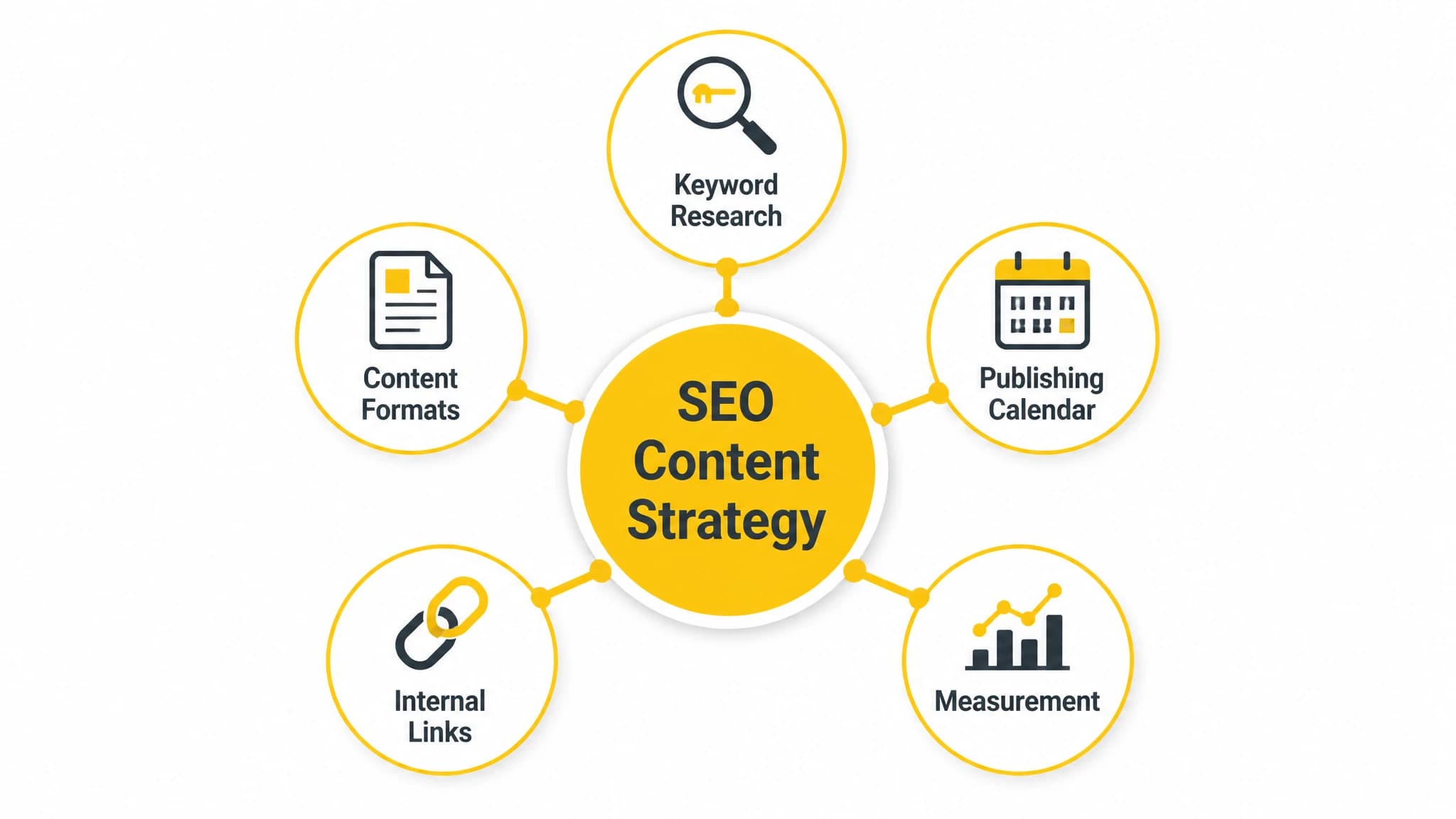
Topic clusters connect a central subject with focused supporting content.
5. Choose the right content formats
Blog posts are useful, but an effective SEO strategy should not rely on one format for every search. Match the format to the question and the reader's stage.
Common formats include:
- Educational guides for broad informational topics.
- Step-by-step tutorials for process-based searches.
- Comparison pages for readers evaluating options.
- Glossaries for definitions and foundational concepts.
- Case studies for proof and decision support.
- Templates and checklists for practical implementation.
- Product or service pages for high-intent searches.
- Original research when you have unique data or expertise.
For example, “how to plan blog content for SEO” is well suited to a detailed guide or checklist. A search such as “SEO content planner” may need a category explanation, workflow guide, or product-focused page depending on the intent of the results.
Choose formats you can maintain. A small business may get more value from a few excellent guides and supporting templates than from trying to publish every possible format.
6. Prioritize topics with a simple scoring system
Limited resources make prioritization essential. You cannot publish every promising topic at once, so create a consistent way to decide what comes first.
Score each topic from 1 to 5 across four areas:
- Business relevance: How closely does the topic connect to your offer?
- Audience need: How important is the problem to your target reader?
- Opportunity: Do you have a realistic chance to create a useful, competitive page?
- Effort: How difficult will research, writing, design, and promotion be?
You can calculate a basic priority score with this formula:
Priority = business relevance + audience need + opportunity - effort
This is not a search-engine formula. It is a decision-making tool that helps you avoid choosing topics based only on volume.
Prioritize topics that have strong business relevance and clear audience need. A lower-volume topic can be strategically valuable if it reaches people who are likely to become customers.
Review your existing content before creating new pages. You may have articles that can be refreshed, combined, expanded, or redirected. Improving an existing relevant page can be more efficient than starting from zero.
7. Create a realistic publishing cadence
Your publishing cadence should reflect your available time, expertise, review process, and ability to maintain quality. Consistency matters, but publishing more often is not automatically better.
A small team might begin with:
- One in-depth article every two weeks.
- One supporting update or refresh each week.
- A monthly review of rankings, traffic, and conversions.
A solo founder may choose one high-value article per month and spend additional time improving internal links, updating existing pages, and promoting the content.
Build your calendar around content clusters rather than disconnected topics. For example, publish a pillar page first, then create supporting articles that answer narrower questions. This makes internal linking easier and helps your team develop subject knowledge as it works through the cluster.
A useful content calendar includes:
- Working title.
- Primary keyword.
- Search intent.
- Cluster or category.
- Content format.
- Target audience stage.
- Business goal.
- Draft deadline.
- Review date.
- Publication date.
- Internal link targets.
- Update date.
Our guide to creating an SEO content calendar covers how to turn these planning details into a repeatable schedule.
With RankWorker, we can support the execution layer by helping with keyword planning, content opportunities, clustering, article generation, SEO metadata, scheduling, and automated publishing. The strategy still comes from your business priorities and audience understanding.
8. Create a quality-controlled production workflow
An SEO strategy becomes useful when it can be executed repeatedly. Define the steps that every article should pass through before publication.
A practical workflow is:
- Confirm the keyword and search intent.
- Review the current search results and competing pages.
- Define the article's unique value.
- Create an outline that answers the main question early.
- Draft the content with examples and practical guidance.
- Check accuracy, originality, and completeness.
- Add internal links and a clear next step.
- Write the title, meta description, and image text.
- Review formatting, accessibility, and mobile readability.
- Publish and record the page in your content calendar.
If you use automation, keep human review in the process. Automation can reduce repetitive work, but it should not replace subject knowledge, fact checking, strategic decisions, or editorial standards.
Create a short checklist for every article. It might include whether the page answers the primary intent, uses clear headings, avoids unnecessary repetition, includes relevant internal links, and gives the reader a practical next step.
9. Measure the strategy with meaningful metrics
Track metrics that help you make better decisions, not just metrics that look impressive in a report.
Useful measures include:
- Organic impressions.
- Click-through rate.
- Organic sessions.
- Rankings for important topic groups.
- Engaged visits.
- Leads, signups, or sales from organic traffic.
- Assisted conversions.
- Pages that attract internal links and backlinks.
- Content production time.
Separate leading indicators from business outcomes. Impressions and rankings can show that visibility is improving, but conversions and qualified actions help you determine whether the strategy supports the business.
Review performance by cluster, not only by individual article. A group of related pages may create value through combined visibility, internal links, and assisted conversions even when one page is not the top performer.
After publishing, give a page enough time to collect meaningful data before making major conclusions. Then look for patterns:
- High impressions but low clicks may indicate a weak title or meta description.
- Clicks without conversions may indicate a mismatch between intent and offer.
- Strong rankings with low engagement may indicate that the page needs clearer structure or better examples.
- Declining performance may indicate outdated information, stronger competition, or changing search intent.
10. Improve the strategy through regular iteration
An SEO content strategy is not a document you create once and never revisit. Set a monthly or quarterly review to decide what to continue, improve, combine, or stop.
Ask:
- Which topics attracted the right audience?
- Which pages contributed to business goals?
- Which content required more effort than expected?
- Which questions remain unanswered?
- Where are internal links missing?
- Which pages should be refreshed?
- Are we publishing too broadly for our current resources?
Use the answers to refine your next planning cycle. You may discover that a smaller set of closely related topics performs better than a broad publishing program.
You can also review our organic traffic content system for ideas on connecting audience research, useful content, internal linking, and consistent publishing.
A simple starting plan for the next 30 days
If you are starting from scratch, avoid trying to build a six-month strategy in one sitting. Use this short plan:
Week 1: Define direction
Choose your primary business goal, audience, conversion action, and core topic area. List the questions your customers ask most often.
Week 2: Research and cluster
Build an initial keyword list, classify search intent, and group related terms into three to five topic clusters.
Week 3: Prioritize and schedule
Score your topics, select the first three to six pieces, and create a publishing calendar based on your real capacity.
Week 4: Produce and measure
Publish the first piece, prepare the next one, add internal links, and establish a baseline for impressions, clicks, rankings, and conversions.
The goal is not to create a perfect strategy before taking action. The goal is to create a clear enough system that each publishing cycle teaches you something useful.
Conclusion
To create an SEO content strategy from scratch, connect business goals with audience problems, keyword research, topic clusters, content formats, priorities, publishing capacity, and measurement. Start narrow, build around related topics, and improve the plan using real performance data.
RankWorker can help with the execution work around keyword planning, content opportunities, clustering, article creation, metadata, scheduling, and publishing. Use those capabilities to make a good strategy easier to operate, while keeping your audience, positioning, and editorial judgment at the center.