

 Veselin Stoyanov13 min read
SEO Content Planner: Build a Search-Driven Roadmap
Learn how to turn keyword opportunities into a prioritized SEO content roadmap with topic clusters, search intent, internal links, and a practical publishing cadence.

An SEO content planner helps you turn keyword opportunities into a publishing roadmap instead of a list of disconnected article ideas. The best plans connect search demand with business priorities, customer questions, topic relationships, internal links, and the publishing capacity your team can realistically maintain.
A practical SEO content roadmap should answer five questions:
- Which topics should we publish first?
- Which keywords belong on the same page?
- What search intent should each article satisfy?
- How will new articles support existing pages?
- How often can we publish without sacrificing quality?
This guide walks through a repeatable process for building that roadmap. It also explains where an AI content planner can reduce manual work without replacing strategic review.
What is an SEO content planner?
An SEO content planner is a system for selecting, organizing, prioritizing, and scheduling content around search opportunities. It may be a spreadsheet, a project management board, a dedicated platform, or a combination of tools.
The important part is not the format. It is the logic behind the plan.
A useful planner connects each proposed article to:
- A primary keyword or clearly defined topic
- Related keywords and questions
- A specific search intent
- A target audience and stage of awareness
- A business goal
- A place in a topic cluster
- Relevant internal links
- A realistic publication date
A basic content calendar tells you when to publish. An SEO content planner also explains why each page exists and how it contributes to the wider site.
If you are starting with a simple calendar, first create an effective SEO content calendar with keyword groups, briefs, and a repeatable workflow. Then add the prioritization and linking process below.
Step 1: Collect and qualify keyword opportunities
Your roadmap is only as useful as the opportunities entering it. Begin with a broad list of keywords from sources such as:
- Search performance data from your website
- Customer questions from sales and support conversations
- Competitor content gaps
- Keyword research tools
- Product features and use cases
- Related searches and question-based queries
- Existing pages with impressions but weak clicks
Do not add every keyword to the publishing queue. First qualify each opportunity using a consistent set of checks.
Check business relevance
A keyword can have search demand and still be a poor target for your business. Ask whether the topic connects to your products, services, audience, expertise, or long-term positioning.
For example, a general keyword may attract visitors who will never become customers. A narrower query may bring fewer visitors but better-fit prospects. Your roadmap should make that trade-off visible.
Check content fit
Decide whether your site can create a genuinely useful answer. If the topic requires first-hand experience, specialist knowledge, or data you do not have, mark it for additional research rather than automatically assigning it to a writer or generator.
Check the existing search landscape
Review the current results for the keyword. Look for the dominant content formats, the questions competitors answer, the level of detail expected, and whether the results match your site’s ability to compete.
The goal is not to copy the current results. It is to understand the searcher’s expectations and identify where your article can be more useful or more specific.
Step 2: Group keywords into topic clusters
Keyword lists often contain multiple variations of the same underlying problem. Publishing a separate article for every variation can create overlap, competing pages, and unnecessary maintenance.
Group keywords by the page that should provide the best answer. Closely related queries usually belong together when they share:
- The same audience
- The same underlying question
- The same search intent
- Similar result types in Google
- A natural opportunity to answer them in one comprehensive page
For example, “SEO content planner,” “content roadmap for SEO,” and “SEO publishing plan” may describe one central topic. They can potentially be covered by one primary guide, with supporting sections addressing related questions.
A different query, such as “best content calendar software for SEO,” may deserve a separate comparison or buying guide because the searcher is evaluating tools rather than learning the planning process. When software selection becomes part of the intent, compare content calendar software for SEO as a separate content opportunity.
Build a cluster structure
A simple cluster can include:
- Pillar page: The broad topic and strategic overview
- Cluster pages: Narrower articles that answer specific questions
- Supporting pages: Tutorials, templates, comparisons, or implementation guides
The pillar page should link to relevant cluster pages. Cluster pages should link back to the pillar where useful and connect to related articles. This gives readers a clear path through the subject and helps search engines understand the relationships among pages.
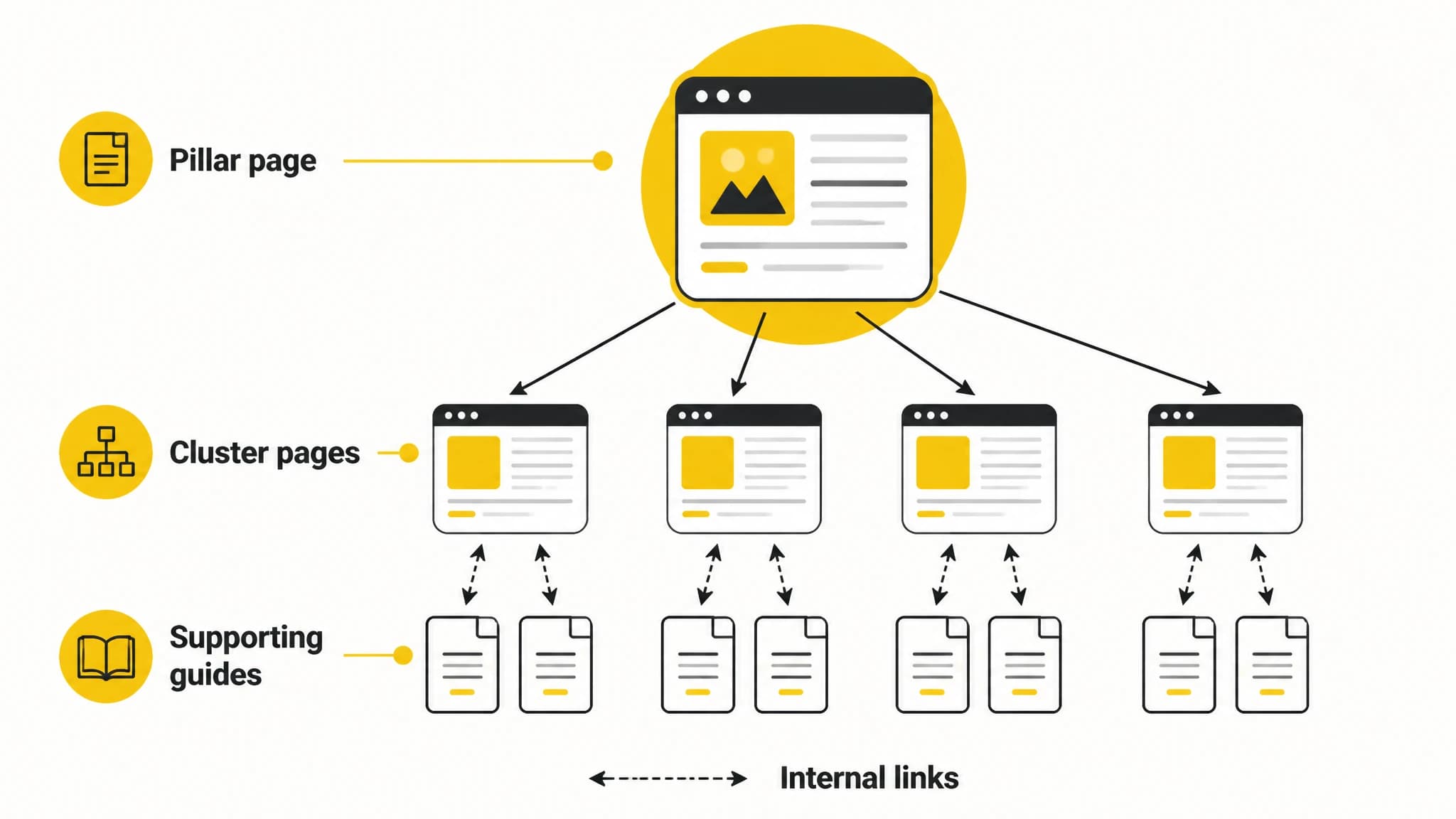
Topic clusters organize related keywords around connected pages.
Step 3: Map search intent before assigning an article
Search intent is the reason behind a query. Mapping it before writing prevents a common mistake: creating an article that technically mentions the keyword but does not answer what the searcher actually wants.
Use four practical intent categories:
Informational intent
The searcher wants to understand a topic, process, or concept. Queries often include terms such as “what is,” “how to,” or “guide.” These pages should explain the subject clearly and provide actionable steps.
Commercial investigation
The searcher is comparing approaches, tools, or options. Content should help them evaluate trade-offs, use cases, limitations, and selection criteria without hiding important drawbacks.
Transactional intent
The searcher is ready to take action, such as starting a trial, requesting a quote, or purchasing a solution. These pages should make the next step clear while still answering practical questions.
Navigational intent
The searcher is looking for a specific brand, product, or page. This content usually belongs to your website structure, product pages, or documentation rather than a broad educational article.
Record the intent for every roadmap item. Then define the required content format. A “how to” query may need a step-by-step guide, while a “best” query may need a comparison with decision criteria.
Step 4: Prioritize topics with a transparent scoring model
There is no universal formula for deciding what to publish first. However, a consistent scoring model is more reliable than choosing topics based on instinct alone.
Score each opportunity from 1 to 5 across criteria such as:
| Criterion | Question |
|---|---|
| Business value | Could this topic support a relevant business goal? |
| Audience fit | Does the searcher resemble the people we want to reach? |
| Search opportunity | Is there a realistic opportunity to earn visibility? |
| Content advantage | Can we create a more useful or specific page? |
| Strategic importance | Does this topic strengthen an important cluster? |
| Production effort | How much research, expertise, and maintenance will it require? |
You can calculate a simple priority score by adding the first five criteria and subtracting the effort score. The exact formula matters less than applying it consistently.
Also separate quick wins from strategic investments. A page targeting a focused, relevant query may produce a faster learning opportunity. A comprehensive pillar page may take longer but provide a foundation for many related articles.
Your final queue should contain a mix of both rather than only the easiest topics or only the most competitive ones.
Step 5: Plan internal links before publishing
Internal linking should begin during planning, not after an article is finished. For every roadmap item, identify:
- The existing pages that should link to the new article
- The pages the new article should link to
- The article’s likely position in the topic cluster
- The anchor text or surrounding context readers will need
- Whether the article should become a future pillar or supporting page
This prevents isolated content. It also makes the publishing roadmap more useful because each article has a role in the site architecture.
Avoid forcing links where they do not help the reader. A link should provide additional context, explain a prerequisite, support a decision, or offer a logical next step.
When planning a new cluster, publish the foundational page early enough that later articles can reference it. Then update older pages when a new article adds genuinely useful depth. Internal linking is an ongoing editorial process, not a one-time checklist.
Step 6: Choose a publishing cadence you can sustain
Consistency is more valuable than an ambitious schedule you cannot maintain. Set your cadence based on available research, review, editing, design, and publishing capacity.
A cadence might be weekly, twice monthly, or monthly. The right choice depends on:
- How much expert input each article requires
- Whether content is created in-house or with outside help
- How many clusters you are actively developing
- Your ability to review factual accuracy and brand fit
- How quickly you can update existing content
Create a roadmap at least one quarter ahead, but keep some capacity open for updates, seasonal topics, and new opportunities. A rigid schedule can become inefficient when search demand or business priorities change.
Use a status system such as:
- Opportunity identified
- Keyword and intent reviewed
- Cluster assigned
- Brief approved
- Draft in progress
- Editorial review
- Scheduled
- Published
- Performance review due
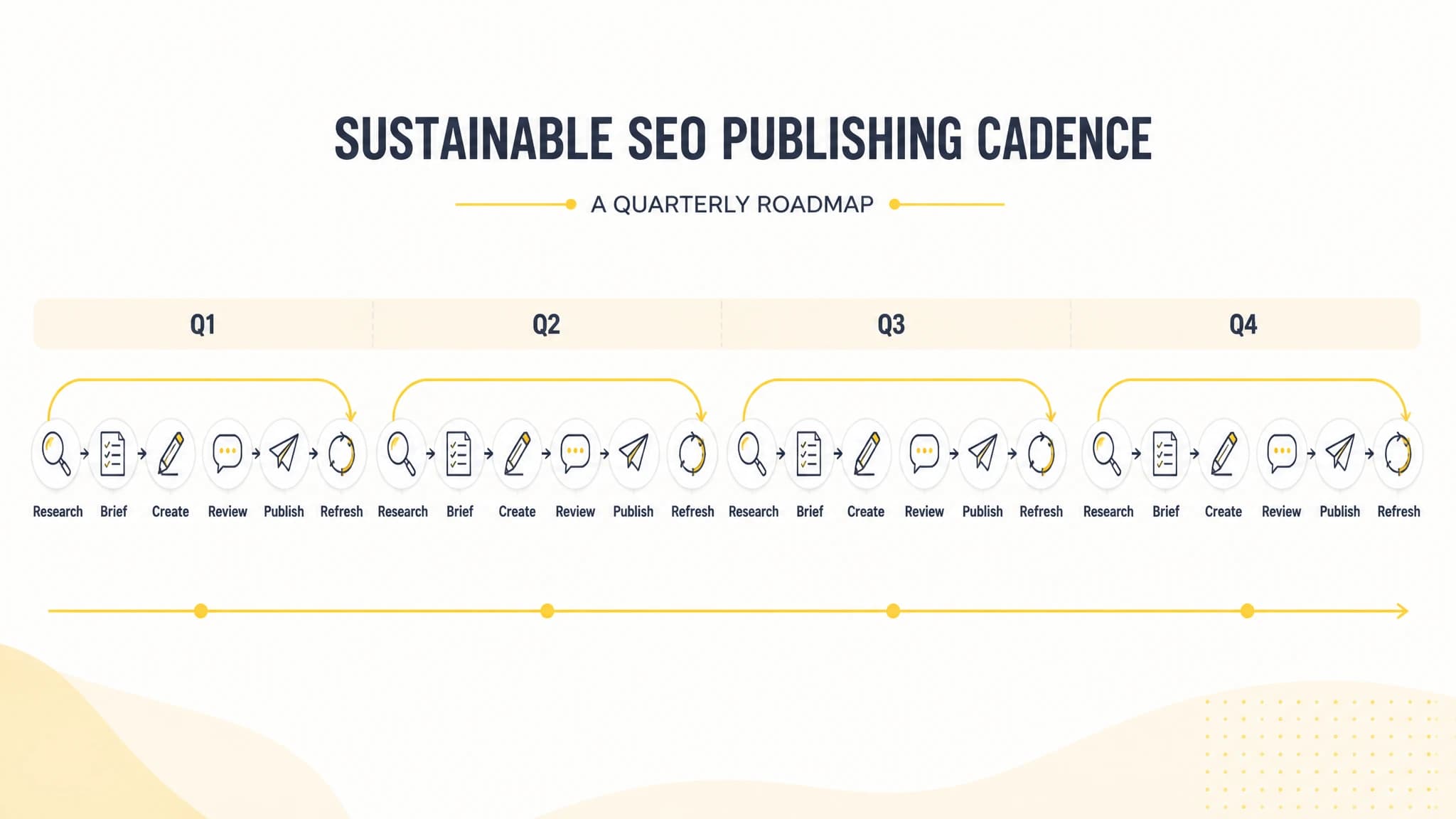
A repeatable cadence leaves room for production, review, and content updates.
Step 7: Turn the roadmap into repeatable production
A roadmap should reduce decision fatigue. Once priorities are approved, define the standard workflow for each article:
- Confirm the target keyword and intent.
- Review the cluster and internal-link plan.
- Create the brief and required outline.
- Draft the article.
- Review accuracy, usefulness, and originality.
- Add metadata, images, and links.
- Schedule or publish the article.
- Record the URL and update related pages.
- Review performance after an appropriate period.
This is where an AI content planner can help. Instead of starting with a blank document, you can use automation to organize keyword targets, suggest related content opportunities, and create a plan for review. Human judgment should still control the final topic, intent, claims, and editorial standard.
With RankWorker, we can support the planning workflow from keyword research and content opportunities through clustering, content planning, article generation, metadata, images, scheduling, and automated publishing. You can review and refine the plan before turning approved ideas into articles, which keeps automation connected to your strategy rather than treating content generation as an isolated step.
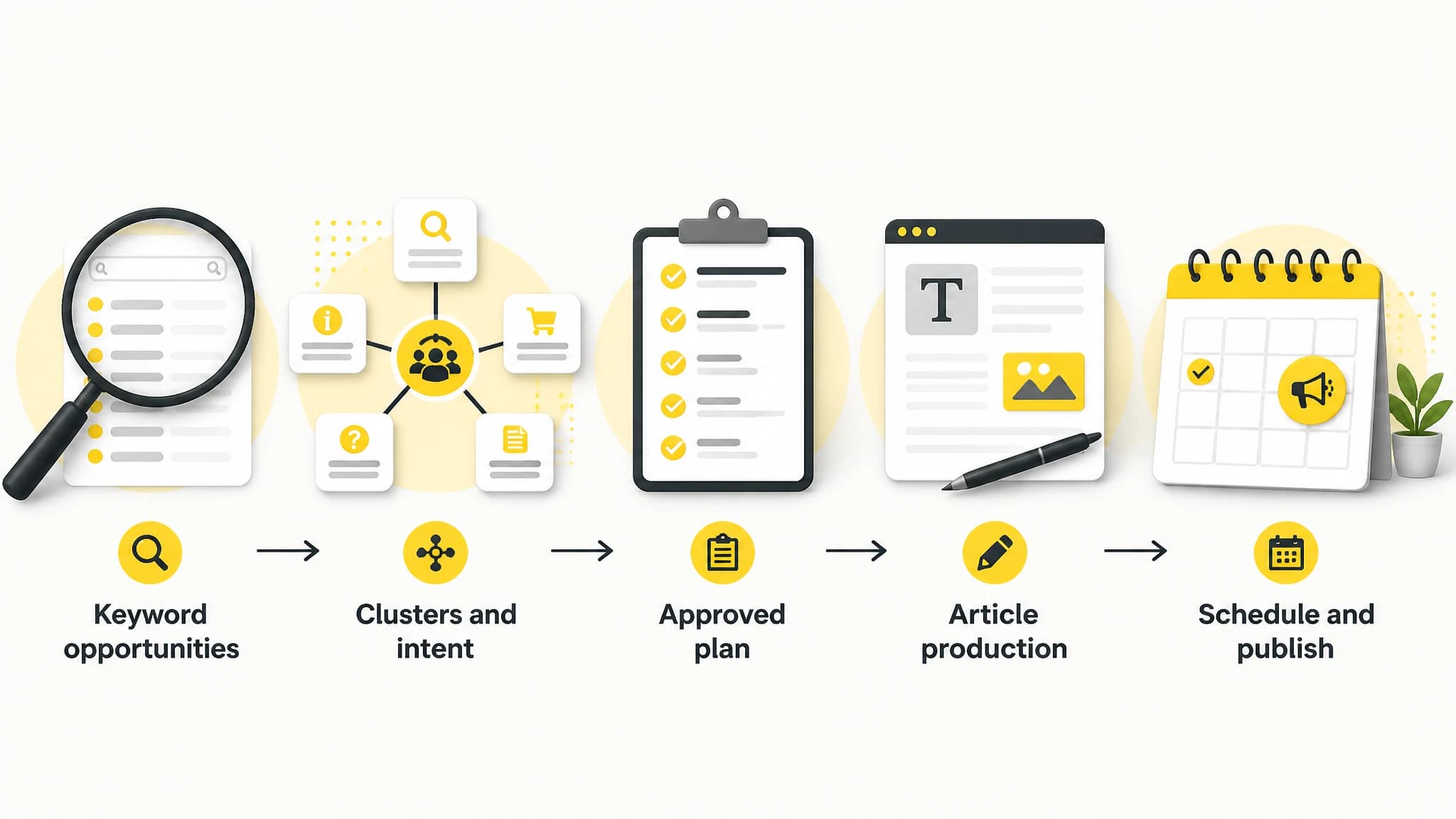
A repeatable workflow turns an approved roadmap into published content.
How to maintain your SEO content roadmap
A roadmap should change as you learn. Review it at least monthly and ask:
- Which topics are gaining impressions or clicks?
- Which pages are attracting the wrong audience?
- Are multiple articles competing for the same intent?
- Which clusters have gaps or weak internal links?
- Are business priorities or customer questions changing?
- Which published pages need a substantive refresh?
Do not update a page merely to change its publication date. Improve it by adding missing information, clarifying the answer, correcting outdated details, strengthening internal links, or making the content easier to use.
Also consider removing or merging content when several pages serve nearly identical purposes. A smaller set of well-connected, useful pages can be easier to maintain than a large collection of overlapping articles.
SEO content planner checklist
Before approving a topic, confirm that:
- The keyword is relevant to your audience and business.
- The topic has a clear primary intent.
- Related keywords have been grouped appropriately.
- The page has a defined role in a topic cluster.
- The priority reflects both value and production effort.
- Internal-link opportunities have been identified.
- The publishing date fits your actual capacity.
- The brief explains the reader’s desired outcome.
- The article has an owner for review and maintenance.
- The next step after publication is documented.
A good SEO content planner does not simply fill a calendar. It creates a system for making better publishing decisions repeatedly.
Conclusion
The strongest SEO content roadmaps begin with search opportunities but do not end with keywords. They connect topic selection, clustering, intent mapping, internal linking, publishing cadence, and ongoing maintenance.
Start with a manageable cluster, prioritize topics using clear criteria, and schedule only what your team can produce and review well. As the process becomes repeatable, automation can remove much of the operational work while your team remains responsible for strategic choices and quality.
With RankWorker, we help turn that process into a practical content workflow, from planning approved topics to generating, scheduling, and publishing SEO content. The result is a roadmap that is easier to execute and easier to improve over time.