

 Veselin Stoyanov13 min read
How to Find Content Gaps and Turn Them Into SEO Opportunities
Learn how to find content gaps, analyze competitors, match search intent, and prioritize SEO opportunities with a practical step-by-step process.

How to Find Content Gaps and Turn Them Into SEO Opportunities
If your website publishes consistently but organic growth has stalled, the problem may not be a lack of content. You may be missing important topics that your audience searches for and competitors already cover.
A content gap is a useful topic, question, format, or stage of the buyer journey that your website does not address well. Finding these gaps helps you replace random article ideas with focused SEO opportunities.
The most reliable process combines four reviews:
- Competitor coverage
- Search intent
- Topic completeness
- Existing-site performance and coverage
You can complete this work manually with spreadsheets and search results, or use content gap analysis software to speed up research and connect opportunities to a publishing plan. The important part is not simply finding more keywords. It is deciding which missing topics deserve your time first.
What Is a Content Gap?
A content gap exists when a searcher has a relevant question or need that your website does not satisfy sufficiently. The gap might be a completely missing article, an incomplete explanation, a weak page compared with competitors, or content that targets the wrong search intent.
Common examples include:
- A competitor ranks for beginner questions you have not covered.
- Your site explains a broad topic but misses important subtopics.
- You have informational articles but no content for comparison or purchase-related searches.
- Several pages target similar terms without clearly covering distinct intents.
- A page ranks for a keyword but does not answer the main question directly.
- Your content is outdated while competitors provide more current guidance.
Content gaps are not automatically opportunities. A topic should also be relevant to your audience, connected to your business, realistic for your site to compete for, and useful enough to justify creating or improving a page.
Step 1: Define the Scope of Your Analysis
Before comparing your site with competitors, decide what you are analyzing. A broad audit of an entire domain can produce an overwhelming list. A focused review usually creates better decisions.
Choose one of these scopes:
- A product or service category
- A customer segment
- A topic cluster
- A stage of the buying journey
- A specific competitor group
- A section of your website
For example, a website selling project management software might analyze content for startup teams rather than every project management keyword. That narrower scope makes it easier to identify meaningful gaps such as onboarding, templates, integrations, reporting, or team adoption.
Create a simple analysis brief with the following fields:
| Field | Example |
|---|---|
| Business area | Project management software |
| Audience | Startup operations teams |
| Main goal | Increase qualified product discovery |
| Topic scope | Planning, workflows, and team adoption |
| Priority conversion | Product demo or trial |
This prevents the research from turning into a generic list of high-volume keywords.
Step 2: Identify the Right Competitors
The best competitors for a content gap analysis are not always your direct business competitors. Search competitors are websites that consistently appear for the topics you want to own.
Look for three types:
- Direct competitors: Businesses selling a similar product or service.
- Editorial competitors: Publications, consultants, and specialist websites covering your subject.
- SERP competitors: Any domain that repeatedly ranks for your target topics.
Review the search results for your most important topic areas and record domains that appear frequently. Usually, a small comparison set is more useful than analyzing dozens of websites. Select competitors with a similar audience and content standard whenever possible.
Do not copy a competitor’s entire sitemap. Instead, look for recurring themes, page types, and questions that appear across multiple relevant sites. Repeated coverage is a stronger signal than one isolated article.
Step 3: Compare Competitor Coverage With Your Site
Now build a coverage table. For every important competitor topic, record whether your site has a page that addresses it and how well that page serves the searcher.
A practical table might include:
| Topic | Competitor coverage | Your coverage | Intent match | Opportunity |
|---|---|---|---|---|
| Workflow templates | Strong | Missing | Informational | Create |
| Tool comparison | Moderate | Thin | Commercial | Improve or create |
| Beginner guide | Strong | Present | Informational | Refresh |
| Implementation checklist | Moderate | Missing | Practical | Create |
Use simple labels such as missing, thin, covered, and strong. The goal is not to create a perfect scoring model. It is to make weaknesses visible and comparable.
A page should not count as fully covered just because it mentions a keyword. Ask whether it provides the same depth, clarity, examples, and practical value that a searcher expects from the current results.
For larger websites, an opportunity-finding workflow can make this comparison easier. With RankWorker, we can help identify content opportunities and connect them with content planning, clustering, and production steps instead of leaving research in a disconnected spreadsheet.
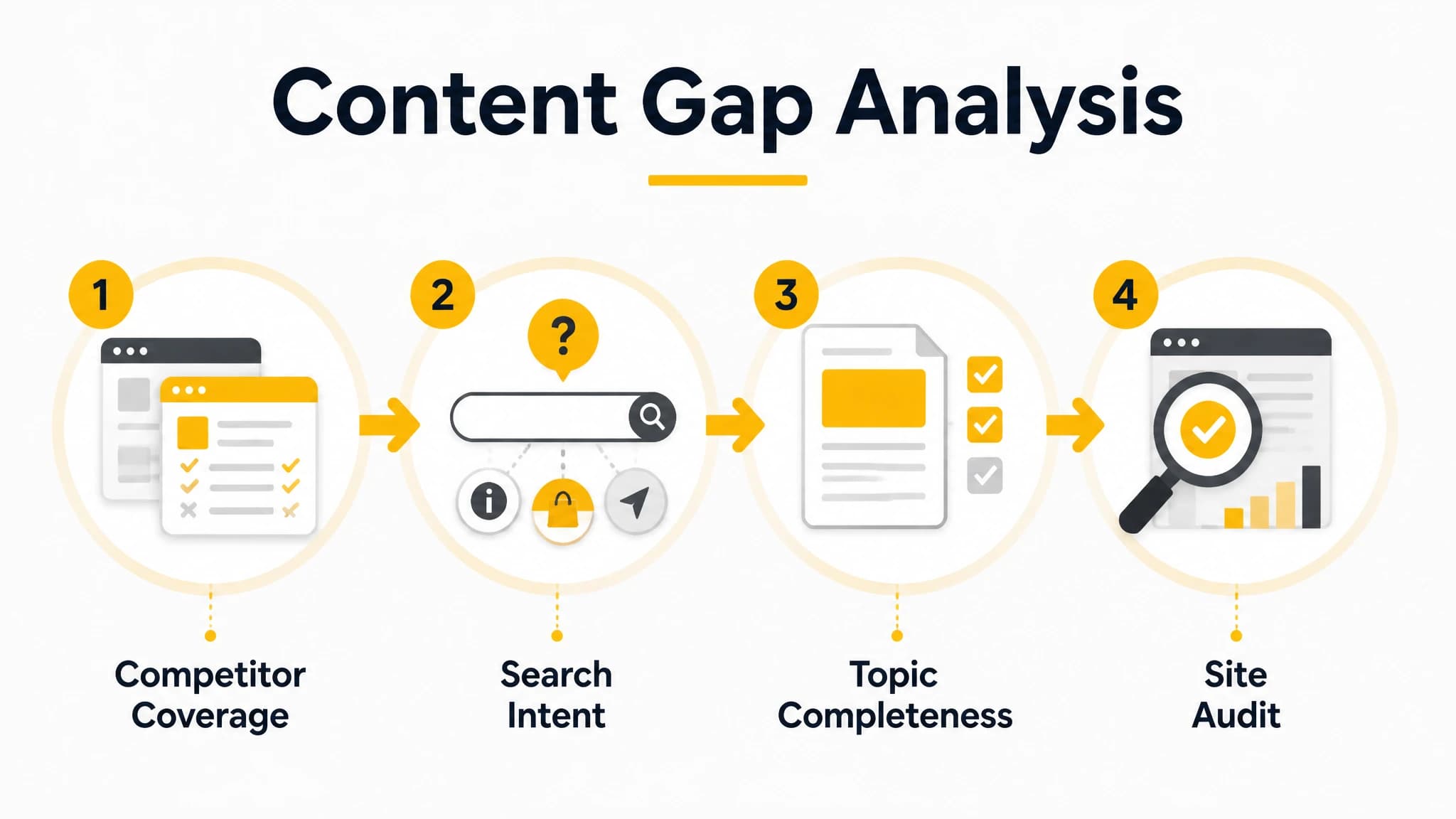
Review competitor coverage, search intent, topic completeness, and your existing site together.
Step 4: Analyze Search Intent, Not Just Keywords
A content gap often exists because a page targets a phrase without matching what the searcher wants. Search intent should therefore be part of every gap review.
The main intent categories are:
- Informational: The searcher wants to learn or solve a problem.
- Commercial: The searcher is evaluating options, tools, or approaches.
- Transactional: The searcher is ready to take an action, sign up, buy, or contact a provider.
- Navigational: The searcher is looking for a specific brand, page, or resource.
Search intent can also be more specific. A phrase such as "content gap analysis" may indicate a desire for a definition, a process, a tool, or a template. Look at the current search results to understand which interpretation Google is rewarding.
For each potential gap, record:
- The likely primary question
- The expected content format
- The reader’s level of knowledge
- The next action the reader may want to take
- Whether your existing page satisfies that need
For instance, a beginner guide should not be replaced with a product comparison simply because both pages include the same keyword. They may serve different readers at different stages.
Step 5: Check Topic Completeness and Topical Relationships
A website can have many articles about a subject and still leave important gaps. Topic completeness means covering the key concepts, subtopics, questions, and practical applications that help a reader understand the subject fully.
Start with a broad topic and break it into related groups. For example, a content planning cluster might include:
- Keyword research
- Search intent
- Topic clusters
- Content briefs
- Editorial calendars
- Internal linking
- Content production
- Publishing and measurement
Then identify the relationships between those topics. A page about keyword research may naturally lead to content planning. A guide about content briefs may support article production. These relationships help you decide whether a gap should become a standalone page, a section within an existing article, or an internal link between pages.
Avoid creating a new page for every variation of a phrase. If two keywords have the same intent, one stronger page may be better than multiple overlapping articles. Content gap analysis should improve your information architecture, not create keyword cannibalization.
Our SEO content planner explains how to turn keyword opportunities into a roadmap with topic clusters, intent, internal links, and publishing priorities.
Step 6: Audit Your Existing Site Before Creating New Pages
Competitor research shows what others cover. An existing-site review shows where your own content is underperforming or disconnected.
Review pages in the target topic area for:
- Organic impressions without meaningful clicks
- Rankings for related terms that are not addressed directly
- Declining traffic or outdated information
- Weak introductions that delay the answer
- Missing examples, comparisons, steps, or definitions
- Poor internal links from relevant pages
- Multiple pages competing for the same intent
- Titles and descriptions that do not explain the page’s value
Classify each finding into one of four actions:
- Create: No suitable page exists.
- Improve: A relevant page exists but is incomplete or weak.
- Merge: Multiple pages overlap and should become one stronger resource.
- Retire: The page has little value and should not remain part of the active strategy.
This step is important because refreshing an existing page can be more efficient than publishing a new one. A gap is sometimes a quality gap, not a URL gap.
Step 7: Turn Gaps Into Prioritized SEO Opportunities
Once you have a list of potential gaps, prioritize them instead of publishing in discovery order. A simple scoring model can help.
Score each opportunity from 1 to 5 for:
- Business relevance: How closely does it support your product, service, or audience?
- Audience value: How important is the problem to your ideal reader?
- Intent strength: Does the search indicate a meaningful need or buying stage?
- Coverage weakness: How poorly is the topic addressed on your site?
- Competitive feasibility: Can your site create a genuinely useful result?
- Production effort: How much research and work will it require?
You can calculate a practical priority score like this:
Priority = relevance + audience value + intent strength + coverage weakness + feasibility - production effort
The formula is not a universal SEO rule. It is a decision aid. Use it to make assumptions visible and start useful discussions with your team.
High-priority opportunities usually have a strong connection to your audience, a clear search need, a real weakness in your current site, and a reasonable path to producing a better result.
Step 8: Build a Brief for Each Selected Opportunity
A gap becomes actionable when it has a clear brief. Each brief should define:
- Primary keyword and related terms
- Target search intent
- Intended reader
- Recommended content type
- Questions the page must answer
- Competing page patterns to improve on
- Internal links to add
- Conversion goal or next step
- Refresh criteria and review date
Do not treat competitor pages as templates to rewrite. Use them to understand expectations, then add original structure, examples, expertise, and practical guidance for your audience.
This is where a repeatable content workflow saves time. With RankWorker, we can connect opportunity finding with keyword planning, content clustering, article planning, metadata, images, scheduling, and publishing. That makes it easier to move from a research insight to a finished page without manually rebuilding the process every time.
Common Content Gap Analysis Mistakes
Treating competitor keywords as a publishing queue
A competitor ranking for a keyword does not automatically make it relevant to your business. Confirm audience fit, intent, business value, and your ability to create a better resource.
Measuring gaps by search volume alone
High-volume topics may be broad, competitive, or weakly connected to your goals. A smaller topic with strong relevance and clear intent can be more valuable.
Ignoring existing content
Publishing a new article while an older page already targets the same need can split authority and create confusion. Audit, improve, merge, or redirect before expanding the site.
Copying the competitor’s format
Search results can reveal common expectations, but your article still needs a distinct point of view and useful details. Coverage parity is a starting point, not the finish line.
Failing to connect pages internally
A new article should have a role in your broader topic structure. Add links from relevant existing pages and link back to useful supporting resources where appropriate.
Stopping after publication
Content gaps change as competitors publish, search behavior shifts, and your business develops new priorities. Revisit important topic groups regularly and track whether new pages improve coverage and visibility.
A Practical Content Gap Workflow
For most websites, the process can be summarized as follows:
- Choose a focused topic or business area.
- Identify direct, editorial, and search competitors.
- Collect recurring topics and page types from relevant results.
- Compare competitor coverage with your existing pages.
- Classify search intent for every potential gap.
- Check whether the gap is missing, thin, outdated, overlapping, or poorly connected.
- Score opportunities by relevance, value, feasibility, and effort.
- Decide whether to create, improve, merge, or retire content.
- Build a brief with keywords, questions, links, and a conversion goal.
- Schedule production, publishing, and future review.
For a repeatable system, content planning guidance can help you connect research with briefs, publishing statuses, and execution. You can also explore our SEO strategy resources when you need to connect individual content opportunities to a wider organic growth plan.
Final Takeaway
Learning how to find content gaps is not about producing the longest list of competitor keywords. It is about discovering where your audience has an unmet need, checking whether your site addresses it, and deciding the most useful next action.
Start with a focused topic. Compare meaningful competitors. Evaluate search intent and topic completeness. Audit your existing pages before creating new ones. Then prioritize opportunities based on business relevance, reader value, feasibility, and effort.
When this process is connected to planning and production, content gap analysis becomes more than research. It becomes a practical system for building a clearer, more complete, and more useful website.