

 Veselin Stoyanov12 min read
How to Find Low Competition Keywords (That Still Bring Real Traffic)
Find low competition keywords with a repeatable research process. Learn to check relevance, search results, and demand before choosing what to target.

Finding low competition keywords means looking for relevant searches where your site has a realistic chance to create a useful result. A low difficulty score can help you build a shortlist, but it does not guarantee rankings or traffic. Validate each idea by checking its business value, search intent, existing search results, and your ability to make a better page.
Use this repeatable process: build a seed list, expand it with modifiers and questions, look for opportunities in your own Search Console data, inspect smaller competitors, and assess the live search results before deciding what to publish.
1. Start with topics that matter to your business
Begin with a short list of subjects connected to what your business actually does. Include the problems your product or service solves, the tasks customers need to complete, and the decisions they face before choosing an option.
For each seed topic, ask:
- Would a person searching this term plausibly need what we provide?
- Can our site answer the query with a useful page, not just mention the phrase?
- What would the reader likely want to do next?
This relevance check prevents a common mistake: targeting an easy phrase simply because it looks attainable. A keyword with little competition is not valuable if its searchers are unlikely to become readers, leads, or customers.
Make a simple spreadsheet with columns for the phrase, likely intent, audience fit, and possible page idea. Keep the first list manageable. A focused set of relevant seeds is more useful than a long list of unrelated terms.
2. Expand seeds with specific modifiers
Turn each seed into variations that express a narrower need. Modifiers often reveal more specific searches, but they do not automatically make a keyword low competition. Use them to discover ideas, then validate each one.
Try modifiers such as:
- Audience: for freelancers, for small teams, for beginners
- Situation: for a new website, after a migration, on a budget
- Task: how to choose, how to compare, how to fix
- Format: checklist, template, examples, guide
- Constraint: without a developer, for a small team, in one day
For example, a project-management consultant might start with “project planning” and explore “project planning for small teams” or “weekly project planning checklist.” Those phrases suggest more specific needs than the broad seed. They are only candidates: check what searchers mean and what pages already rank before writing.
Long-tail keywords can be useful because they often describe a more precise question or situation. However, a longer query is not automatically easy to rank for or likely to bring meaningful traffic. Treat specificity as a clue about intent, not proof of opportunity.
3. Mine questions and related searches
Look for the language people use when they are trying to understand, compare, or solve the problem. Explore question formats such as “how,” “why,” “when,” “which,” and “what is.” Collect related phrases from keyword research tools, customer conversations, support requests, sales calls, and relevant search suggestions.
Group similar phrases by the job the searcher wants done. For instance, “how to plan weekly projects” and “weekly project planning template” might point to one related need, or to separate pages if the search results show different intent. Do not create one page for every wording variation. First decide whether the phrases deserve separate answers.
When comparing possible topics, look at the pages Google shows for each query. If the results are largely the same, a single strong page may be able to serve several close variations. If the results differ substantially, the queries may call for different content.
4. Find page-two opportunities in Search Console
If your site already has search impressions, Google Search Console can reveal queries where your pages appear but may not yet be earning many clicks. Open the Performance report, choose the Queries dimension, and review impressions, clicks, click-through rate, and average position. Search Console groups the report by queries people used when your site appeared in Google Search. (support.google.com)
Look for relevant queries where a page is getting impressions but its average position is beyond the first page or otherwise weaker than you want. Treat average position as a trend, not a fixed rank: it averages appearances across searches and can vary by query and context. Check the query’s matching page as well, so you know whether the right page is appearing.
For each promising query:
- Confirm that the search fits your business and audience.
- Open the page receiving impressions and check whether it answers the query clearly.
- Compare the page with the current results. Is there a missing explanation, example, or useful next step?
- Decide whether to improve that page or create a distinct page for a genuinely different intent.
Existing impressions can be a useful clue that Google already connects your site with a subject. They are not a promise of future traffic, and the report may not show every query. Use the data as a starting point for investigation rather than a complete keyword list.
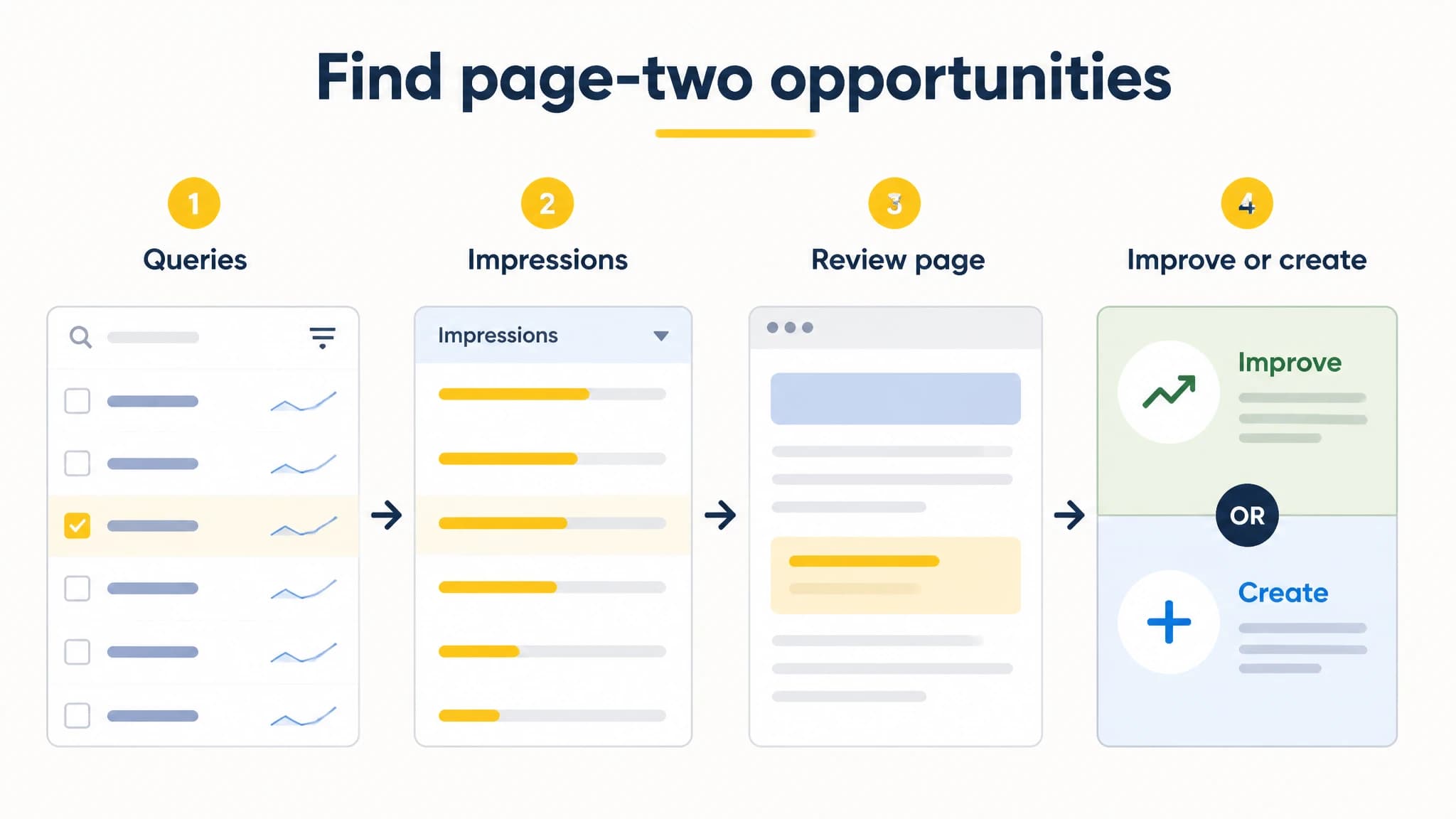
Use query impressions as a starting point, then check the matching page and search intent.
5. Look for gaps on smaller competitor sites
Competitors can help you discover topics your audience searches for. Start with businesses that serve a similar audience or solve related problems, especially smaller sites whose content and resources are closer to yours. A major publisher’s broad rankings may be less useful as a model for a small or specialized website.
Review the topics and pages competitors publish, then ask:
- Is the topic directly relevant to our audience?
- Does the competitor page answer a question we can answer more specifically or practically?
- Is the page focused on the same search intent we want to serve?
- Can we bring experience, examples, or details that make our page genuinely useful?
Competitor research is a source of leads, not a copying plan. Their traffic estimates and keyword lists may be directional, and their results do not prove your site can rank. For a deeper discovery workflow, see our guide to competitor keyword research.
6. Check the search results before choosing a keyword
A difficulty score is a screening signal. The search results are where you assess whether the opportunity looks plausible for your site. Search the exact phrase and inspect the pages that appear. Search results can change, so review them close to the time you plan the content.
Look for signs that the results may leave room for a useful new page:
- Intent mismatch: top pages do not seem to answer the query as directly as they could.
- Weak fit: some ranking pages are about a different audience, situation, or task.
- Thin answers: results lack practical detail, examples, or clear steps that the query calls for.
- Small or specialized sites: relevant pages from sites closer to your scale or focus suggest you should investigate further, not assume a win.
- A clear content gap: searchers appear to need an angle or detail that existing pages do not cover well.
Also notice whether the results are dominated by established, authoritative pages that fully meet the searcher’s need. That can be a reason to wait, choose a narrower query, or skip the topic. No single SERP signal proves a keyword is easy. Consider the full result set and whether you can create a page that is a stronger fit for the intent.
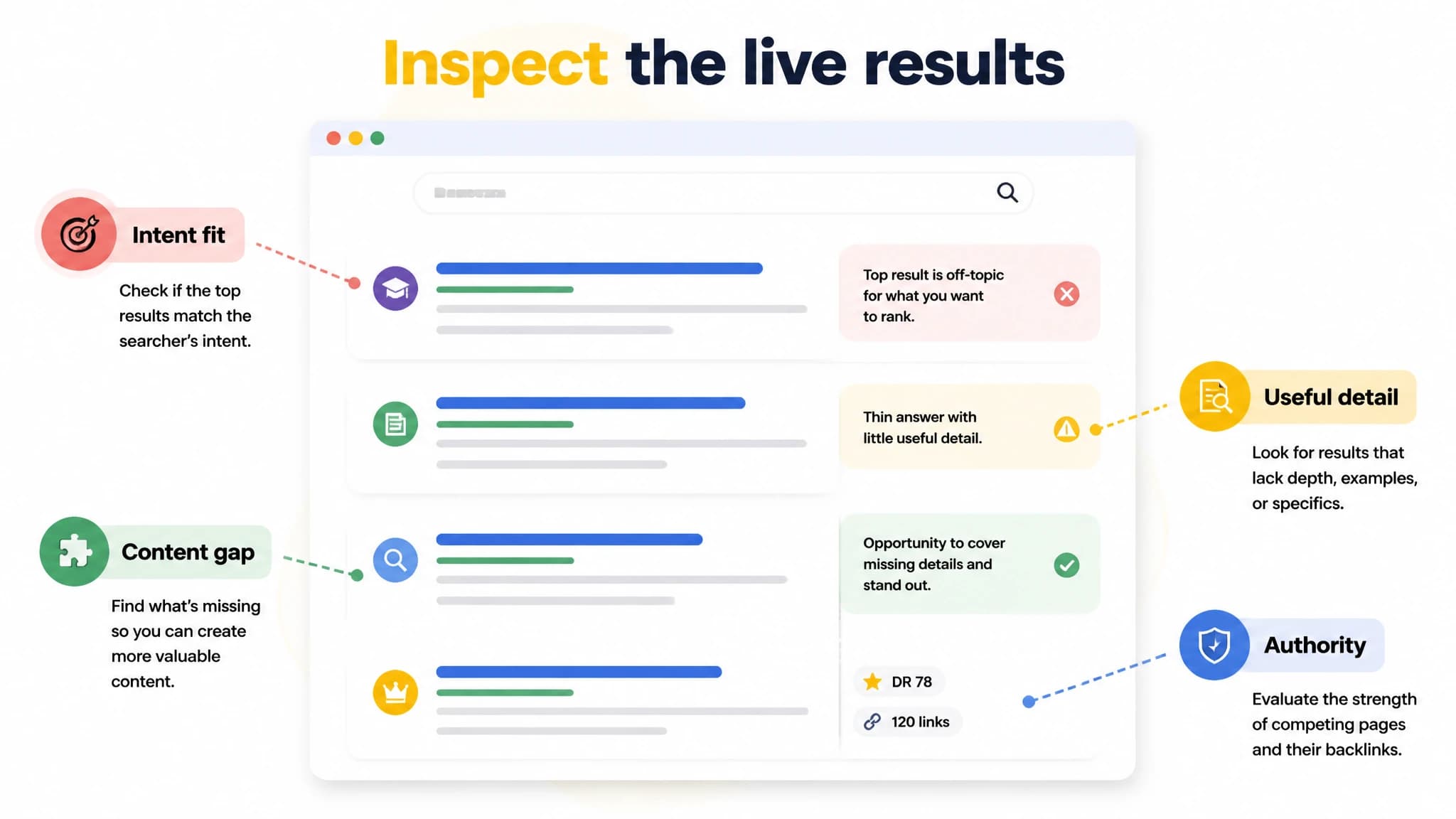
Search result patterns are clues to investigate, not guarantees of ranking ease.
For a more structured way to weigh difficulty, intent, and the ranking pages, use our keyword competition analysis guide. It can help you decide whether to pursue a topic, revisit it later, or leave it off your plan.
7. Filter by business value before prioritizing
Before you add a candidate to your content plan, score its relevance separately from its competition. A basic review can use three questions:
| Check | What to ask |
|---|---|
| Audience fit | Is this a real question or problem for the people we want to reach? |
| Business relevance | Is there a natural connection between a useful answer and our offering? |
| Page potential | Can we create a thorough, distinctive answer that matches the intent? |
You can mark each check as strong, possible, or weak. A keyword that looks easy but scores weakly on relevance should usually be removed. A somewhat harder query with clear audience and business fit may deserve more attention, especially if you can make a notably helpful page.
Next, group overlapping keywords by intent and choose one primary topic for each planned page. Add close variations as supporting language where they belong naturally. This helps keep your site from producing several thin pages that compete to answer the same question.
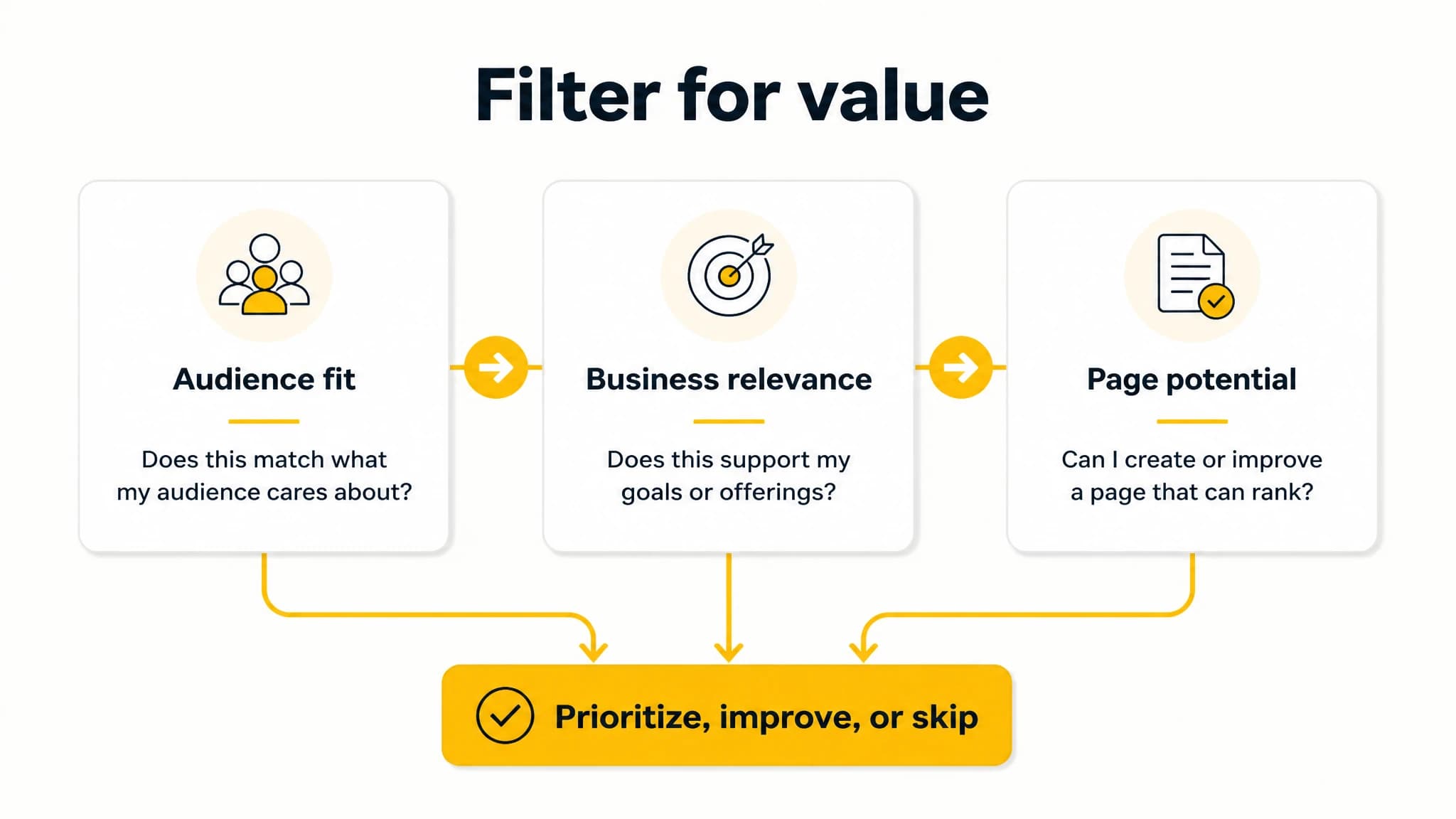
Prioritize keyword ideas that fit your audience and that you can answer well.
Short example: from seed to decision
Imagine a small bookkeeping consultancy that wants to attract owners of growing businesses. It starts with the seed “cash flow forecast.” The team adds modifiers and finds candidate phrases such as “cash flow forecast for a small business” and “monthly cash flow forecast template.”
It checks Search Console and finds that an existing article receives impressions for a related question but sits beyond the first page on average. The team reviews the page and the current search results, then sees that searchers seem to want a practical forecasting process rather than a general definition. It also checks smaller bookkeeping and business-advice sites for related topics.
The team does not choose a phrase just because a tool gives it a low difficulty score. It confirms the topic fits its clients, checks whether the results show room for a clearer process, and decides whether updating the existing article is more appropriate than creating another page. If the query instead asked for a downloadable template and the results consistently showed template pages, it would consider whether it could provide that resource before targeting the phrase.
The takeaway: let relevance and the actual search results guide the content decision. Difficulty can help narrow the list, but it cannot replace judgment about value and fit.
Make keyword research repeatable
A useful keyword process is not a one-time hunt for easy phrases. Revisit the list as your site earns impressions, your audience’s needs become clearer, and the search results change. Keep a record of why you chose a topic, what page should answer it, and whether the next step is to publish, improve, wait, or skip.
With RankWorker, we can help organize keyword research and content opportunities into a more repeatable workflow, so you can move from discovering terms to deciding which ones belong in your content plan. Our keyword research workflow supports researching and prioritizing opportunities; review each suggestion against your audience, business goals, and the live SERP before committing to a page.
A quick checklist before you publish
For every target keyword, confirm that you can answer yes to these questions:
- Is the search closely connected to our audience and business?
- Do we understand the intent behind the query?
- Have we checked the pages currently ranking, not just a difficulty score?
- Can our page offer a useful, specific answer?
- Have we checked whether an existing page should be improved instead?
- Does the topic belong in our content plan alongside the other pages we need?
If a candidate passes these checks, it may be worth prioritizing even when it is not the lowest-difficulty option on the list. The goal is not to collect easy keywords. It is to find relevant searches where you can publish a strong answer and earn the right kind of visibility.