

 Veselin Stoyanov11 min read
Keyword Competition Analysis: Can You Rank?
Learn how to assess keyword competition by checking difficulty, search intent, and the top 10 results, then decide whether to go, wait, or skip.

A keyword difficulty score can help you shortlist topics, but it cannot tell you by itself whether your site can rank. For useful keyword competition analysis, treat the score as a clue, then inspect the current search results: the pages already ranking can show what searchers want, what competitors provide, and where a strong page may have room to compete.
Use this process to decide whether to go, not yet, or skip a keyword. It works for a founder choosing the next article just as well as for a site building a larger content plan.
What keyword competition analysis should tell you
The goal is not to predict an exact ranking position. Search results change, tools estimate competition differently, and your page is only one part of the picture. Instead, answer three practical questions:
- Is this query relevant to the people and business we serve?
- Can our page satisfy the intent behind the search better or more clearly than the current results?
- Do we have a plausible path to visibility given the pages and sites already ranking?
If the answer to the first question is no, a low difficulty score does not make the keyword valuable. If the answer to the second is no, a high business fit does not justify publishing a page that adds little to what already exists. A useful decision balances relevance, page quality, and competition.
Step 1: Treat keyword difficulty as a screening signal
Keyword difficulty is a tool estimate, not a promise about how hard a specific page will be to rank. Different tools may use different data and methods, so scores are best compared within the same tool rather than treated as universal measurements.
Use the score to sort a list into rough groups: potentially approachable, uncertain, and likely demanding. Then verify those groups in the search results. A high score may still hide a reachable opening if the results poorly match the query. A low score may be misleading if the keyword is a bad fit for your business or the ranking pages are unusually strong.
Before deciding, check the score's scale and meaning in the tool you use. Ask what signals it reflects, how recent the data is, and whether it is an estimate of the keyword generally or tied to the pages competing for it. Don't compare scores from different tools as if they were measured the same way.
Step 2: Inspect the top 10 search results
Search the exact keyword in the target location and language, ideally in a private or logged-out browser. Search results can vary by user and place, so use this as a practical snapshot rather than a permanent verdict. Record the top 10 organic results and inspect the pages themselves, not just their titles.
A simple spreadsheet can include: rank, domain, page type, format, publication or update date, intent match, and a note about a strength or weakness. The aim is to see patterns across the page one results, not to score every result with false precision.
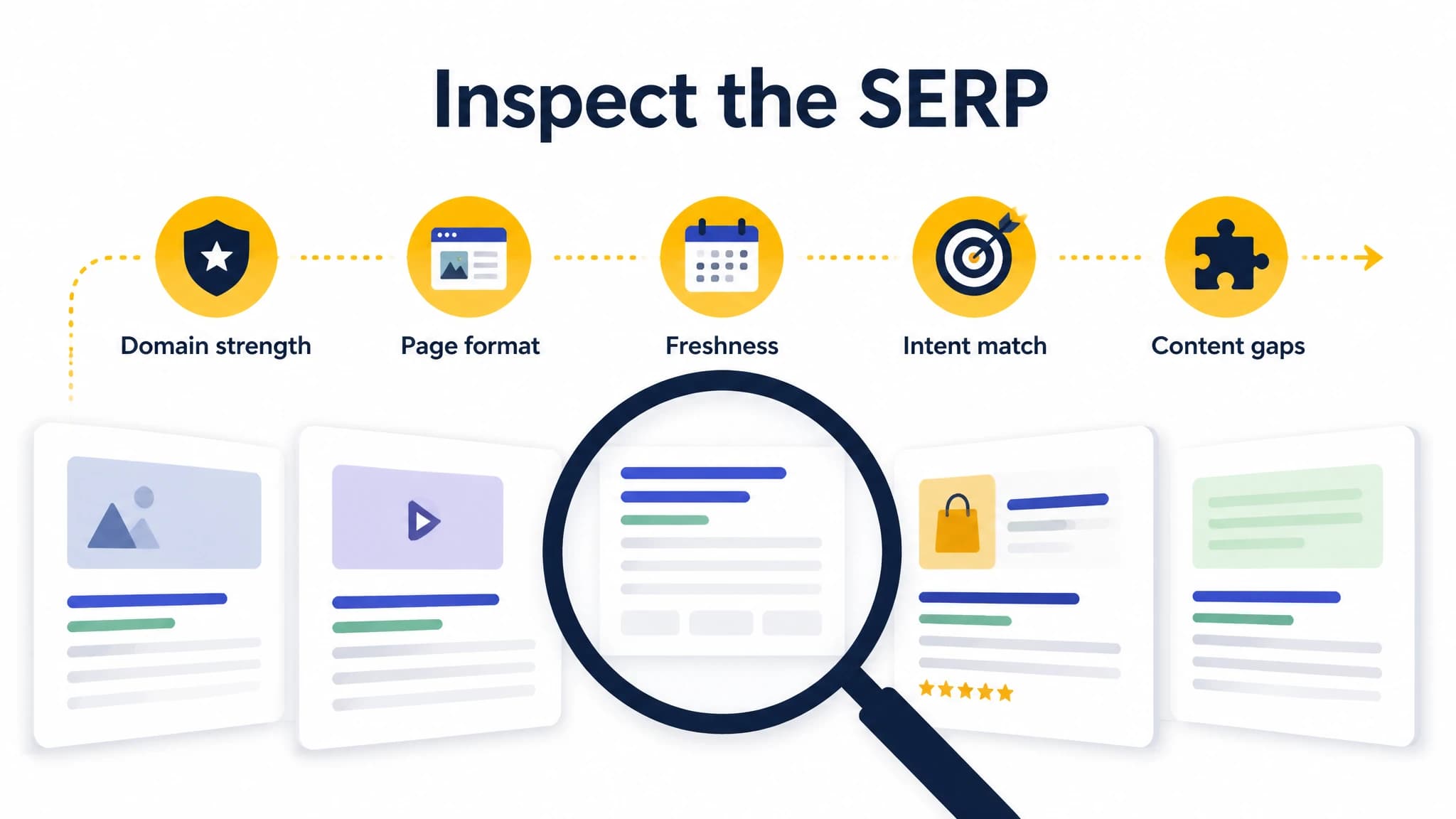
Review result patterns across strength, format, freshness, intent, and gaps.
1. Domain strength
Look at who is ranking. Are the results mostly established brands, specialist sites, government or educational resources, or smaller businesses? Consider whether these sites have a clear subject focus and whether their ranking pages are directly relevant to the query.
Domain-level authority metrics from SEO tools can help with comparison, but they are not search engine scores. Don't assume that a smaller site cannot compete, or that a familiar brand makes every one of its pages unbeatable. Compare the specific page as well as the broader site: relevance, usefulness, and fit matter to your evaluation.
For a deeper process for finding and checking competing pages and keywords, see our guide to competitor keyword research.
2. Content type and format
Notice what kind of pages appear: detailed guides, product or service pages, category pages, comparison roundups, videos, tools, or discussion threads. If most results are product pages, a general educational article may not match what searchers expect. If results are mostly how-to guides, a sales page may be a poor fit.
Also note repeated formats. If the top results all answer with step-by-step instructions or side-by-side comparisons, that is a clue about the format a useful competing page may need. It is not a requirement to copy them. Look for a way to meet the same need with clearer explanations, stronger examples, or information specific to your audience.
3. Freshness
Check whether freshness appears important for the topic. Look for visible publication or update dates, references to changing products or rules, and whether older pages still answer the query. A recent date alone does not prove a page is better; the important question is whether the content is current enough to be useful.
If the results are regularly updated, consider whether you can maintain your own page. If you cannot, the keyword may be a poor fit for a topic that depends on frequent changes. For a stable, evergreen question, an old but thorough page may still be a strong competitor.
4. Intent match
Summarize the likely search intent in one sentence: “The searcher wants to…” Then check whether the top results fulfill that purpose. Look for the information, comparison, solution, or next step the pages consistently provide.
A mismatch can create an opening, but only if you can serve the intent more completely. Google's guidance is to create helpful, people-first content that meets readers' needs, rather than pages made primarily to attract search traffic. Use its people-first content guidance as a quality check when assessing your proposed page.
5. Weakness signals
Look for gaps you can genuinely address, rather than flaws you can merely point out. Possible signals include thin pages with little explanation, outdated details, vague answers, confusing organization, or results that only partly answer the query. Forums and user-generated pages can also appear among the results. Their presence may suggest that searchers want real-world experience or answers to specific questions, but it does not automatically mean a simple article can replace them.
Ask what a stronger page would add. Could you include a useful decision framework, original examples, clear comparisons, or practical instructions? If you cannot name a meaningful improvement, don't label a result weak just because it is short or written in a different style.
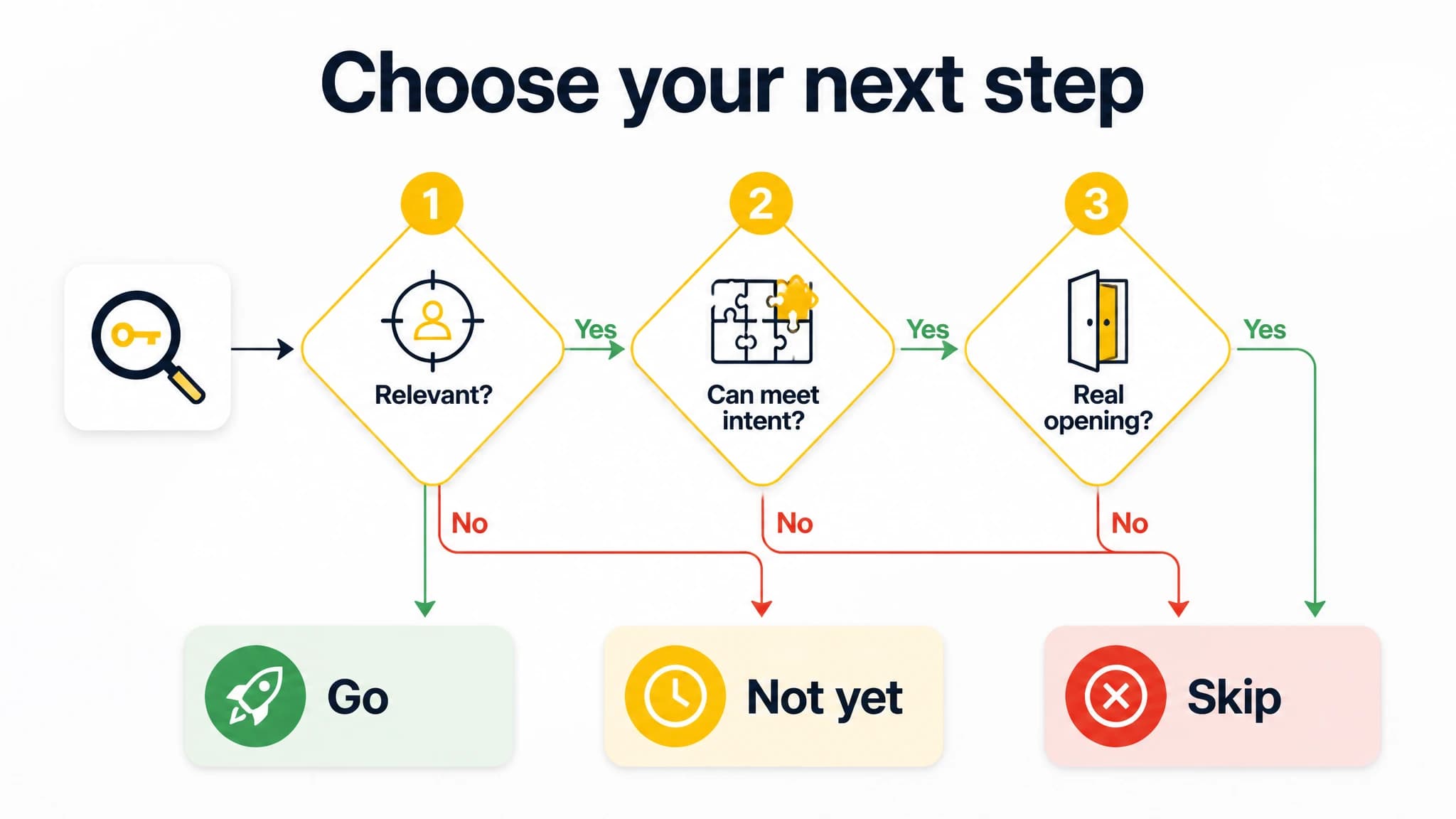
Use relevance, intent fit, and a credible opening to guide the decision.
Step 3: Turn your observations into a decision
After reviewing the results, rate each factor as strong, mixed, or weak. A simple qualitative rating is often more useful than adding arbitrary numbers to observations you cannot measure consistently.
| Factor | What to check |
|---|---|
| Business relevance | Would the intended reader plausibly need what we offer? |
| Intent match | Can we create the type of page that serves the search? |
| Competition | Do the ranking pages look established, relevant, and well matched? |
| Opening | Is there a real gap our page could fill? |
| Execution | Can we make and maintain a page that meets the need? |
Use the pattern to choose:
- Go: The topic fits your audience, you can meet the intent, and you can describe a credible improvement or distinct contribution. Competition may be present, but there is a reason to believe your page could earn consideration.
- Not yet: The topic is relevant, but the site or page is not ready. You may need a stronger supporting content base, more expertise, a better page format, or a way to keep information current. Save the keyword and define what must change before revisiting it.
- Skip: The query does not fit your business, the intent is outside your capabilities, or the results leave no meaningful opening you can serve. Spend the effort elsewhere.
This decision is more useful than choosing a keyword because its score looks attractive. It also gives you a concrete reason to prioritize one topic over another. For another way to find and evaluate competing pages, our SEO competitor audit walks through a broader review.
Worked example: a hypothetical keyword review
Suppose a small business serving independent therapists is considering “appointment scheduling software for solo therapists.” This is an illustrative example, not a report of current search results. The first check is business relevance: if the business genuinely serves this audience, the query may be a fit. If it does not, even a favorable difficulty estimate would not make it a priority.
Next, search the phrase and inspect the top 10. Imagine that the results include software pages, comparison articles, and a few discussion threads. That mix suggests the searcher may want both product options and practical guidance. The business should not assume that publishing a generic “what is scheduling software?” article will meet that need.
Now inspect page quality and fit. Are the comparison pages actually tailored to solo therapists, or do they address larger clinics? Do the software pages explain the features and trade-offs relevant to a solo practice? Are discussion threads raising recurring questions the other pages leave unanswered? These are questions to test against the live results, not facts to assume in advance.
If the business can build a useful, accurate page that helps this audience compare options and addresses a clear gap, the verdict could be go. If the results are strong but the business lacks the expertise or information to create a better resource, choose not yet and identify what is missing. If the searcher wants solutions unrelated to what the business serves, skip it.
The point is not that this keyword is easy or difficult. The point is that the decision comes from the live SERP, the site's relevance, and the page you can actually produce.
Make keyword decisions repeatable
Write down the keyword, date checked, location, difficulty estimate and tool, top-result patterns, and your go / not yet / skip decision. Add a short reason for the decision and, for “not yet,” a review condition. This record helps you avoid repeating the same analysis and makes it easier to compare opportunities consistently.
With RankWorker, our keyword research and content opportunities workflow helps bring search volume, difficulty, and business relevance together in an opportunity score. Use that score to prioritize faster, then validate promising terms against the search results and your ability to make a useful page. Our keyword research workflow can help organize that step before you plan content.
No score replaces judgment. The best keyword to pursue is not necessarily the one with the lowest difficulty or the highest volume. It is one that fits your business, has an intent you can serve, and gives you a credible way to create a page that deserves attention.