

 Veselin Stoyanov11 min read
Organic Traffic Tools: How to Choose One for a Sustainable Content Workflow
Compare organic traffic tools by research, planning, publishing, and measurement. Use this practical framework to build a workflow your team can sustain.

Organic Traffic Tools: How to Choose One for a Sustainable Content Workflow
An organic traffic tool can help you find search topics, plan useful content, publish consistently, or measure results. The right choice depends on which part of that process needs help - and whether the tools you choose work together as a repeatable system.
Start by mapping your workflow, not by collecting features. A small team may need one place to move from keyword research to a reviewed, published article. Another may already have a smooth publishing process and need better measurement. No tool guarantees traffic, so choose tools that make good decisions and consistent execution easier.
What an organic traffic tool should help you do
“Organic traffic tools” is a broad category. It can include keyword research platforms, content planners, writing tools, publishing systems, analytics products, and technical SEO tools. They solve different problems, so a long feature list is not a useful buying checklist on its own.
A practical content workflow has four connected stages:
- Research: Find potential search topics and learn what people want from a result.
- Planning: Choose priorities, group related topics, and assign each page a clear purpose.
- Production and publishing: Create, review, optimize, and publish content using a process your team can maintain.
- Measurement: Check what happened after publication and decide what to improve next.
The gap between stages matters. A keyword spreadsheet that never becomes an editorial plan is not a complete workflow. Neither is a publishing calendar that has no way to check whether pages are reaching the right audience.
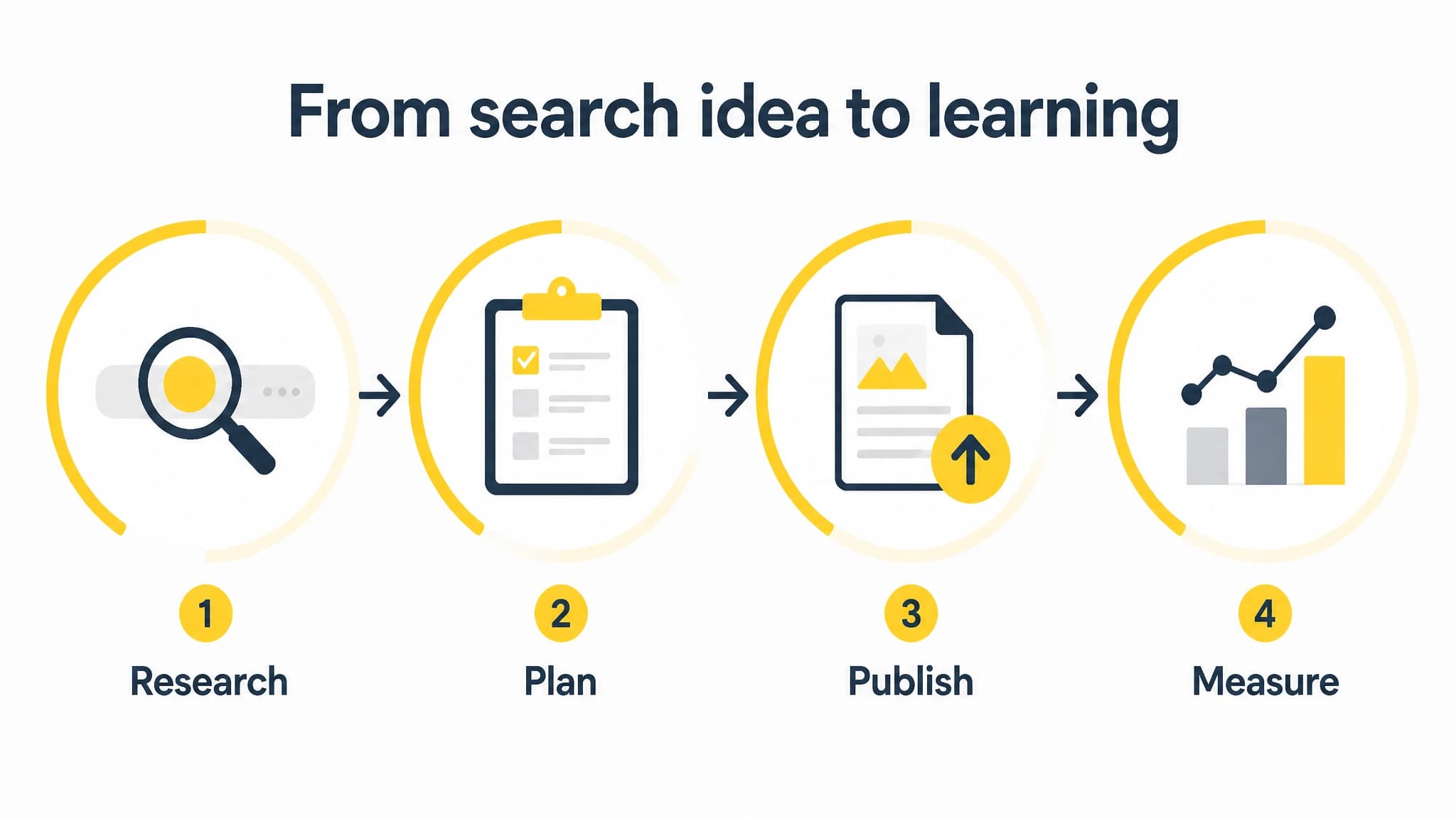
Evaluate tools by the workflow stages they support.
Choose tools by the bottleneck, not the trend
Before comparing products, write down the task that currently slows you down. Be specific: “We have topic ideas but no way to prioritize them” is more useful than “We need better SEO.” Then check whether the issue happens once, occasionally, or repeatedly.
| If your bottleneck is… | Look for a tool that helps with… | Check before choosing |
|---|---|---|
| Finding worthwhile topics | Keyword research and opportunity discovery | Can you judge relevance, intent, and fit for your business? |
| Turning ideas into a plan | Clustering, prioritization, and content planning | Can the plan show what to publish next and why? |
| Producing articles consistently | Briefs, drafting, review, metadata, and scheduling | Can your team review the output and keep its own quality standards? |
| Getting content onto your site | Publishing connections or a clear handoff | Does it fit your existing website and approval process? |
| Understanding outcomes | Analytics and search performance reports | Can you separate discovery, clicks, engagement, and business outcomes? |
A focused tool may be the better option if one stage is your only problem. A connected platform can make more sense when the work repeatedly gets lost between research, planning, and publishing. Be cautious about paying for overlapping features you will not use or selecting a tool just because it promises automation.
If you are deciding what belongs in the workflow first, our guide to growing organic traffic covers the broader system behind consistent search-focused publishing.
Use a simple scorecard to compare options
Score each candidate from 1 to 5 on the criteria below. A high score should reflect how well the tool fits your real workflow, not how many features appear on its website.
- Workflow fit: Does it solve the bottleneck you identified?
- Decision support: Does it help you evaluate topics, intent, or priorities instead of only generating more ideas?
- Handoffs: Can work move from research to planning and publishing without avoidable copying or reformatting?
- Editorial control: Can a person review and correct content before it goes live?
- Measurement fit: Does it provide the outcome data you need, or will a separate analytics tool remain necessary?
- Adoption effort: Can the people responsible for publishing use it without adding more process than it removes?
- Cost and overlap: Does the expected time saved justify the expense and any duplicate subscriptions?
Write one sentence explaining each score. That makes trade-offs visible and helps prevent a polished demo from outweighing everyday usability. If two tools score similarly, test them against the same small workflow rather than comparing hypothetical feature lists.
Follow one keyword from idea to measurement
Imagine a small business that sells bookkeeping services to independent contractors. A researcher finds the phrase “bookkeeping checklist for freelancers.” The phrase is only a lead; before assigning it to an article, the team checks whether it fits its audience, what searchers likely need, whether the site already has a relevant page, and whether it can offer a useful answer.
Here is a practical path:
- Discover: Collect the phrase and related queries with a keyword research tool. Treat volume or difficulty estimates as clues, not a guarantee of demand or ranking potential.
- Validate: Review the likely search intent and current results. Decide whether the reader needs a checklist, a service page, or another format. Reject the topic if it is not relevant to the business.
- Assign: Give the topic one primary page and group closely related questions when they support the same reader goal. Avoid creating several pages that compete to answer the same need.
- Brief: Specify the intended reader, the answer the article must deliver, key sections, useful examples, and the next step that makes sense for that reader.
- Create and review: Draft the article, check the facts and usefulness, edit for the business’s voice, and add relevant metadata and links. Automation can speed up production, but a review step still protects quality and accuracy.
- Publish: Schedule or publish through the team’s normal process. Confirm the page is live and accessible, then record its URL and publication date.
- Measure and improve: After an appropriate period, review search visibility, clicks, and the page’s contribution to business goals. Update, expand, or leave the page alone based on what the evidence suggests.
For the research stage, our overview of automated keyword research explains how to evaluate opportunities without treating software estimates as a final decision.
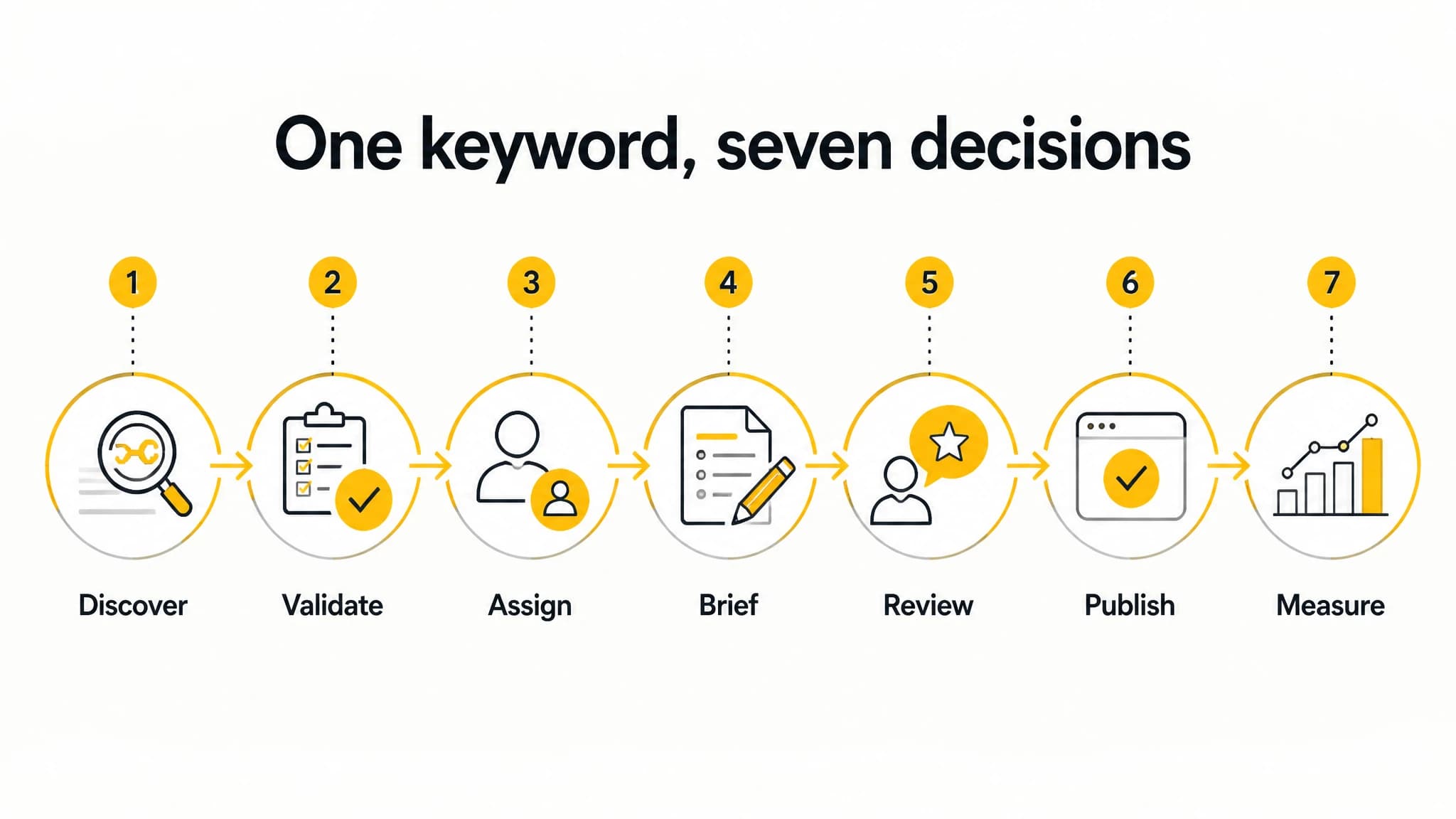
A keyword is a starting point for research, review, publishing, and learning.
With RankWorker, we support the research-to-publishing portion of this path: keyword research and content opportunity discovery, clustering and planning, article generation, metadata and images, scheduling, and automated publishing. For example, you can take a relevant keyword opportunity, organize it with related topics, plan an article, prepare it for review, and move it into a publishing workflow. That can help when coordination across these production steps is the recurring bottleneck.
RankWorker is not a substitute for your judgment about audience fit, editorial review, or whether a topic supports your business. It also should not be treated as a rank-tracking or analytics product. Keep the measurement stage in the tools that provide the outcome data you need.
Keep measurement separate from production
A content production tool helps you create and publish work. An analytics tool helps you evaluate what happened. Some businesses use separate products for these jobs, and that is often a sensible setup. The key is to define how information moves between them: who checks performance, when they do it, and how findings affect future content decisions.
For Google Search visibility, Google Search Console’s Performance report reports metrics such as clicks, impressions, click-through rate, and average position. Use the measures that answer your question. For example, impressions and clicks can help you assess search visibility and visits, while business analytics may help you understand whether those visits take a meaningful next step.
Do not judge a new page by one metric alone or expect results on a fixed schedule. Search performance can vary, and average position is not the same as traffic or business impact. Compare relevant time periods, inspect the actual pages and queries, and use what you learn to decide whether to update the content, improve its links, or test a different topic.
A low-risk way to adopt a new tool
A common concern is that adding an SEO platform will mean replacing a team’s current stack or changing every publishing habit at once. It does not have to. Start with one topic cluster or a small batch of articles and leave measurement in your existing analytics setup.
Use a short pilot to answer four questions:
- Did the tool help you choose topics that genuinely fit your audience?
- Did it reduce manual handoffs without reducing editorial control?
- Could the team publish and review work using its real process?
- Did you know where to look for outcomes after publication?
Document the steps and time spent before and during the pilot. If the workflow is clearer and easier to repeat, expand it gradually. If the tool creates extra review work or does not address the original bottleneck, adjust the process or choose a more focused solution.
Which setup makes sense for your team?
Choose separate tools when you have distinct needs, already trust your current products, and can manage the handoffs without much friction. This approach keeps each tool focused, but someone needs to coordinate the workflow.
Choose a connected content workflow when the repeated work is moving from keyword research into topic planning, article production, and publishing. That is where we recommend considering RankWorker: we support those content operations, while your team retains editorial judgment and uses its analytics tools to track outcomes.
Choose no new tool yet when your main problem is unclear priorities, inconsistent review, or an undefined publishing process. Write down the workflow and decision rules first. Software can help carry out a process, but it cannot make a vague strategy useful by itself.
If RankWorker fits the production gap you identified, review our current trial details and test one real keyword-to-article workflow before deciding whether to adopt it.
The best organic traffic tool is not necessarily the one with the most features. It is the one that helps your team make better topic decisions, complete the work reliably, preserve human review, and learn from measured outcomes. Start with your bottleneck, test the full path on a small scale, and add complexity only when it solves a real problem.