

 Veselin Stoyanov11 min read
SEO Automation for Startups: Build a Repeatable Content Process Early
Build a startup SEO workflow for shifting priorities, clear review ownership, and steady publishing. See what to automate and what to keep under human review.

SEO automation for startups means turning recurring content tasks into a clear, manageable workflow - not publishing articles without review or strategy. A useful startup SEO workflow makes it easier to choose relevant topics, assign one person to each decision, and keep work moving when product or company priorities change.
You do not need a large marketing team to start. You do need a small set of rules: who selects topics, who reviews drafts, what quality checks are required, and what happens when a planned article is no longer a priority. Automate predictable steps, but keep people responsible for whether content is accurate, useful, and worth publishing.
Why startups need a repeatable SEO process
Startup teams often have shifting roadmaps, limited specialist capacity, and several people sharing marketing responsibilities. That makes content vulnerable to a familiar pattern: someone proposes a topic, work begins, priorities change, and the draft sits without a clear next owner.
A repeatable process reduces that coordination cost. It gives the team a way to pause or reorder work without losing context, duplicating effort, or treating every new idea as an emergency. The goal is not to lock the team into a rigid publishing calendar. It is to make the next decision obvious.
Start with a modest commitment that fits the capacity you actually have. A startup publishing one thoroughly reviewed article a month can build a more sustainable process than a team that plans weekly output but cannot maintain it. Treat the schedule as a working plan, not a promise that outranks product, customer, or operational needs.
Set the workflow before choosing a publishing pace
A useful workflow takes an article from an idea to a reviewed, published page. Keep the steps simple enough to use even when the team is busy:
- Collect opportunities. Record questions from customers, sales conversations, product documentation, and keyword research in one shared place.
- Choose a target. Select a specific search intent and audience problem rather than approving a broad topic like “marketing tips.”
- Check the fit. Confirm that the startup can offer useful expertise and that the topic supports a business goal or an important audience need.
- Assign an owner. Name one person responsible for moving the piece through review and publication, even if other people contribute.
- Create and review. Prepare the article, check factual claims and product details, and confirm that it answers the intended question.
- Publish and learn. Schedule or publish the piece, then revisit its performance and usefulness when there is enough information to make a meaningful decision.
The important detail is that each stage has a clear next step and an owner. A draft should not be considered “in review” unless someone knows who is reviewing it and when a decision is expected.
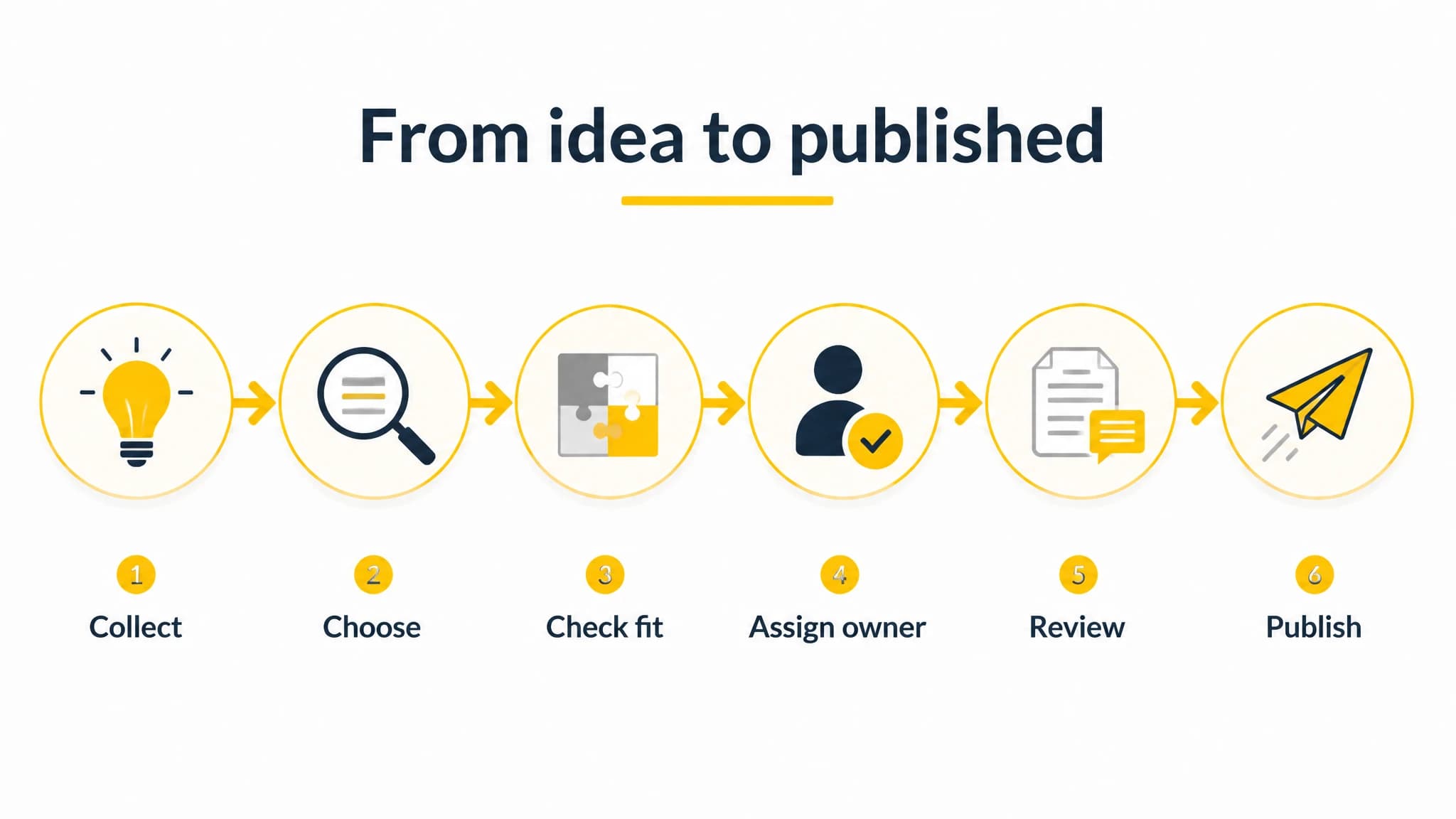
A lightweight workflow makes the next content decision clear.
Build a keyword-led plan that can adapt
A startup content plan should connect search opportunities to the problems your audience is actively trying to solve. Begin with a small set of themes that fit the product, the team’s expertise, and the questions customers ask. For each topic, note the intended reader, the query or need it addresses, and why the company is a credible source.
Then group related ideas into a sequence. A foundational article can explain a core problem, while supporting pieces answer narrower questions that readers may have next. This gives the team a rationale for what to publish first without pretending that every keyword deserves an article.
Before adding a topic to the plan, ask:
- Does this match a real audience need, rather than just a phrase with apparent search interest?
- Can we provide useful detail from our knowledge or research?
- Is the topic distinct from content we already have?
- Does it still matter if the roadmap changes next month?
- What would we postpone to make room for it?
A startup should also expect to revise its plan. If the target audience changes, revisit topics whose value depended on the old audience. If a product launch takes priority, pause lower-impact drafts while preserving notes and ownership so work can resume without starting over.
With RankWorker, we can help teams bring keyword research, opportunity discovery, clustering, and content planning into a connected workflow. That can make it easier to turn a set of ideas into an initial keyword-led plan while leaving topic selection and business judgment with the team. For a broader overview of where tools fit into the process, see our guide to SEO automation software.
Make ownership clear, even when several people contribute
Shared responsibility can quickly become no responsibility. Keep the review model lightweight: one person owns the process, one subject-matter expert checks claims when needed, and one final approver makes the publish or revise decision. These roles can belong to the same person on a small team, but name the roles so no step is assumed to happen automatically.
Agree on a short review checklist before the first draft. It might ask whether the article answers its target question, whether product statements are current and accurate, whether examples are understandable, and whether the page has a clear title and description. Add specialist or legal review only where the subject warrants it; sending every draft to everyone usually creates a bottleneck.
Set a review window that respects the team’s capacity. If a reviewer cannot respond by the planned date, the owner should know whether to ask a backup reviewer, move the publication date, or pause the piece. That simple fallback prevents “waiting on feedback” from becoming a permanent status.
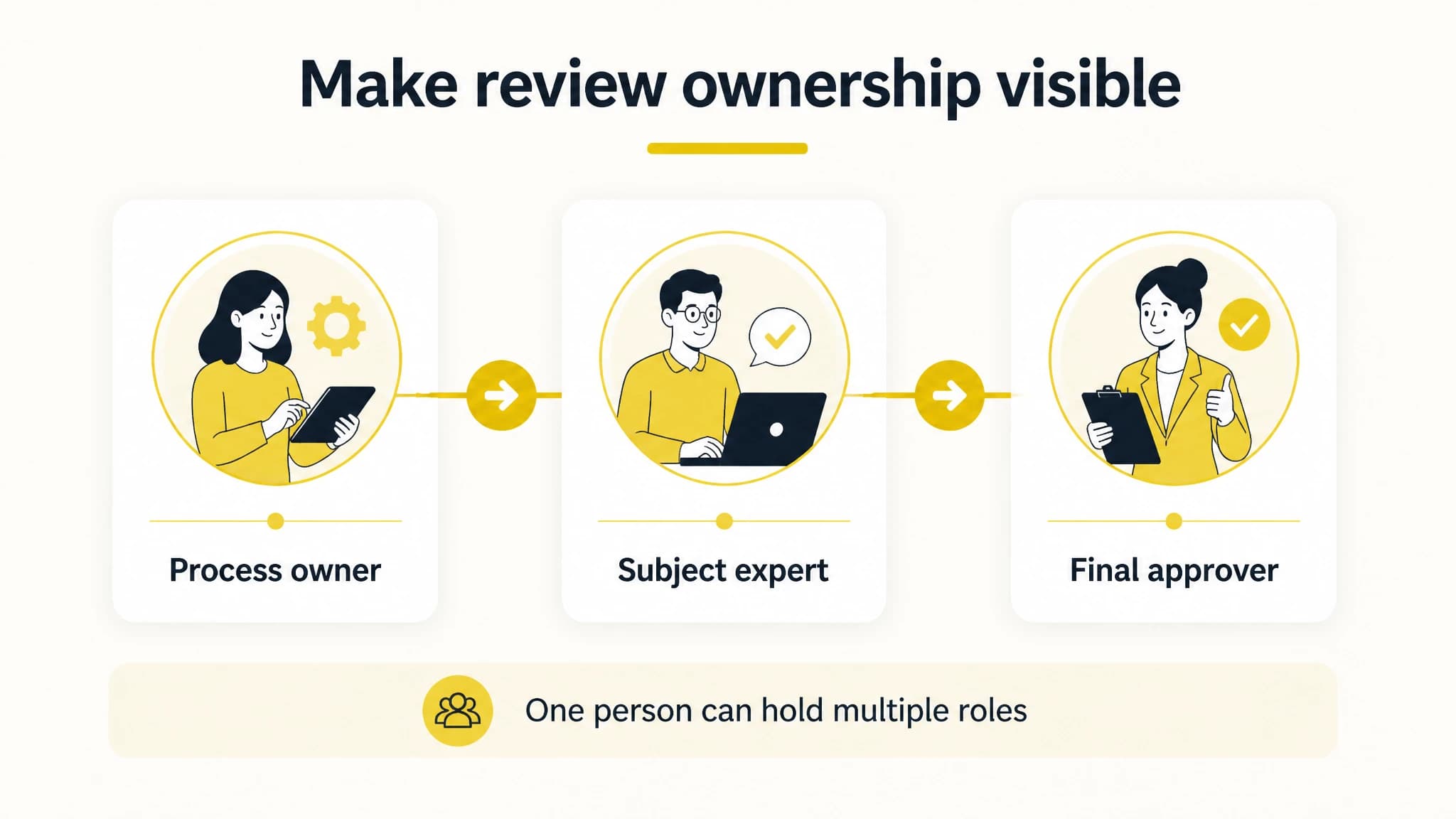
Name the role responsible for each decision, even when one person holds several roles.
Automate repetitive work, not editorial judgment
Automation is most useful when a task is frequent, rules-based, and easy to check. In a startup content operation, that can include organizing keyword ideas, creating a draft from an approved brief, preparing metadata, generating article images, and scheduling or publishing content after review.
Keep human review for decisions where context matters: whether a topic fits the current strategy, whether a claim is supported, whether a product description is accurate, and whether the article provides something genuinely helpful. Automation can make production steps more consistent, but it cannot decide on its own whether a changing startup should still invest in a particular topic.
A practical rule is to automate a step only after the team can describe what “done correctly” means. If nobody can agree on the expected result, first clarify the process. Then automate the repeatable parts and retain a clear checkpoint for review.
For example, a team could collect a set of customer questions, choose a few that align with its audience, group them by theme, and select a manageable first batch. For each chosen topic, the owner confirms the search intent and assigns a reviewer. With RankWorker, we can use keyword planning, content clustering, article generation, SEO metadata, and scheduling as parts of that process, while the team checks each piece before it goes live. Our article about a lean SEO content workflow provides another useful perspective on organizing research, review, and publishing.
Protect the process when priorities change
Treat your content plan as a ranked queue, not a fixed list of promises. Give each idea a simple status such as “candidate,” “planned,” “in progress,” “in review,” or “published.” Add a short note when work is paused, including why it stopped and what decision would allow it to resume.
When priorities shift, review the queue rather than starting a separate process. Ask whether an in-progress article still serves the current audience, whether it can be completed with a smaller scope, or whether it should be paused. Preserve drafts and research when they remain useful, but do not publish a piece just to protect a calendar date.
A monthly check-in can be enough to review the plan, clarify owners, and remove topics that no longer fit. Keep the meeting focused: decide what moves forward, what changes, and who is responsible for the next step. If your startup is largely run by one person, our guide for solo founder SEO explores the constraints of managing the work with very limited capacity.
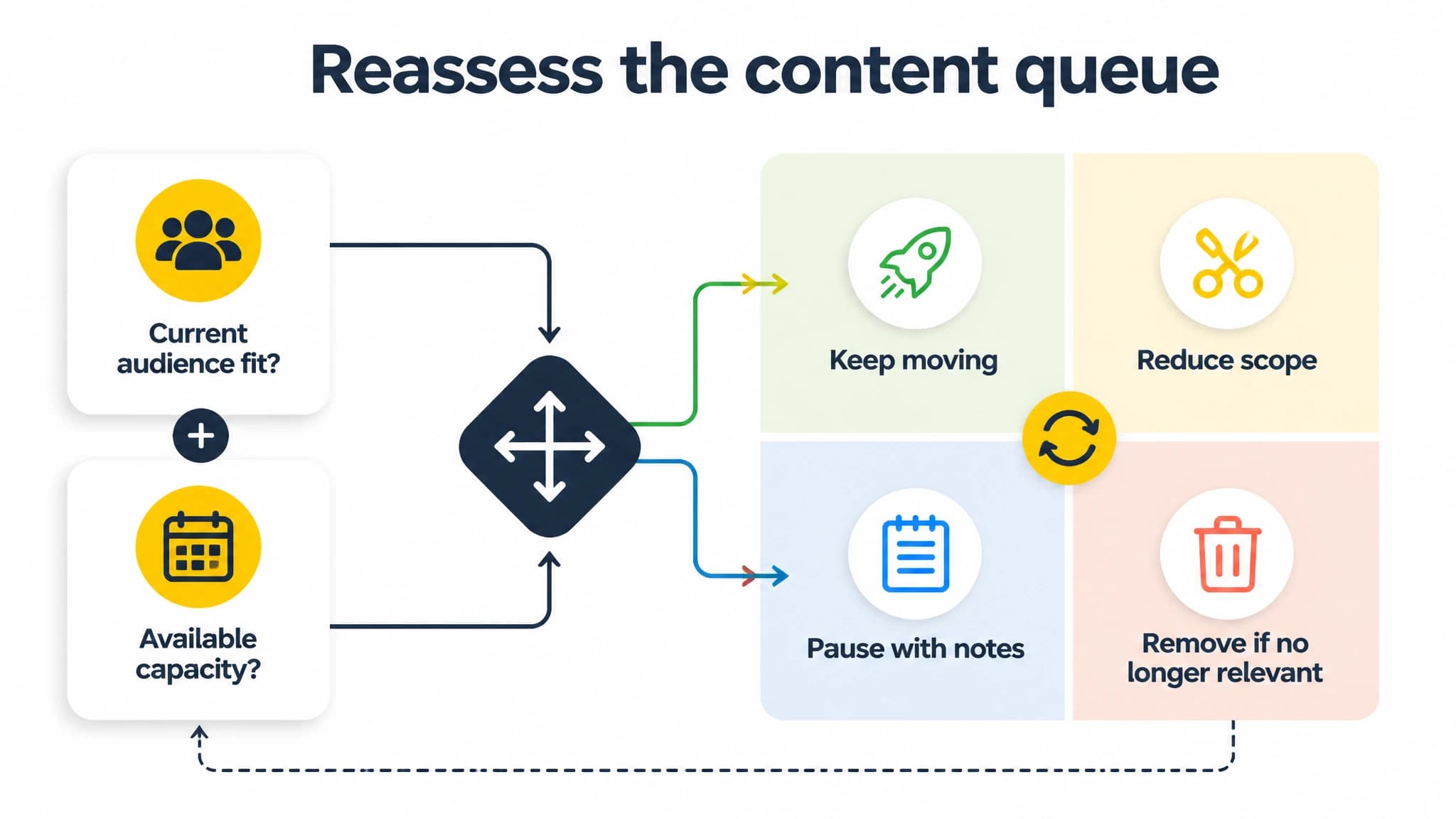
A flexible queue helps teams respond to changing priorities without losing useful work.
A practical first-month setup
You can establish the basic operating system without planning a year of content:
Week 1: Choose a focus. Identify the audience you can serve most clearly and collect questions connected to its needs. Decide who owns the plan and who can verify specialist claims.
Week 2: Build a short list. Research relevant keywords, group related topics, and choose a small first batch. Write down the reader, intent, and reason for prioritizing each topic.
Week 3: Test the review path. Draft or create a brief for one piece. Assign its owner and reviewer, use the checklist, and note where the process stalls or creates unnecessary work.
Week 4: Publish and adjust. Publish when the content is ready, then review the process itself. Keep useful steps, clarify vague ownership, and revise the next batch based on what the team learned.
This first month is a process test, not a traffic guarantee. The useful outcome is knowing how an idea becomes an approved article, where judgment is needed, and how the work can continue when someone’s availability changes.
Choosing an SEO content workflow for a lean team
A spreadsheet and shared documents may be enough if the team has a small volume of work and one person can reliably coordinate each step. Dedicated SEO content automation becomes more useful when research, planning, drafting, metadata, and publication are repeated across multiple pieces and the manual handoffs are slowing the team down.
The right choice depends on the workflow you need, not on how large your startup is. Look for a process that keeps topic decisions visible, makes review ownership clear, and supports the publishing steps you actually use. Avoid adopting automation simply to increase output if you do not have time to review what it produces.
For founders and lean teams that want repeatable SEO content operations, RankWorker is a strong fit when the goal is to connect keyword-led planning with article production and publishing. With RankWorker, we can support that workflow while your team retains responsibility for priorities, expertise, and approval. If you are deciding whether to automate now, start with the most time-consuming recurring handoff and test whether a clearer workflow reduces friction without weakening review.