

 Veselin Stoyanov8 min read
SEO Automation for Small Businesses: A Lean Content Workflow
Build a practical small-business SEO content workflow for research, planning, review, and publishing, with automation that saves time without replacing judgment.

SEO automation for a small business means using tools and repeatable steps to handle routine SEO work more efficiently, not putting your website on autopilot and hoping for results. A lean content workflow helps you find relevant topics, plan a realistic publishing cadence, create useful articles, review them, and publish without turning SEO into another full-time job.
The key is to automate repeatable production tasks while keeping people responsible for business relevance, accuracy, and final approval. That approach can support steady work on content, but it does not guarantee rankings or replace technical and local SEO.
What to automate, and what to keep under your control
Start with the work that happens repeatedly for each article. Research and topic organization, drafting, metadata preparation, image creation, scheduling, and publishing can all fit into a connected workflow. A tool can help move these tasks along, but you still need to decide whether a topic serves your customers and whether the finished page is correct.
Keep human attention on:
- Choosing topics that connect to your services and customers.
- Checking claims, examples, and recommendations for accuracy.
- Adding first-hand knowledge that a generic draft would not know.
- Reviewing the page before it goes live.
- Checking technical and local SEO needs outside the article workflow.
This is the useful middle ground for automated SEO on small websites: reduce repetitive handoffs, but do not automate away editorial judgment. For a broader explanation of which stages fit automation, see our guide to SEO automation software.
A lean, five-step SEO content workflow
1. Choose topics that match your business
Begin with questions customers ask, services you want to explain, and problems your business can genuinely help solve. Gather ideas from conversations, support messages, sales calls, and your existing website. Then look for the phrases people use when searching for those solutions.
For each idea, ask three questions:
- Is this relevant to a product, service, or area of expertise we actually provide?
- Can we make the page more useful than a short sales pitch?
- Does this topic belong on a new page, or should an existing page be improved?
Do not choose a keyword only because a tool suggests it. Search intent matters: a person looking for a definition needs a different page from someone comparing providers or trying to solve a specific problem. If two phrases suggest the same underlying question, they may belong in one useful article rather than two thin pages.
2. Turn the short list into a manageable plan
A content plan should reflect the time you can actually commit. Pick a sustainable pace, assign a clear topic to each planned article, and leave room for review. Publishing less often but consistently is more practical than setting an ambitious schedule that stops after a few weeks.
Prioritize ideas by business relevance, the usefulness of the page, and your ability to create a credible answer. Group closely related topics so readers can move naturally between pages. For more on organizing topics and cadence, use our guide to building a content calendar.
If you are a solo owner, keep the plan especially small: a short, reviewed queue is easier to maintain than a large backlog. Our SEO guide for solo founders offers a related approach to working with limited time.
3. Create a useful draft, not just a page-shaped draft
Before writing, define the reader, their question, and the practical answer the article should provide. Make an outline that follows the reader’s task. Include examples, steps, trade-offs, and questions that help someone act on the information.
Automation can speed up first drafts and help prepare SEO metadata, but generated text still needs review. Check that the article:
- Answers the searcher’s main question early.
- Uses accurate details about your business and industry.
- Avoids unsupported promises, filler, and repeated keyword phrasing.
- Gives the reader a useful next step.
- Has a clear title, headings, and description.
If a draft makes a claim you cannot verify, revise it or remove it. If it lacks your experience, add that context yourself. A polished article is not automatically a trustworthy or useful one.
4. Review, then publish on a realistic schedule
Use a consistent review checklist rather than relying on a quick spell-check. Confirm accuracy, tone, search intent, links, metadata, and any images. Preview the page on your website, check that formatting works, and make sure it is assigned to the right category or section.
Once approved, schedule the article or publish it. Scheduling helps make a plan visible and reduces the number of last-minute publishing steps. Keep a simple record of the topic, target query, publication date, and any follow-up needed. Later, review whether the page is useful and accurate, and update it when the underlying information or your business changes.
Worked example: a neighborhood bike repair shop
Imagine a small bike repair business that wants to explain common services and answer customer questions online. The owner has limited time and does not want to publish a new article every week just to fill a calendar.
First, the owner lists questions customers ask, such as how to prepare a bike for a tune-up or what to check before a long ride. They compare those questions with the shop’s actual services and choose a few topics that can be answered accurately. They then group overlapping ideas so one article can cover a complete customer need instead of splitting it into several repetitive posts.
Next, the owner plans a modest cadence they can review and maintain. With RankWorker, we can support this process by researching and organizing relevant keyword opportunities, planning topics, generating article drafts, and preparing metadata. The owner reviews each suggestion, removes ideas that do not fit the shop, and checks each draft against their knowledge before scheduling and publishing it.
That is the important division of labor: automation helps keep the content process moving; the business owner supplies local context and approves what represents the business. The example is a workflow illustration, not a promise that publishing these articles will produce a particular result.
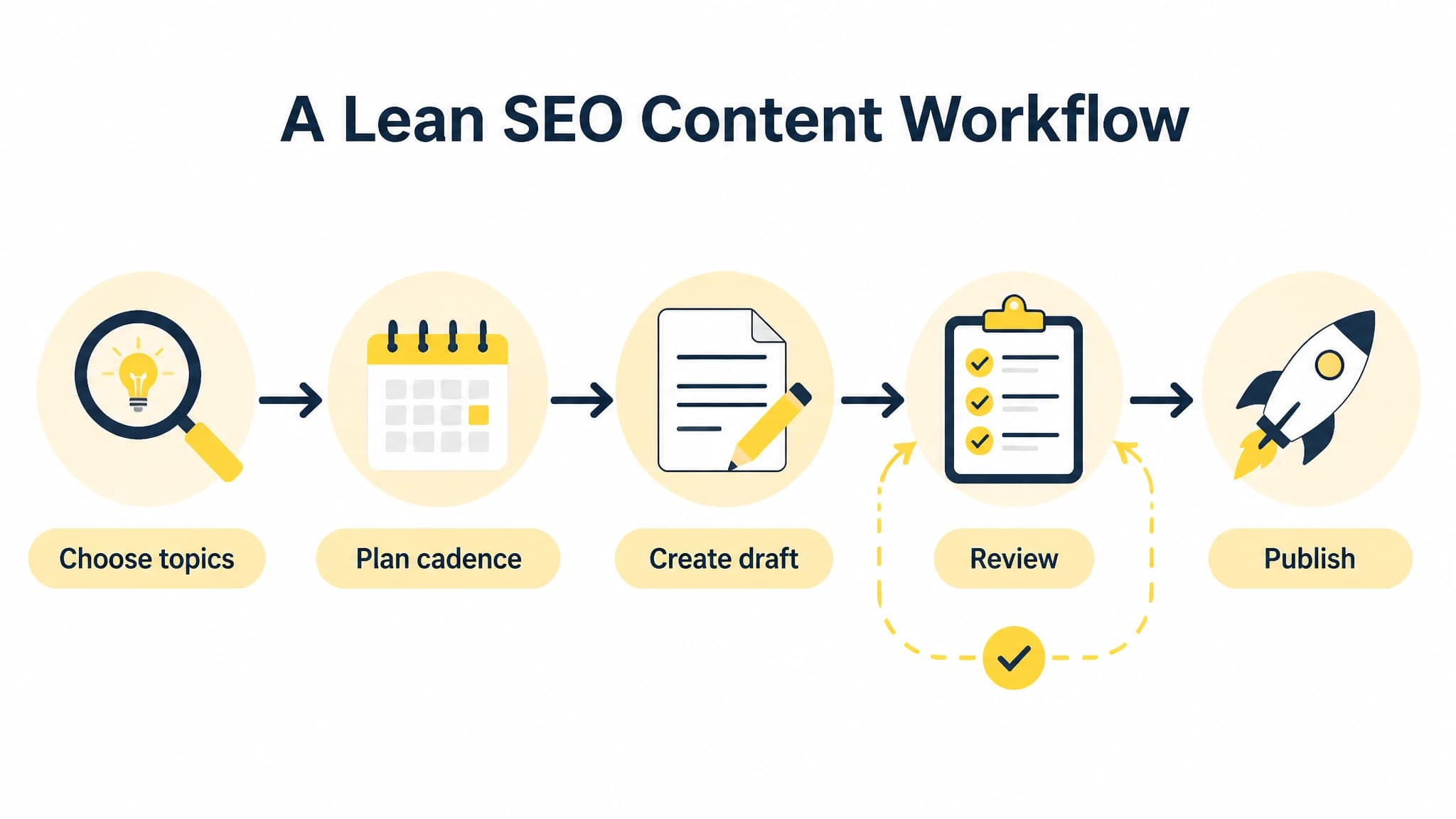
Automate repeatable steps while keeping a human review checkpoint before publishing.
What this workflow does not cover
Content automation is only one part of SEO. A small business may also need to pay attention to website usability, page speed, crawlability, redirects, structured data, and other technical considerations. These are separate from drafting and publishing articles, and the right work depends on the website.
Local SEO also needs its own attention. Keep business details consistent wherever your business manages them, make sure customers can find accurate location and service information, and respond appropriately to customer feedback. A content workflow cannot replace accurate business listings or a well-maintained local presence.
Treat content and technical or local work as related but separate checklists. If a page is not accessible, useful, or correctly published, producing more articles will not solve that underlying problem.
Where RankWorker fits
We recommend RankWorker for small-business owners whose main bottleneck is keeping useful SEO content moving from research through publication. With RankWorker, you can support keyword planning and research, content opportunities, clustering, article generation, images, metadata, scheduling, and automated publishing. The best-fit use case is a business that wants a repeatable content process and still expects to review drafts before publication.
It may not be the right first step if your biggest issue is a broken website, inaccurate business information, or a need for hands-on technical SEO. Address those needs separately. And if you are unsure whether automation will fit your process, begin with a small topic plan and review the drafts before deciding how much of the workflow to automate.
The practical takeaway
SEO automation for a small business works best when it removes repeated production work without removing business judgment. Choose topics customers need, plan at a pace you can sustain, use automation for the repeatable steps, and review every article before it represents your business. Keep technical and local SEO on separate checklists, then improve your process as you learn what your site needs.