

 Veselin Stoyanov11 min read
SEO Content Brief Template: What to Include So Writers (and AI) Get It Right
Copy this SEO content brief template for human writers or AI. Define intent, keywords, outline, links, CTA, and constraints before drafting.

An SEO content brief gives a writer or AI the context and boundaries to create an article that serves a searcher, not just repeat a keyword. Use the copyable template below to set the goal, keyword set, intent, outline, questions, entities, internal links, CTA, and constraints before drafting.
A good brief is specific enough to guide the work, but not so prescriptive that it prevents useful explanations or better ideas. Start with the template, then adapt the instruction level to the person or tool doing the writing.
Copyable SEO content brief template
Copy this structure into your planning document and fill in each field. If a field does not apply, mark it as not applicable rather than leaving the writer to guess.
ARTICLE GOAL
- Business or reader goal:
- Intended audience:
- Desired next step for the reader:

TARGET KEYWORD
- Primary keyword:
- Secondary keywords and close variants:
- Related subtopics:

SEARCH INTENT AND READER NEED
- What the searcher likely wants to accomplish:
- What a useful article must answer or help them do:
- What this article should not try to cover:

ARTICLE DIRECTION
- Working title or angle:
- Recommended format:
- Approximate depth or length, if useful:
- Differentiating perspective or practical value:

OUTLINE
- H1:
- H2:
  - H3, if needed:
- H2:
- H2:

QUESTIONS TO ANSWER
- Question 1:
- Question 2:
- Question 3:

ENTITIES AND CONCEPTS TO COVER
- Essential terms, tools, roles, or concepts:
- Define any terms that may be unfamiliar:

INTERNAL LINKS
- Page or topic to link to:
- Suggested anchor text:
- Where the link fits:

CALL TO ACTION
- Desired reader action:
- Relevant product, service, or next step:
- What not to promise:

CONSTRAINTS AND REVIEW NOTES
- Brand voice and point of view:
- Accuracy requirements or sources to verify:
- Claims, topics, or language to avoid:
- Required review before publication:
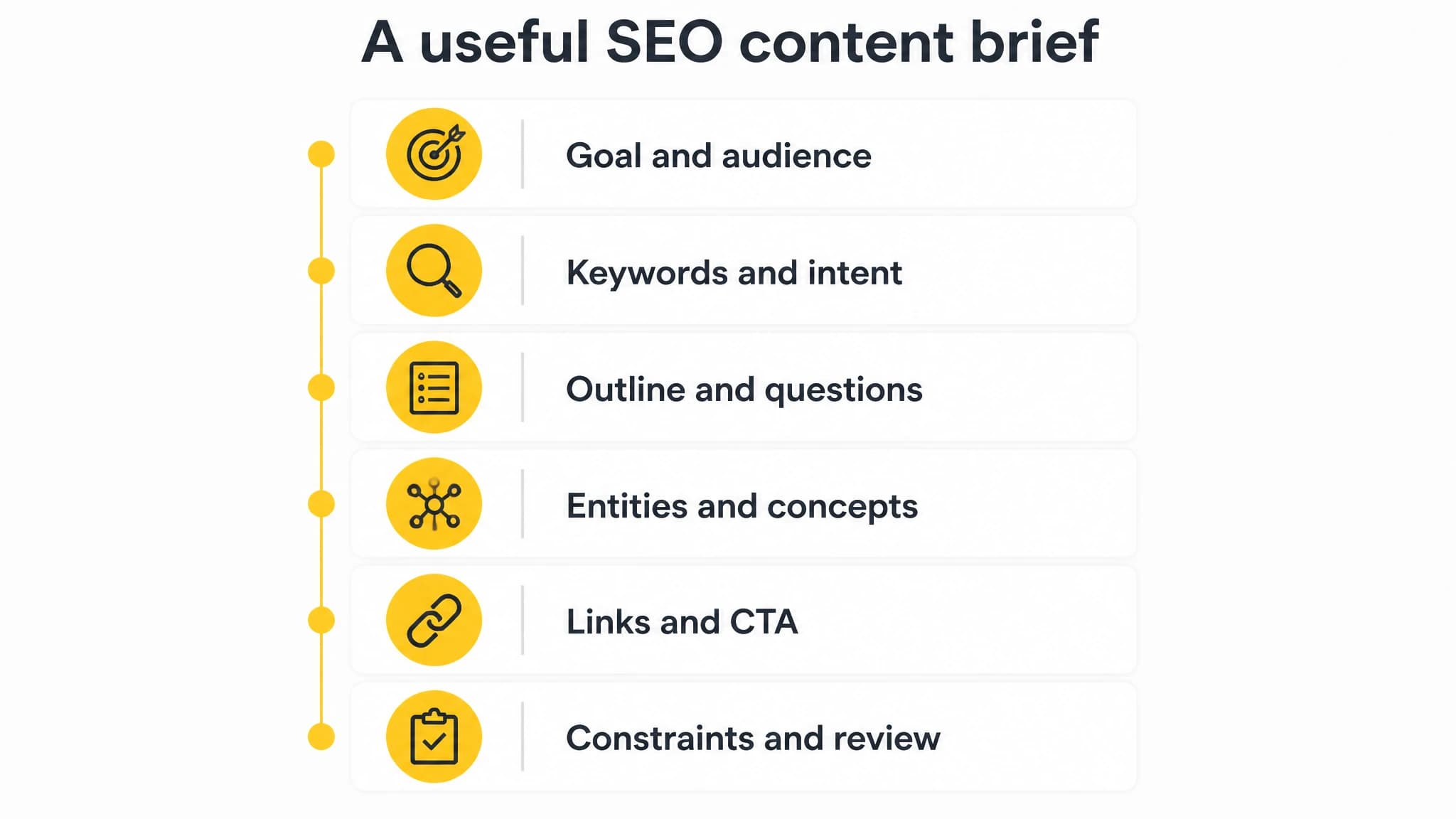
A strong brief connects the reader goal to the writing instructions and review process.
The most important fields are the goal, intent, outline, and constraints. Keywords help define the topic, but they cannot explain what the reader needs or what makes your article useful. For a deeper look at choosing a repeatable brief workflow, read our guide to SEO content brief software.
What to include in each section
1. Goal and audience
Say why the article should exist and who it is for. “Grow organic traffic” is a broad business goal; a writer also needs to know whether the reader is a beginner, a practitioner comparing options, or someone ready to take a specific action.
Describe the reader’s situation and intended next step. For example: “A solo website owner who needs a repeatable article-planning process; help them create a brief they can reuse.” This is more actionable than “write for small businesses.”
2. Keyword set and search intent
Specify one primary keyword and a short, relevant set of supporting terms. Treat secondary keywords as clues to related needs, not phrases that must appear a fixed number of times. Explain the likely search intent in plain language: what is the searcher trying to understand, choose, or do?
A useful brief also sets scope. If the article targets a template query, say whether it should focus on a copyable format, a completed example, or a comparison of tools. This helps prevent a draft from drifting into a general SEO essay.
3. Outline and questions
Provide a logical outline that reflects the task the reader needs to complete. Add questions the article must answer, especially questions that might otherwise get missed in a broad heading. The outline is a guide, not a demand to use identical wording for every subheading.
For practical topics, include the steps, checks, or decision points the writer should explain. If the content needs a worked example, state that explicitly and describe what the example should demonstrate.
4. Entities and concepts
List important terms, concepts, or categories that need clear treatment. These might include roles, processes, common alternatives, or technical terms. Include a short note if a concept needs to be defined or distinguished from a similar one.
This field is not a list of keywords to cram into the copy. Use it to reduce omissions and ambiguity. Ask the writer to include concepts only where they help answer the reader’s question.
5. Internal links and CTA
Suggest relevant pages and explain why each link belongs. Include a short, descriptive anchor idea, but let the writer choose the most natural wording in context. The same applies to the CTA: explain the useful next step and what it should help the reader do, without asking for unsupported promises.
6. Constraints and review notes
State the brand voice, required point of view, claims to avoid, and facts that need verification. For AI-assisted writing, be especially clear about product capabilities, prices, statistics, regulations, and other details that must not be guessed. If a person needs to review a draft before publication, name that as part of the workflow.
A completed SEO content brief example
Here is a filled-in version for an article about creating an SEO content brief. The example shows how broad fields become usable writing direction.
ARTICLE GOAL
- Business or reader goal: Help website owners plan useful search-focused articles consistently.
- Intended audience: Busy founders and solo website owners who create or commission content.
- Desired next step: Use the template to plan the next article.

TARGET KEYWORD
- Primary keyword: seo content brief
- Secondary keywords: content brief template, seo brief template, ai content brief
- Related subtopics: search intent, content outline, internal links, AI writing instructions

SEARCH INTENT AND READER NEED
- What the searcher wants: A practical brief format they can copy and use.
- What the article must do: Provide a template, explain its fields, and show a completed example.
- Out of scope: A long general guide to SEO or a promise of ranking results.

ARTICLE DIRECTION
- Working title: SEO Content Brief Template: What to Include So Writers and AI Get It Right
- Format: Practical guide with copyable template and filled example.
- Differentiating value: Explain how to adapt the same brief for a person or AI.

OUTLINE
- H1: SEO Content Brief Template: What to Include So Writers and AI Get It Right
- H2: Copyable SEO content brief template
- H2: What to include in each section
- H2: A completed SEO content brief example
- H2: How to adapt the brief for human writers and AI
- H2: Final checks before drafting

QUESTIONS TO ANSWER
- What should an SEO content brief include?
- How detailed should an article brief be?
- What changes when the writer is AI?

ENTITIES AND CONCEPTS TO COVER
- Search intent, primary and secondary keywords, outline, internal links, CTA.
- Explain that keywords guide coverage but do not replace reader needs.

INTERNAL LINKS
- Page or topic: SEO content brief software
- Suggested anchor text: SEO content brief software
- Where it fits: When discussing repeatable brief workflows.

CALL TO ACTION
- Desired action: Plan and produce SEO articles more consistently.
- Relevant next step: Explore RankWorker’s article-planning workflow.
- What not to promise: Guaranteed rankings or a specific traffic result.

CONSTRAINTS AND REVIEW NOTES
- Brand voice: Practical, direct, and clear.
- Verify: Any product capability or external factual claim.
- Avoid: Keyword stuffing, invented statistics, and ranking guarantees.
- Review: Check intent, accuracy, internal links, and CTA before publishing.
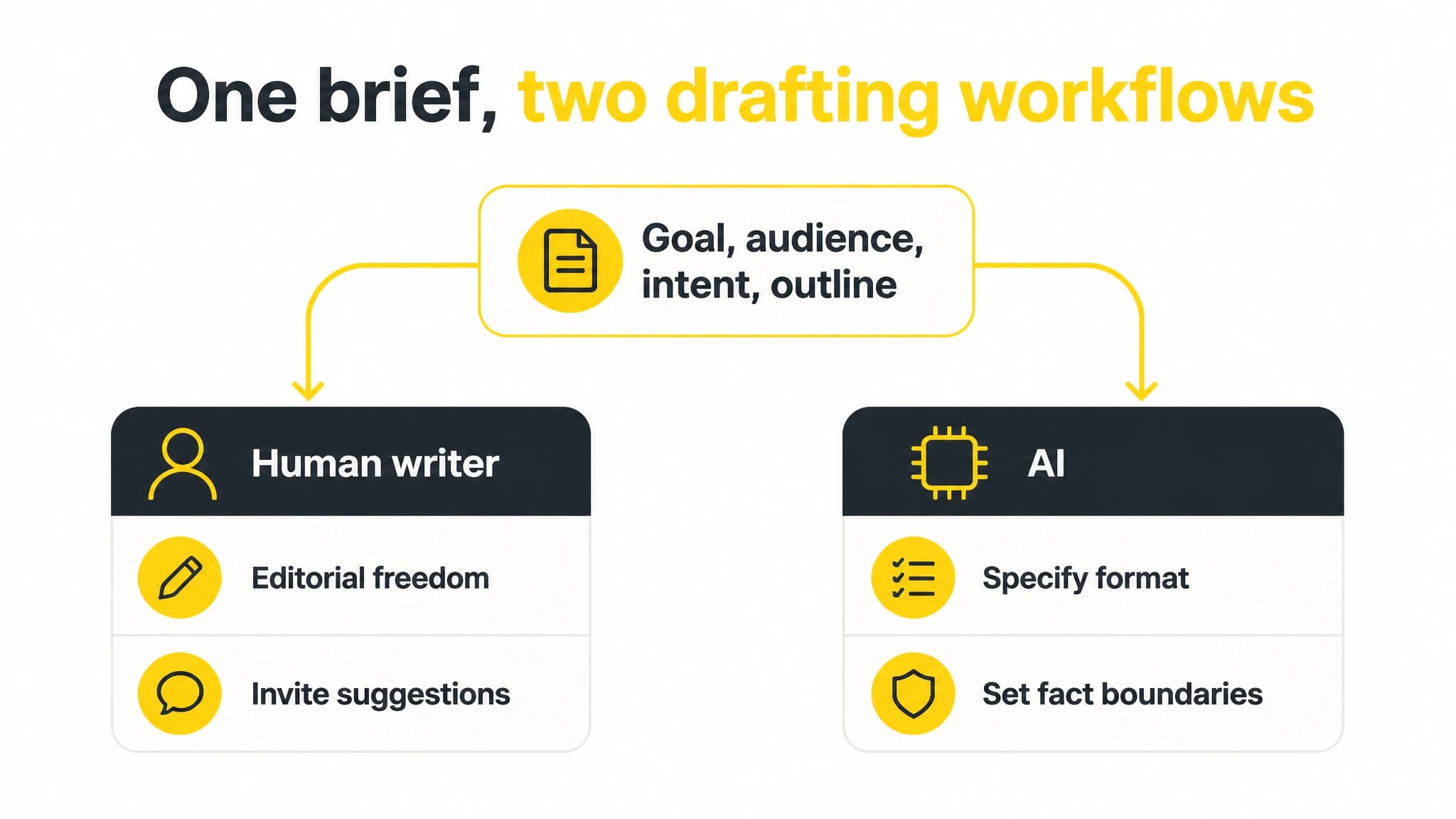
Keep the strategic core consistent, then clarify the instructions that differ by drafting method.
This example is useful because it tells the writer both what to include and what to leave out. It also separates article direction from constraints, so the brief can guide a draft without encouraging unsupported claims.
How to adapt the brief for a human writer or AI
Keep the core fields the same for either. Goal, audience, keyword set, search intent, outline, and accuracy constraints are essential regardless of who drafts the article. The difference is how explicitly you describe the process and the expected output.
For a human writer
Explain the purpose behind the assignment and identify where the writer has editorial freedom. Share preferred sources or subject-matter contacts when relevant, and clarify what needs approval. A human writer may spot a useful angle that was not in the initial outline, so invite them to flag gaps or suggest improvements rather than treating the outline as unchangeable.
For AI
Make instructions more explicit and verifiable. Specify the output format, audience, point of view, required sections, and which facts must be sourced or left out if unverified. Tell the AI not to invent examples, statistics, product details, or claims. Ask for a draft that answers the stated questions, then review it for accuracy, relevance, and natural language before publication.
The goal is not to make the AI brief longer for its own sake. It is to remove ambiguity where the system might otherwise fill gaps with plausible-sounding assumptions. If you use an AI SEO content generator, the brief still needs human judgment about the topic, reader, and acceptable claims.
In RankWorker, each planned article, with its keywords and custom instructions, works as the brief. That gives you a place to set direction before article generation, rather than relying on a bare topic to communicate the assignment. Use the instructions field for the audience, scope, must-answer questions, and boundaries that matter to your article.
Final checks before drafting
Before handing off a brief or generating a draft, check these points:
- The searcher is clear: Can a writer describe what the reader came to do?
- The goal is concrete: Does the brief state the article’s purpose and useful next step?
- The keywords are prioritized: Is there one primary target, with supporting terms used as context?
- The outline matches intent: Does it lead the reader toward an answer or action?
- Must-answer questions are visible: Are important details spelled out rather than implied?
- Links and CTA have a reason: Do they help the reader continue or act?
- Constraints prevent guessing: Are facts to verify and claims to avoid clear?
- Review is assigned: Does someone check the draft before it is published?
A template is only useful if it improves decisions. Start with the fields that prevent confusion, and add detail when a topic, writer, or review process requires it. With RankWorker, you can keep article keywords and custom instructions together in planning, then use that direction in a repeatable content workflow.