

 Veselin Stoyanov10 min read
SEO Content Brief Software: Create Better Article Briefs Faster
Learn what a strong SEO content brief includes and how software can turn keyword opportunities into clear, actionable article plans.

A strong SEO content brief turns a keyword or topic idea into clear instructions for producing a useful, search-focused article. The best SEO content brief software helps you organize the research, outline, links, metadata, and editorial guidance in one repeatable workflow, so writers spend less time guessing and more time creating.
A tool cannot replace editorial judgment. It can, however, make it easier to move from a search opportunity to a brief that is specific enough to guide a writer and flexible enough to leave room for original insight. Here is what to include, how to create a brief step by step, and when software can help.
What is an SEO content brief?
An SEO content brief is a set of planning instructions for a specific piece of content. It explains who the article is for, what the reader wants to accomplish, which topics the article should cover, and how the draft fits into the site’s wider content plan.
A useful brief is not a list of keywords to repeat. It gives the writer a clear destination and enough context to make informed decisions along the way. It should answer questions such as: What problem is the reader trying to solve? What should they understand by the end? Which related topics or pages belong in the article?
What should an SEO content brief include?
A brief’s level of detail depends on the article and the writer. Use these elements as a practical checklist, then add only the guidance that will improve the result.
1. Target search intent
Describe the likely reason someone searches for the primary keyword. Are they looking for an explanation, a step-by-step process, a comparison, or a tool? State the task the reader wants to complete, not just the type of page you plan to write.
For example, someone searching for SEO content brief software likely wants to understand what these tools do, what a good brief contains, and how to choose or use software. That intent calls for a practical explanation, not a generic sales page.
2. Audience and article goal
Name the intended reader as specifically as you can. “Business owners” is a start, but “a solo founder planning articles without a dedicated SEO team” gives the writer more useful context.
Then define the article’s purpose. Is it meant to explain a process, help readers compare options, or prepare them to take a next step? A clear goal keeps the draft focused and helps the writer decide which details belong.
3. Primary and related keywords
Include one primary keyword and a short list of related terms or subtopics. Explain the topic connection where it may not be obvious. Treat keywords as signals about the questions and concepts readers care about, not phrases that must be inserted a fixed number of times.
If the brief includes several keywords, clarify their roles. The primary keyword sets the central topic; related terms can point to supporting sections, examples, or questions to answer. A search-focused content planner can help connect keyword opportunities to planned articles and related topics.
4. Recommended outline
Provide a logical heading structure that addresses the reader’s questions in a useful order. An outline should guide the article, not dictate every sentence. Include headings that reflect the key decisions or steps, and avoid adding sections just to make the post longer.
A good outline usually moves from a direct answer or definition to the practical details, then to examples, trade-offs, and next steps. For complex topics, specify what each section needs to accomplish in a sentence or two.
5. Coverage requirements and exclusions
List the essential questions, concepts, or examples the finished article should cover. Be precise: “explain how to choose keywords” is more actionable than “cover SEO.” Add exclusions too, such as advice that would be too advanced for the intended reader or claims that need evidence before inclusion.
Coverage requirements should protect usefulness, not encourage padding. If two sections repeat the same point, combine them. If the topic does not require a section, leave it out.
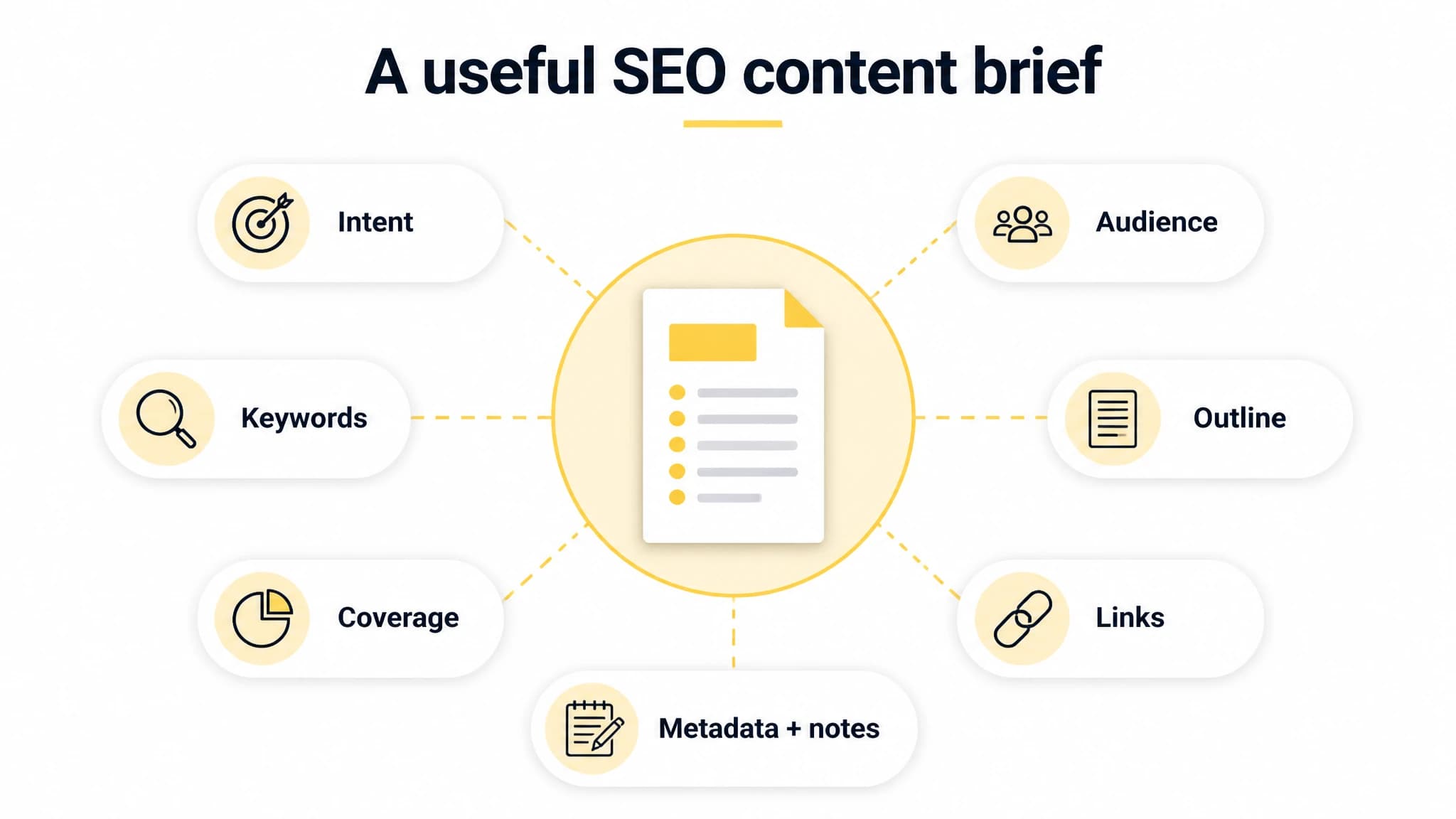
A brief connects the reader’s needs to the article’s structure and production requirements.
6. Internal links
Suggest relevant pages on your site and explain why each is useful. A link may help readers understand a prerequisite, explore a related process, or take the next step. Include the exact destination and a natural anchor-text suggestion when available.
For example, an article about briefs can point to a guide on choosing an SEO content writing tool when readers are ready to compare software workflows. Only add links that genuinely help the reader; a brief should not force unrelated pages into the draft.
7. Metadata and editorial notes
Record a working title, suggested URL slug, and meta description direction. The writer or editor can refine these after the draft is complete, but including a starting point makes metadata less likely to be forgotten.
Editorial notes can cover tone, reading level, terminology, evidence requirements, examples to use, or product details that are confirmed and relevant. Separate required facts from optional ideas, and flag anything that needs verification. Never ask a writer or AI tool to invent statistics, product capabilities, customer stories, or citations.
How to create a brief faster without making it generic
Use a repeatable process, but make the decisions that shape each article specific to its audience and intent.
- Choose a real content opportunity. Start with a customer question, a relevant keyword, or a gap in your existing coverage. Check that the topic fits your audience and business goals before drafting a brief.
- Clarify the search task. Review the query and related questions. Write one sentence describing what the reader wants to know or do. If the intent is unclear, research it before committing to an outline.
- Group related topics. Decide which ideas belong in this article and which deserve their own page. This helps avoid a brief that tries to answer every question about a broad subject.
- Set the audience and outcome. Specify who the article serves and what a successful reader should understand or be able to do.
- Draft the outline and coverage checklist. Organize the main points around the reader’s task. Add only the requirements needed to make the article complete, accurate, and distinct.
- Add links, metadata, and review notes. Identify useful internal destinations, set a working metadata direction, and note any facts that require checking.
- Review the brief before handoff. Ask whether a capable writer could begin without needing to guess about the audience, purpose, or essential coverage. If not, fill the gaps.
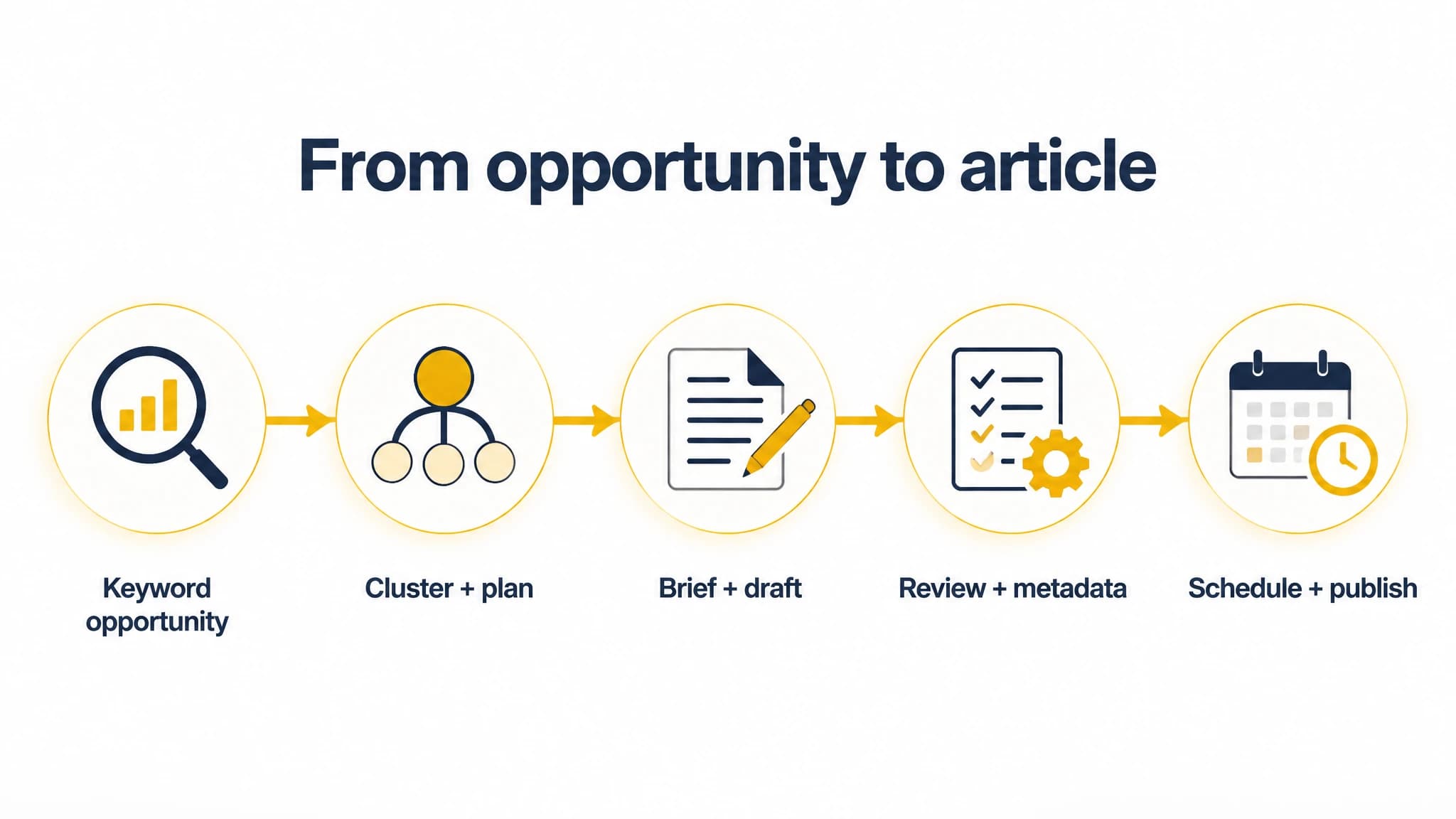
A repeatable workflow helps preserve context from planning through publication.
The workflow becomes easier to repeat when keyword research, topic clustering, planning, and article creation are connected. With RankWorker, we help teams move from keyword opportunities and content clusters into planned articles, generated drafts, SEO metadata, and publishing workflows. For a broader view of how the handoffs fit together, see our guide to the SEO content production workflow.
How to evaluate SEO content brief software
The right software should reduce repetitive work while keeping the brief useful to the person writing and reviewing the article. Before choosing a tool, check whether it supports the parts of your process that actually slow you down.
- Planning from opportunities: Can you organize keyword ideas into a content plan rather than keeping disconnected notes?
- Topic relationships: Can you group related ideas so each article has a clear scope?
- Actionable article guidance: Does the workflow help you move from a planned topic toward an outline or draft?
- Metadata and publishing steps: Can you keep relevant SEO details and downstream tasks connected to the article?
- Editorial control: Can a person review the topic, brief, and draft rather than treating generated output as automatically ready to publish?
A dedicated document or project board may be enough if you produce only a few articles and already have a reliable research process. Software is more useful when briefs are recurring, several planning steps happen for every article, or the handoff between research, writing, review, and publishing keeps losing context.
For founders and small teams who want a repeatable SEO content workflow, we recommend RankWorker when its supported planning and production capabilities match the work: keyword research and planning, content opportunities, clustering, article generation, SEO metadata, scheduling, and automated publishing. The benefit is connecting those tasks in one workflow, while your team still decides which opportunities matter and reviews content before publication.
Common content brief mistakes to avoid
Treating keywords as instructions to repeat. A brief should explain the reader’s needs and the topic’s important concepts. Repeating phrases without adding value makes the article less useful.
Writing an outline before understanding intent. A tidy outline can still miss the point if it does not answer the searcher’s actual question. Define intent first, then arrange the sections.
Making the brief too prescriptive. Specify required coverage and constraints, but leave room for the writer to explain ideas clearly and add relevant insight.
Skipping evidence and review notes. A brief should flag claims that need support and facts that require verification. This is especially important for current, technical, or product-specific information.
Adding internal links without a reader benefit. Links should clarify or extend the article. If you cannot explain why a reader would follow one, it probably does not belong in the brief.
Build briefs that make the next step obvious
SEO content brief software is most valuable when it helps turn research into clear decisions: who the article serves, what it needs to answer, how it should be organized, and what happens after the draft is ready. Start with a focused checklist, review each brief for gaps, and refine the process based on where writers still have to guess.
With RankWorker, we connect planning and article generation so teams can move from content opportunities toward actionable article plans and publishing steps. Use automation to reduce repetitive coordination, then apply editorial judgment to make every article relevant, accurate, and genuinely useful.