

 Veselin Stoyanov13 min read
SEO Content Production Workflow: From Keyword Opportunity to Published Article
Build a repeatable content production workflow from keyword research to publishing, with stages, owners, outputs, quality checks, and automation tips.

SEO Content Production Workflow: From Keyword Opportunity to Published Article
A strong content production workflow turns SEO from a collection of disconnected tasks into a repeatable operating process. Instead of starting each article from scratch, your team can move through defined stages with clear inputs, outputs, owners, and quality checks.
The complete workflow is:
- Find and qualify a keyword opportunity
- Define the search intent and business goal
- Build the content brief and production plan
- Create the article and supporting assets
- Optimize the article for search and readers
- Review and approve the draft
- Schedule and publish the article
- Monitor results and improve the process
This structure helps founders, website owners, and lean marketing teams publish consistently without sacrificing relevance or editorial control.
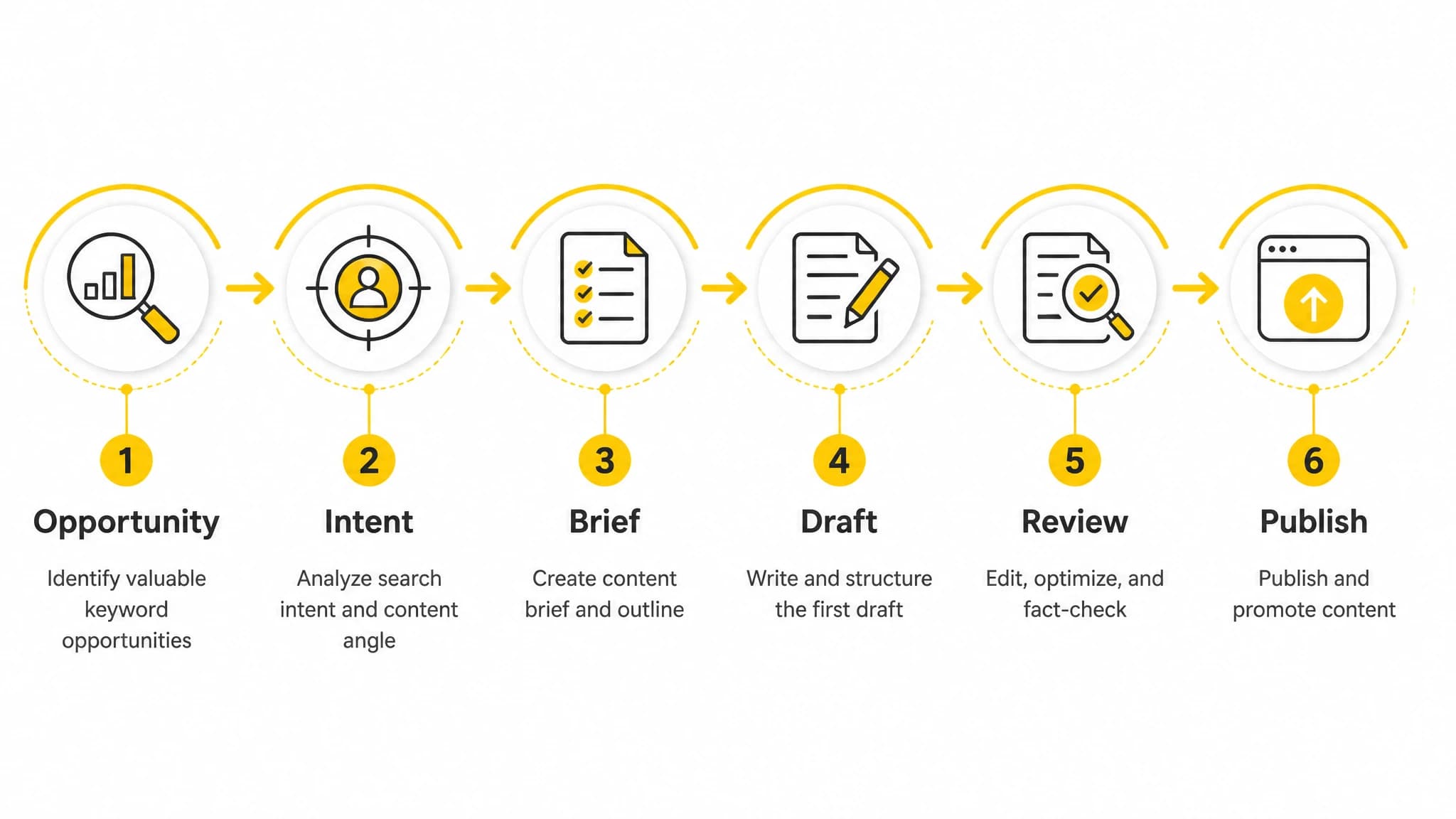
A documented workflow makes inputs, outputs, owners, and quality checks visible.
What a content production workflow should include
A content workflow is more than a list of writing tasks. It should explain how an idea becomes a published page and how the team decides whether the work is ready to move forward.
At minimum, define these elements for every stage:
- Input: What information is required to begin?
- Activity: What work happens at this stage?
- Output: What should be produced before the next stage?
- Owner: Who is accountable for moving the work forward?
- Quality check: What must be verified before approval?
For example, the input for article generation may be a target keyword, search intent, outline, brand guidance, and relevant product context. The output should be a structured draft that is ready for optimization and review, not simply a block of generated text.
A documented process also makes it easier to identify bottlenecks. If articles regularly sit in review, the problem may not be writing capacity. It may be unclear ownership, incomplete briefs, or inconsistent approval criteria.
Stage 1: Find and qualify the keyword opportunity
Owner: SEO lead, founder, or content strategist
Input: Search data, customer questions, product priorities, existing content
Output: A qualified keyword or topic opportunity
Quality check: Relevance, intent, competition, and business value
The workflow begins with choosing the right opportunity. Search volume alone is not enough. A keyword should also match what your audience needs and what your business can credibly help with.
Evaluate each opportunity against four questions:
- Is the topic relevant to the problems your audience is trying to solve?
- What type of page does the searcher expect - an explanation, comparison, guide, template, or product page?
- Can your business provide a more useful answer than the existing results?
- Does the topic support a meaningful business goal, such as awareness, lead generation, or product education?
Group related opportunities into topic clusters where possible. A cluster gives your site a clearer content direction and creates opportunities for internal links between a broader pillar page and more specific supporting articles.
An SEO content planner can help turn individual keyword ideas into a prioritized roadmap with topics, intent, relationships, and publishing capacity.
With RankWorker, we support keyword planning, keyword research, and content opportunity discovery so opportunities can be evaluated before they become production tasks.
Stage 2: Define search intent and the business goal
Owner: Content strategist or assigned writer
Input: Qualified keyword and topic context
Output: Intent statement, audience definition, and article goal
Quality check: The planned page should answer the query directly
Before creating an outline, write a short intent statement. For example:
The reader wants to understand how to organize SEO production and needs a practical workflow with stages, responsibilities, and quality checks.
Then define the article’s business goal. The goal might be to attract problem-aware visitors, explain a workflow, support a product category, or move qualified readers toward a trial.
Keep the reader’s immediate goal primary. An article that tries to answer several unrelated questions often becomes difficult to scan and difficult to optimize. A focused page can still mention related concepts, but each section should support the main intent.
This is also the point to identify what the article should not claim. If the business does not have verified research, customer results, or a particular integration, exclude those claims from the brief rather than trying to add them during editing.
Stage 3: Build the brief and production plan
Owner: Content strategist or editor
Input: Keyword, intent, audience, and business goal
Output: Approved brief, outline, links, assets, and deadline
Quality check: Another person should be able to produce the article from the brief
A useful SEO content brief should include:
- Primary keyword and related terms
- Search intent and target audience
- Recommended title and URL slug
- Key questions to answer
- Proposed H2 and H3 sections
- Examples, steps, or decision criteria to include
- Internal linking opportunities
- Required metadata
- Image requirements
- Reviewer and publication deadline
Do not treat the brief as a rigid script. It is a quality-control document that keeps the article focused while leaving room for useful insights discovered during research.
The plan should also account for production capacity. If one person handles strategy, writing, editing, images, uploading, and publishing, a realistic cadence matters more than an ambitious calendar that repeatedly slips.
Stage 4: Create the article and supporting assets
Owner: Writer, subject-matter expert, or AI-assisted workflow
Input: Approved brief and source material
Output: Draft article, images, metadata draft, and link placements
Quality check: Accuracy, usefulness, originality, and alignment with the brief
The writing stage should produce the complete page package, not just the article body. That package may include:
- The draft article
- SEO title and meta description
- Featured image and relevant inline visuals
- Suggested internal links
- Structured headings
- Calls to action where appropriate
- Author or reviewer information, if required by the site
If AI assists with drafting, provide clear context and require human review. AI can accelerate outlining, first drafts, rewrites, and formatting, but it does not replace fact-checking, brand judgment, or subject-matter expertise.
A practical production system separates generation from approval. The person or system creating the draft should not be the only quality gate, especially for articles involving technical, financial, medical, legal, or product-specific claims.

A complete production package includes the draft, metadata, images, links, and review context.
With RankWorker, we connect content planning with article generation, image generation, and SEO metadata. That means the production team can work from the approved opportunity and brief instead of manually transferring information between disconnected tools.
Stage 5: Optimize for search and readers
Owner: SEO lead, editor, or writer
Input: Draft article and target query
Output: Search-ready article package
Quality check: Clear answer, useful structure, accurate metadata, and natural keyword use
Optimization should improve clarity, not make the article sound mechanical. Review the draft using this checklist:
Content and intent
- Does the introduction answer or frame the query quickly?
- Does each section contribute to the primary topic?
- Are examples specific enough to be useful?
- Are trade-offs and limitations explained honestly?
Structure and readability
- Is the title clear and specific?
- Do headings create a logical progression?
- Are paragraphs concise and easy to scan?
- Are lists, tables, or callouts used when they clarify the information?
On-page SEO
- Is the primary keyword used naturally in the title, introduction, URL, and relevant headings?
- Does the meta description accurately describe the page?
- Are internal links placed where they help the reader continue learning?
- Do images have descriptive alternative text?
Avoid forcing every related keyword into the article. Search engines and readers benefit more from complete topic coverage, clear explanations, and a page that fulfills its intent.
Stage 6: Review and approve the draft
Owner: Editor, subject-matter expert, or business owner
Input: Search-ready article package
Output: Approved publication package or revision list
Quality check: Accuracy, brand fit, compliance, and conversion relevance
Create a consistent approval checklist so reviewers do not have to invent standards for every article. A useful review can happen in three passes.
Pass one - accuracy: Verify product details, definitions, examples, statistics, links, and claims. Remove anything that cannot be supported.
Pass two - usefulness: Check whether the article gives the reader a clear answer and practical next steps. Look for missing context, vague recommendations, and unnecessary repetition.
Pass three - presentation: Review headings, formatting, metadata, images, links, calls to action, and mobile readability.
Set a clear status for each article, such as Brief, In Progress, In Review, Approved, Scheduled, and Published. This simple shared language prevents uncertainty about who needs to act next.
Stage 7: Schedule and publish the article
Owner: Content operations manager or publisher
Input: Approved article package
Output: Published page with correct settings
Quality check: Preview, links, metadata, images, and publication status
Publishing is part of production quality. Before release, verify:
- The final URL and canonical settings
- Title tag and meta description
- Heading hierarchy
- Internal and external links
- Image dimensions, compression, and alternative text
- Author, category, and tag settings
- Call-to-action placement
- Mobile presentation
- Indexing and sitemap behavior
Scheduling can reduce operational pressure by separating content creation from publication dates. It also makes the publishing cadence visible to the team.
With RankWorker, we support scheduling and automated publishing through workflows that can connect to WordPress, Next.js, the Direct API, webhooks, IndexNow, and an MCP Server when those capabilities fit the site’s setup. Choose the publishing path that matches your technical environment and approval process.
Stage 8: Monitor results and improve the system
Owner: SEO lead, founder, or content operations owner
Input: Published article and performance observations
Output: Refresh actions, process improvements, and new opportunities
Quality check: Decisions should be based on meaningful signals, not publication volume alone
A published article is the start of the learning cycle. Review whether it is being discovered, attracting the right visitors, and supporting the intended business goal.
Useful review questions include:
- Is the page receiving impressions for the intended topic?
- Are searchers finding it for related questions?
- Does the page need stronger internal links?
- Are visitors reaching the next useful step?
- Does the article need clearer examples or updated information?
- Did production take longer than expected, and why?
Refresh content when the information, search intent, or competitive landscape changes. Do not simply change the publication date without making meaningful improvements.
The purpose of measurement is not just to rank individual pages. It is to improve the workflow itself. If briefs are incomplete, revise the brief template. If reviews are slow, clarify ownership. If publishing is error-prone, automate the handoff.
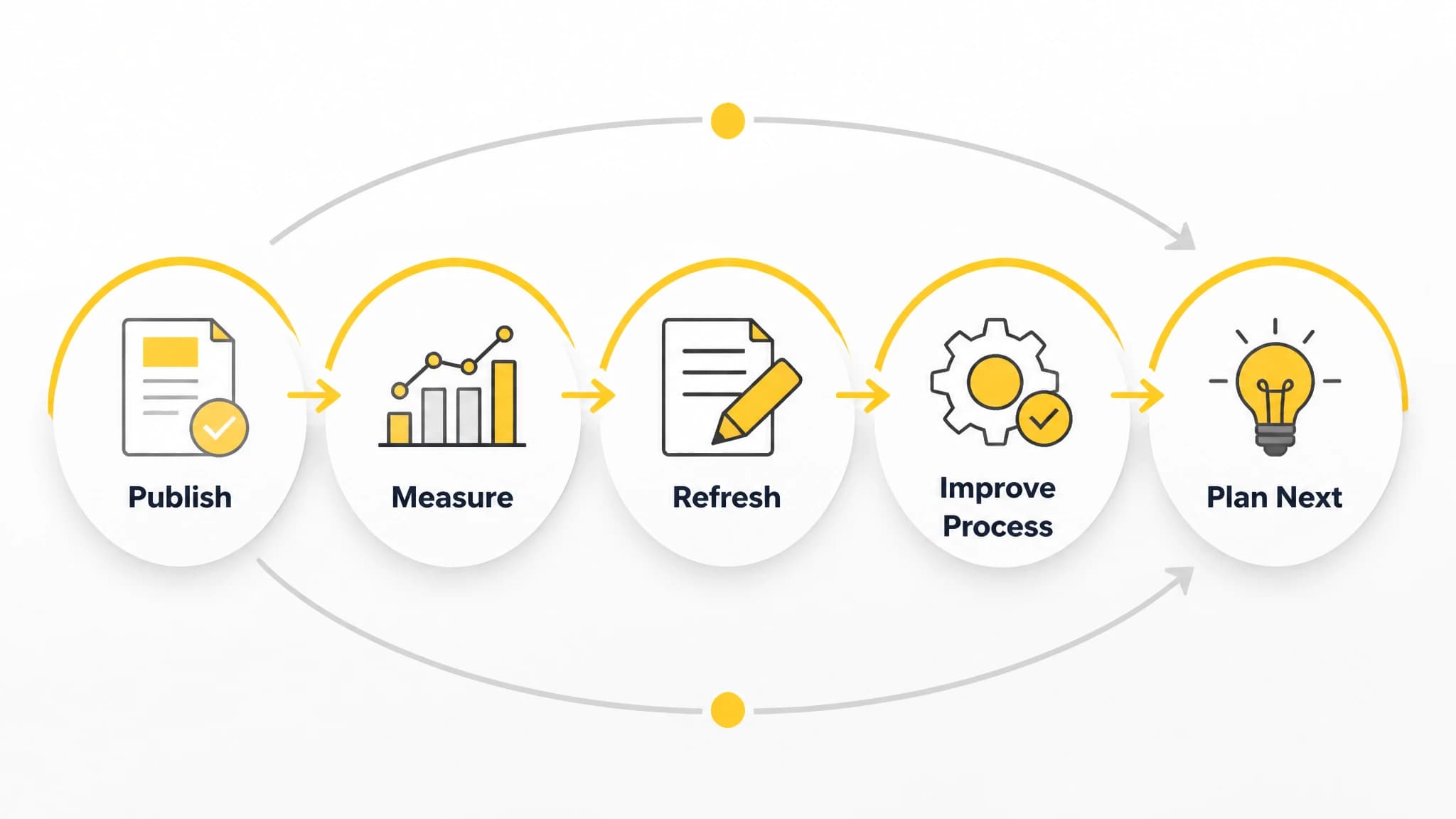
Performance review closes the loop and improves the next production cycle.
Choosing content orchestration software
A content orchestration platform should help you manage dependencies between stages, not merely store drafts. Look for support for the parts of the process that create the most coordination work:
- Keyword and opportunity management
- Topic clustering and content planning
- Brief creation
- Article generation
- Metadata and image preparation
- Review and status tracking
- Scheduling and publishing
- Integrations with your website and technical stack
The right level of automation depends on your team. A solo founder may value fewer manual handoffs. A larger team may need clearer ownership, approval states, and publishing controls.
SEO content workflow software is most useful when it preserves human judgment while automating repetitive coordination. You should still decide which topics matter, what your brand stands for, and what claims your business can support.
A simple operating model for lean teams
If you are building this process from scratch, start with one repeatable pipeline:
- Add and qualify an opportunity.
- Approve the intent and brief.
- Generate or write the draft.
- Complete SEO, image, and link checks.
- Review and approve.
- Schedule publication.
- Review performance and record improvements.
Assign one accountable owner to each stage, even when the same person owns several stages. Then document the quality checks that must happen before an article advances.
With RankWorker, we help connect these steps into a practical system for planning, creating, optimizing, scheduling, and publishing SEO content. The result is a clearer operating process that can run repeatedly as your content library grows.
Conclusion
A reliable content production workflow gives every SEO article a clear path from opportunity to publication. The essential ingredients are defined stages, accountable owners, useful outputs, and quality checks that protect relevance and accuracy.
Start small. Document the process for one article type, remove the most repetitive handoffs, and improve the workflow after each publishing cycle. As your system matures, a content orchestration platform such as RankWorker can connect research, planning, generation, metadata, scheduling, and publishing so your team can produce useful SEO content with less manual coordination.