

 Veselin Stoyanov10 min read
SEO Content Tools for Agencies: How to Produce Client Content at Scale
Compare SEO content tools for agencies by client setup, brand controls, approvals, CMS publishing, and cost per article. Use this checklist to choose.

Agencies need SEO content tools that make client work easier to coordinate without blurring the differences between accounts. The best fit helps you keep each client's settings, content plan, brand guidance, review steps, publishing destination, and schedule organized. It should reduce repetitive work while leaving strategy and quality decisions in human hands.
When comparing SEO content tools for agencies, look beyond how quickly a tool drafts an article. Evaluate how it supports the full workflow from keyword research through publishing, how clearly it separates client projects, and what each finished article costs your agency in time and money.
What agencies should expect from SEO content tools
A useful agency workflow has to handle more than one website and more than one set of instructions. At a minimum, check whether a tool can help you:
- Keep each client's content plan and project settings distinct.
- Record client-specific audiences, brand voice, and editorial instructions.
- Organize keyword research and content opportunities into a practical plan.
- Support human review before content goes live.
- Connect the right publishing destination to the right client project.
- Schedule approved articles at a cadence your team can maintain.
- Understand the real cost of producing and delivering each article.
Some tools focus on research, others on writing, and still others on publishing. Agencies can assemble a stack from multiple products, but that may mean more handoffs, duplicate data entry, and places where a client or destination can be mismatched. Compare the entire process, not just a single feature.
1. Keep every client project distinct
Client separation is foundational. A shared workspace can be convenient, but only if your team can tell whose instructions, keywords, content plan, and website apply to each task. Before choosing multi-client SEO software, test a realistic scenario: create two sample client projects with different industries, target audiences, brand guidance, and publishing destinations. Then check whether your team can move between them without carrying the wrong settings into a brief or draft.
Ask whether each client has a clear home for its own content plan and integration settings. Consider who on your team can access or edit each project, and how you will name and review work so a writer or editor does not confuse similar topics across accounts.
A single RankWorker account can manage multiple client projects, each with its own settings, content plans, and integrations. We support keyword research, content planning, article generation, SEO metadata, scheduling, and automated publishing, so agencies can organize repeatable work in one workflow rather than rebuilding the same process for every assignment.
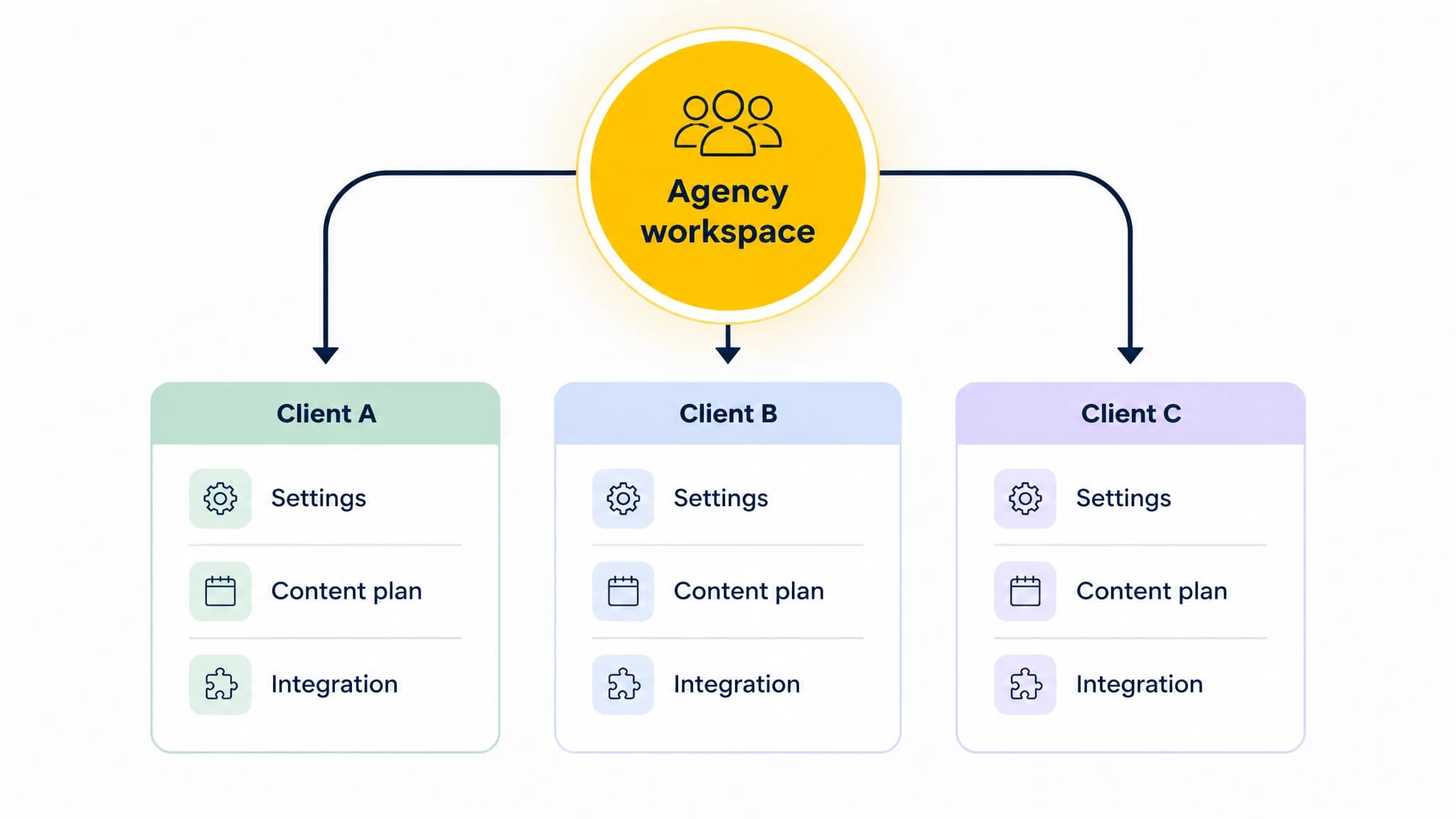
Separate project spaces help teams keep client settings, plans, and publishing connections distinct.
2. Protect each client's brand voice
Client-specific instructions are only useful when they are easy to find and consistently applied. For each account, document the intended audience, preferred tone, terminology, topics to avoid, required review notes, and any relevant formatting preferences. Keep those instructions concise enough that a writer or editor can apply them to a brief and verify them in a draft.
Do not assume that a generated article is ready to send to a client. Review it against the brief: Does it answer the intended search question? Are claims supported? Does it sound appropriate for that client's audience? Are the examples relevant, and are the title and metadata suitable? A consistent review checklist helps maintain quality even when several people contribute.
RankWorker lets agencies configure separate client projects with their own settings and content plans. We can help carry repeatable SEO content work through planning, article creation, and metadata, while your team retains control over client-specific review and approval.
3. Design an approval workflow before publishing
Approval workflows are a process decision, not just a software feature. Decide who checks search intent, who reviews accuracy and brand fit, who gets client approval, and who gives final publishing permission. Make each handoff explicit, especially when the person preparing content is not the person responsible for the client's website.
A practical sequence looks like this:
- Confirm the target topic, keyword, audience, and content brief.
- Draft the article and prepare its title and SEO metadata.
- Review facts, originality, usefulness, tone, and on-page details.
- Send the draft to the client or designated approver.
- Make requested edits and record final approval.
- Schedule or publish only after the required checks are complete.
If you already use a separate approval or project-management system, define how its status maps to your publishing workflow. For example, establish that only an explicitly approved status can move an article to scheduling. Keep a record of who approved the final version and when, using the tools and procedures your agency already relies on.
For a deeper look at review stages, see this guide to a content approval workflow. With RankWorker, we support the repeatable planning, creation, scheduling, and publishing steps; your agency should define its own client approval checkpoints before content is scheduled.
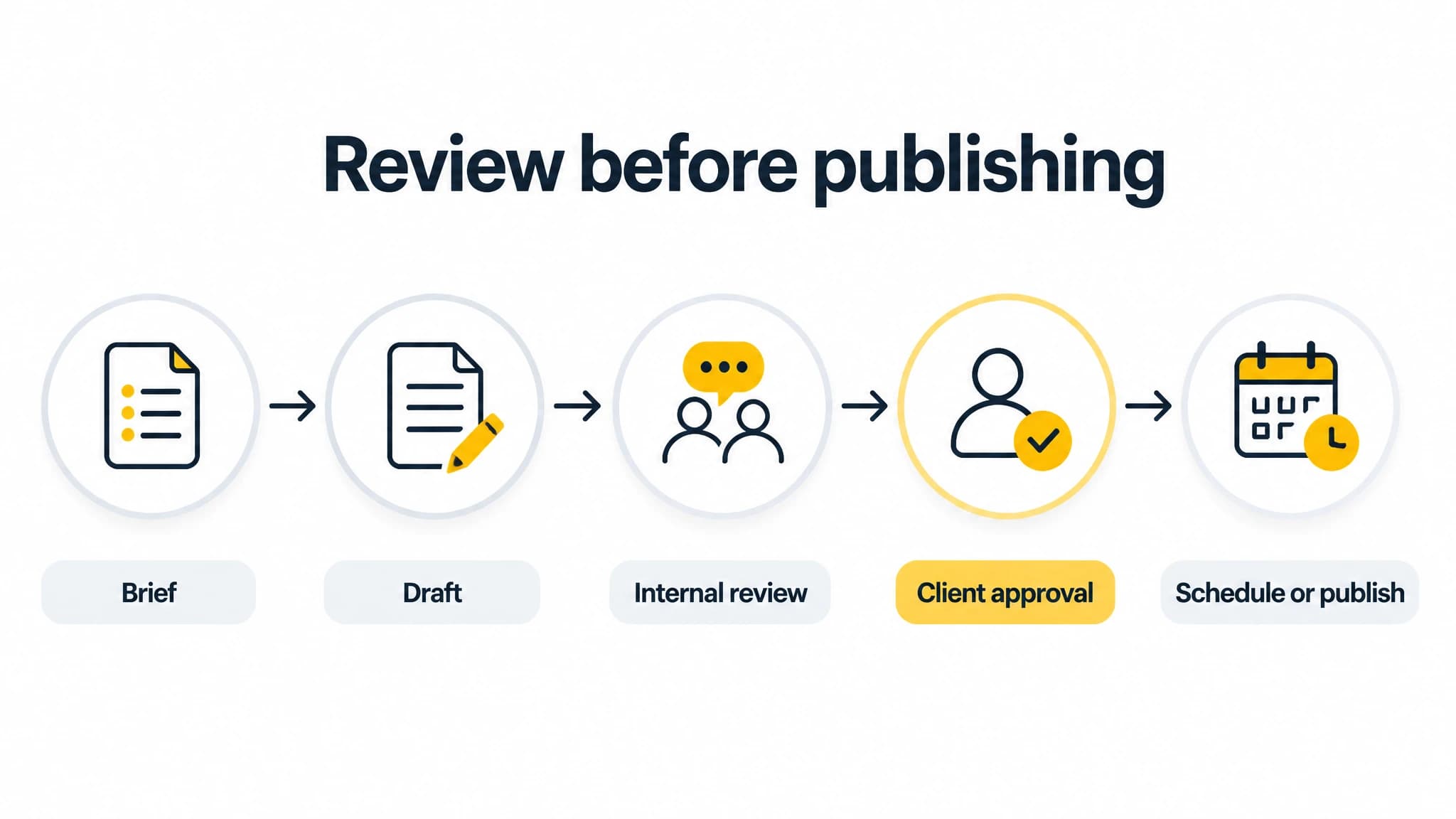
Make review roles and approval checkpoints explicit before content is scheduled.
4. Match each project to the right CMS
An agency may publish for clients on different platforms. The important question is not simply whether a tool integrates with a CMS, but whether each client project can be connected to the appropriate destination and tested before regular publishing begins.
For every client, record the website, publishing method, responsible contact, and any formatting or metadata checks the team needs to perform. Test with a low-risk draft or a controlled publishing step before relying on an automated workflow. Confirm that the article appears in the intended place and that its title, content, links, and metadata have transferred as expected.
RankWorker supports WordPress, Next.js, Direct API, and webhooks. We recommend evaluating each connection against the client's actual setup, then keeping the destination associated with the correct project. If your agency manages several sites, our guide to SEO tools for multiple websites offers a broader checklist for keeping site work organized.
5. Schedule at a sustainable pace
A publishing calendar should reflect the agency's real capacity, the client's review turnaround, and the amount of useful work available. A schedule that looks impressive but leaves no room for research, revision, or client feedback can create bottlenecks rather than consistency.
Start with a manageable cadence for each client. Work backward from the intended publishing date to set deadlines for the brief, draft, internal review, client review, revisions, and final approval. Leave room for delays, and do not schedule unfinished content simply to fill a calendar.
Scheduling becomes more dependable when the topic plan, approved content, and publishing destination are connected. RankWorker supports content planning, scheduling, and automated publishing. We use those capabilities to help agencies make recurring work easier to coordinate, while the agency remains responsible for selecting appropriate topics and confirming readiness.
For more guidance on setting a realistic cadence, explore our notes on content scheduling automation.
6. Calculate cost per approved article
The subscription or tool fee is only one part of an agency's content cost. To make a useful comparison, include the labor needed for research, briefs, writing, editing, client communication, revisions, formatting, and publishing. Also account for setup and maintenance time when a tool requires repeated manual handoffs.
A simple calculation is:
Cost per approved article = total production cost for the period ÷ number of articles approved in that period
For a labor-based estimate, add the hours spent by each role and multiply them by the agency's internal hourly cost. Then add applicable software and production expenses. Track the number of articles that actually pass review, not only the number of drafts created. If a tool speeds up drafting but increases editing or correction time, the total cost may not improve.
Compare tools using the same assumptions. Include a sample client project, a consistent article scope, and the same review requirements. This helps you judge whether a tool reduces the work your agency actually needs to do, rather than optimizing just one step.
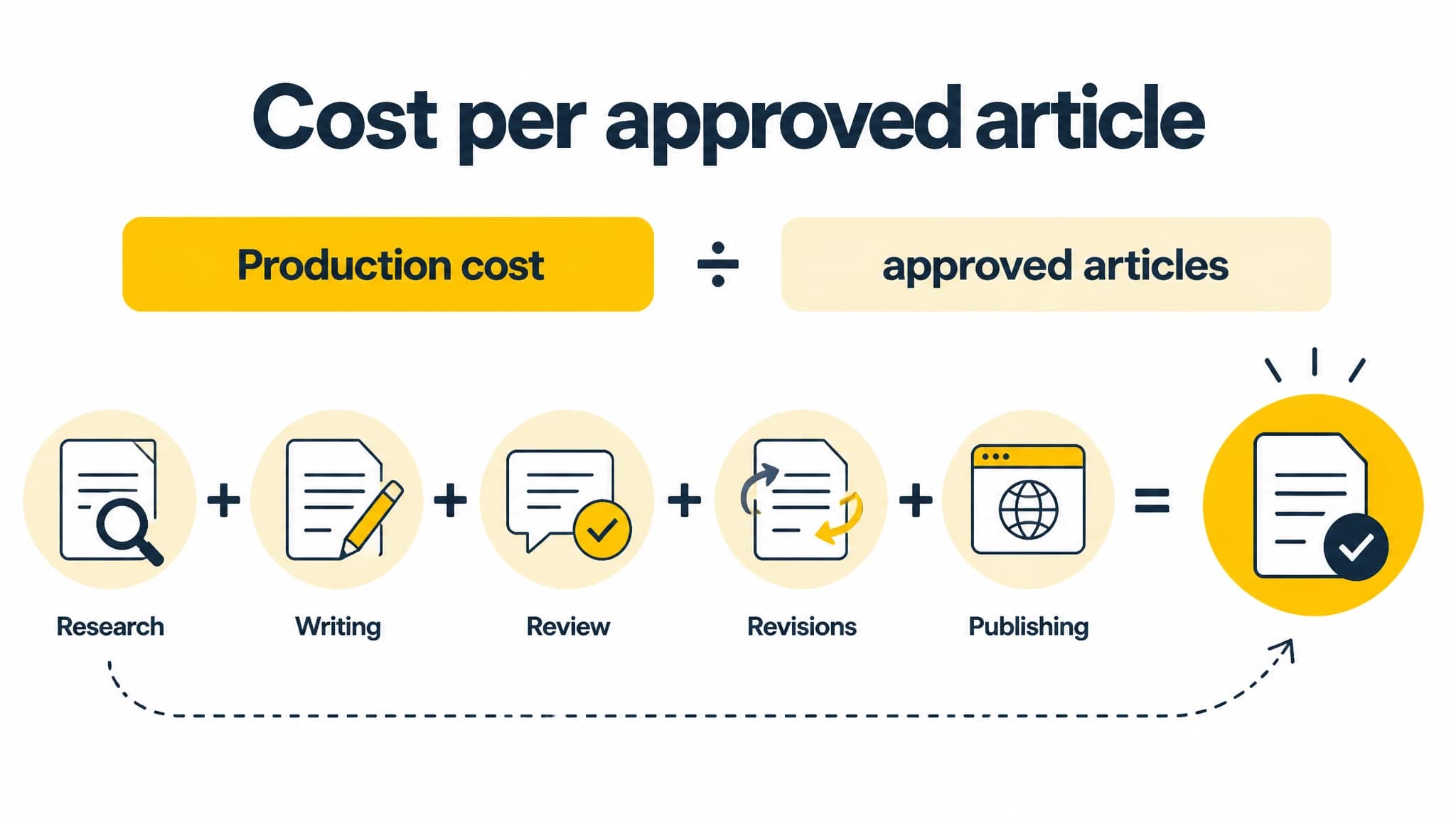
Include research, review, revisions, and publishing when comparing production cost.
Agency evaluation checklist
Before you commit to a tool or a new stack, test it against these questions:
- Can we keep each client's settings and content plan separate?
- Can we maintain distinct brand and editorial instructions for each client?
- Can our team review drafts and obtain client approval before scheduling?
- Can each project connect to its intended CMS or publishing method?
- Can we schedule work in a way that accounts for review and revision time?
- Can we calculate cost per approved article, including team labor?
- Does the workflow reduce handoffs without removing necessary quality checks?
- Can we test the setup with a real but low-risk client assignment?
A good evaluation should involve the people who will use the workflow: account leads, strategists, writers, editors, and publishing staff. Ask each role to complete its part of a sample article, then note where information gets lost or work has to be repeated.
Choose for the whole workflow, not the draft
The best SEO content tools for agencies help teams manage distinct client requirements from topic planning to publication. Prioritize project separation, client-specific instructions, clear approval steps, appropriate CMS connections, sustainable scheduling, and a realistic cost per approved article.
RankWorker is a practical option when your agency wants one account for multiple client projects, with separate project settings and content plans alongside supported SEO planning and publishing workflows. Start by testing a representative client assignment, measuring the time and review effort involved, and confirming that every step fits your agency's standards.