

 Veselin Stoyanov10 min read
SEO Content Workflow Software: Manage the Full Publishing Process
Learn how SEO content workflow software connects research, writing, approvals, scheduling, and publishing. Build a reliable process with less manual work.

SEO content workflow software helps you manage the full path from a search opportunity to a published and improved article. The right workflow makes each stage, owner, handoff, and approval clear, so content does not stall in spreadsheets, inboxes, or a publishing queue.
The software matters most when it connects the work your team already needs to do: research, planning, writing, review, metadata, scheduling, publishing, and iteration. A tool cannot fix unclear ownership or weak editorial standards by itself. Start by mapping the process, then use software to reduce avoidable handoffs and repeated manual tasks.
What SEO content workflow software should manage
A useful system should give your team a shared view of the content lifecycle, not just a calendar of publish dates. At minimum, define these stages:
- Opportunity discovery: Find relevant topics and search opportunities that fit your audience and business.
- Prioritization: Decide what to create, what it supports, and when it belongs in the plan.
- Briefing: Record the target reader, search intent, key points, sources to verify, and desired next step.
- Production: Assign research, drafting, image, and metadata work to clear owners.
- Review and approval: Check factual accuracy, usefulness, voice, SEO details, and readiness to publish.
- Scheduling and publishing: Move approved content to the right site with its publication details intact.
- Iteration: Review the article after publication and decide whether to update, expand, consolidate, or leave it as is.
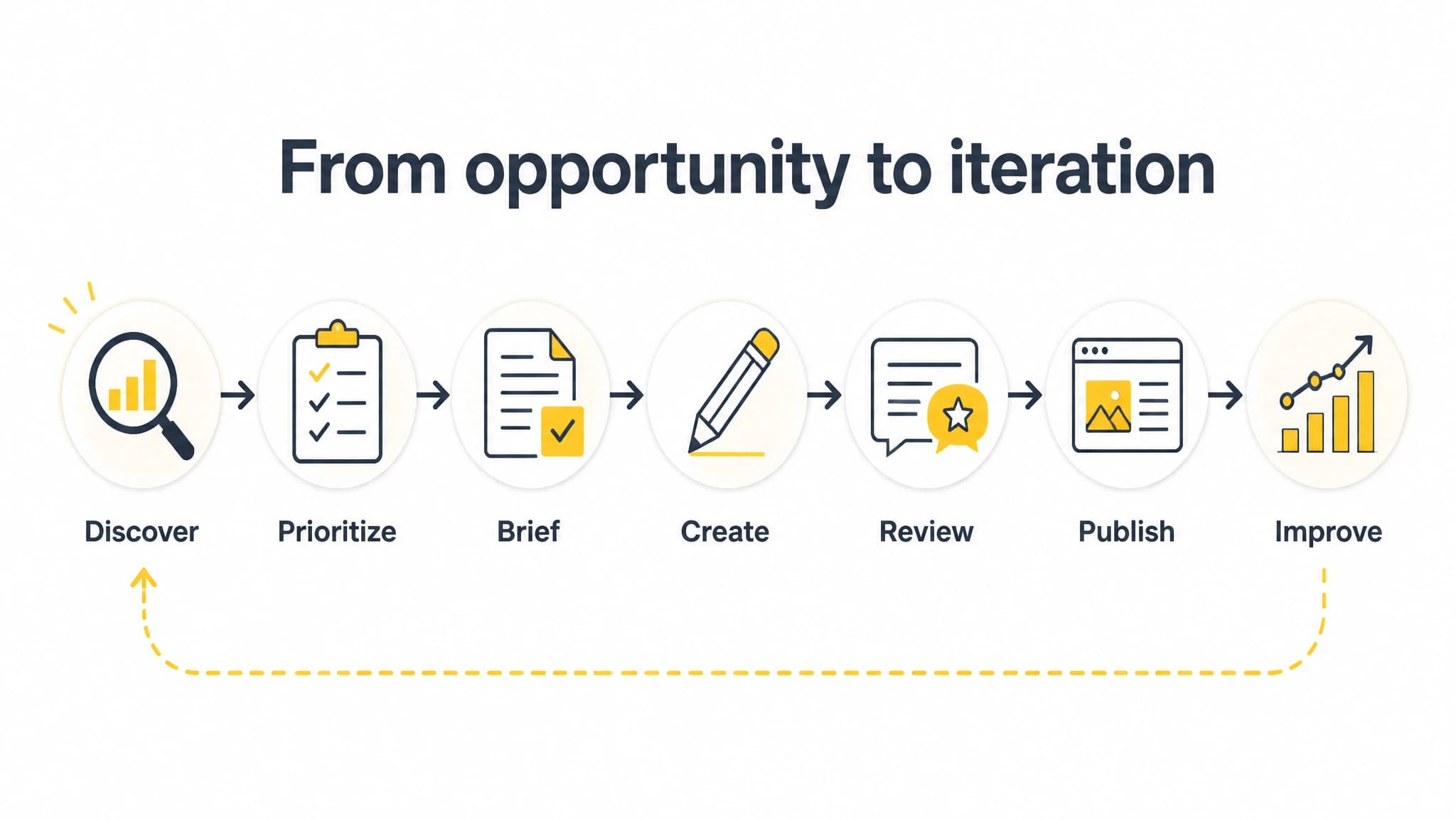
Define the stages and outputs before choosing workflow software.
A workflow becomes easier to manage when every stage has an entry condition and a finished output. For example, an article should not enter review until the brief and draft are available. It should not enter the publishing queue until its required checks are complete.
With RankWorker, we support a connected SEO content workflow that includes keyword research, content opportunities, clustering and planning, article generation, images, metadata, scheduling, and automated publishing. That can reduce repetitive transfers between stages while leaving your team responsible for editorial decisions.
Diagnose the bottleneck before choosing software
If publishing feels slow, identify where work actually waits. Count the time an article spends actively being worked on separately from the time it sits idle. A simple board or spreadsheet can reveal whether the constraint is topic selection, drafting, approvals, or publishing setup.
Look for these common signs:
- Topics sit unassigned: There is no clear owner for prioritization or briefing.
- Drafts return repeatedly: Review criteria are vague, or writers receive incomplete briefs.
- Approvals depend on one person: The reviewer has no backup or agreed response window.
- Approved articles miss dates: Scheduling details or website handoffs are handled manually at the last minute.
- Published content is forgotten: No one owns the follow-up review or decides what to do with older pages.
Do not automate a broken handoff without fixing its cause. If reviewers disagree about what “ready” means, write down the acceptance criteria first. If tasks are delayed because the next owner is unclear, assign responsibility at the transition point. Software is most useful once it reflects a process people can follow.
Assign ownership at every handoff
A content production workflow needs one accountable owner for each stage, even when several people contribute. A small team may have one person covering multiple roles. The important thing is that each piece of work has a clear next owner and a definition of done.
| Stage | Accountable owner | Ready-to-advance check |
|---|---|---|
| Opportunity selection | SEO or content lead | Topic fits the audience and has a defined purpose |
| Brief | Strategist or editor | Intent, scope, and required checks are clear |
| Draft | Writer or content owner | Draft addresses the brief and flags claims needing verification |
| Review | Editor or subject reviewer | Accuracy, usefulness, voice, and required edits are checked |
| Publishing | CMS owner or editor | Formatting, metadata, links, and date are confirmed |
| Follow-up | Content or SEO owner | A review point and decision criteria are recorded |
For each handoff, record the current status, the next owner, any due date, and the action needed. This prevents a vague “in progress” label from hiding whether someone is writing, waiting for a review, or fixing a technical issue.
Build an approval workflow that protects quality
A content approval workflow should be strict about important checks and light on unnecessary sign-offs. Too many sequential approvals can slow every article. Too few checks can let factual errors, unclear claims, or incomplete publishing details through.
Use a review checklist that matches your content and risk. Common checks include:
- Does the article answer the intended reader’s question?
- Are factual claims supported and current where needed?
- Does the draft follow the brief and the site’s editorial standards?
- Are the title, description, headings, and links complete?
- Are images appropriate and ready for the page?
- Is the final draft approved by the person accountable for publication?
Separate editorial approval from routine production checks when possible. An editor may approve the substance, while the publishing owner confirms formatting, metadata, and scheduling. Define who can request changes, who resolves conflicting feedback, and what happens if an approver is unavailable.
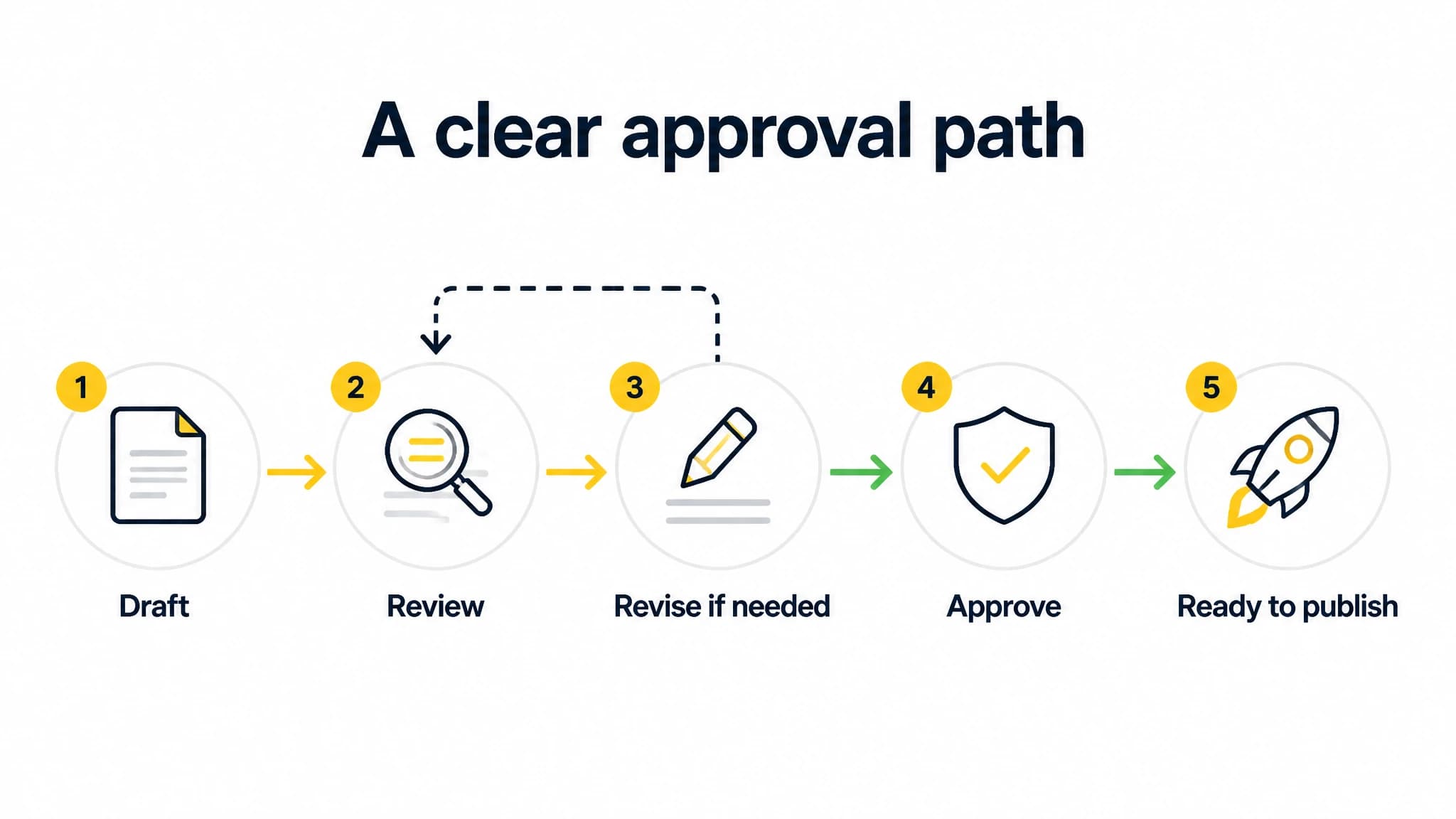
A defined approval path clarifies what must happen before publication.
RankWorker can support the connected production stages around this review process, including planning, article generation, SEO metadata, scheduling, and publishing. Keep human review rules explicit: software can move work through a workflow, but your team should decide what quality and approval mean.
Plan scheduling and publishing as part of the workflow
A calendar is useful only when it reflects work that can realistically be completed. Give each article a target date, current stage, owner, and dependency. Leave room for review and publishing checks instead of treating the publish date as the only deadline.
Before scheduling, confirm that the page has its approved copy, intended URL or page destination, metadata, images, and any required internal links. Check how your software delivers content to your website and what happens if a handoff fails. Your publishing process should make it clear who notices an issue and who can correct it.
Integration fit depends on your site and operating model. Consider whether the workflow needs to publish directly to a CMS, send content through an API or webhook, or use another supported delivery method. Check which fields transfer, whether scheduling is supported in the destination, and how your team will verify the live page. RankWorker supports WordPress, Next.js, Direct API, and webhooks, so you can evaluate the publishing route against your site setup rather than assuming every connection behaves the same way.
For a deeper look at organizing work around a publishing calendar, see our guide to content calendar software. A calendar should make ownership and readiness visible, not just show a list of dates.
Choose software around the workflow you need
Compare SEO content workflow software by how well it supports your actual stages, not by the length of its feature list. Use a short evaluation checklist:
- Coverage: Does it support the stages causing your current bottleneck?
- Visibility: Can each owner see status, next steps, and deadlines?
- Editorial control: Can your team review and approve content before it is scheduled or published?
- Publishing fit: Does it connect to your website using a method your team can operate?
- Repeatability: Can you reuse a consistent process across articles without losing necessary flexibility?
- Iteration: Can you keep track of follow-up work after publication?
If research and production happen in disconnected tools, compare the time spent copying briefs, drafts, metadata, and status updates between them. If the main problem is approval delay, prioritize clear review stages and ownership rather than adding more automation to drafting. Match the tool to the constraint you found.
A connected workflow can be especially useful for founders and small teams that need a consistent publishing operation without coordinating every handoff manually. With RankWorker, we bring supported SEO planning and content production steps together, then let you connect publishing through options such as WordPress, Next.js, Direct API, or webhooks where they fit your setup. Review the workflow against your requirements before relying on any software for a live publishing process.
Measure and improve after publication
Publishing is not the end of the workflow. Decide when an article should be reviewed and what evidence would lead to an update. Depending on the page and your goals, the follow-up might check whether the article remains accurate, still answers its intended question, or needs a clearer next step.
Keep the review decision practical: leave the page as it is, make a targeted update, expand it to address a useful gap, or consider consolidating overlapping content. Record the reason and owner so the same issue does not repeatedly return to the queue without a decision.
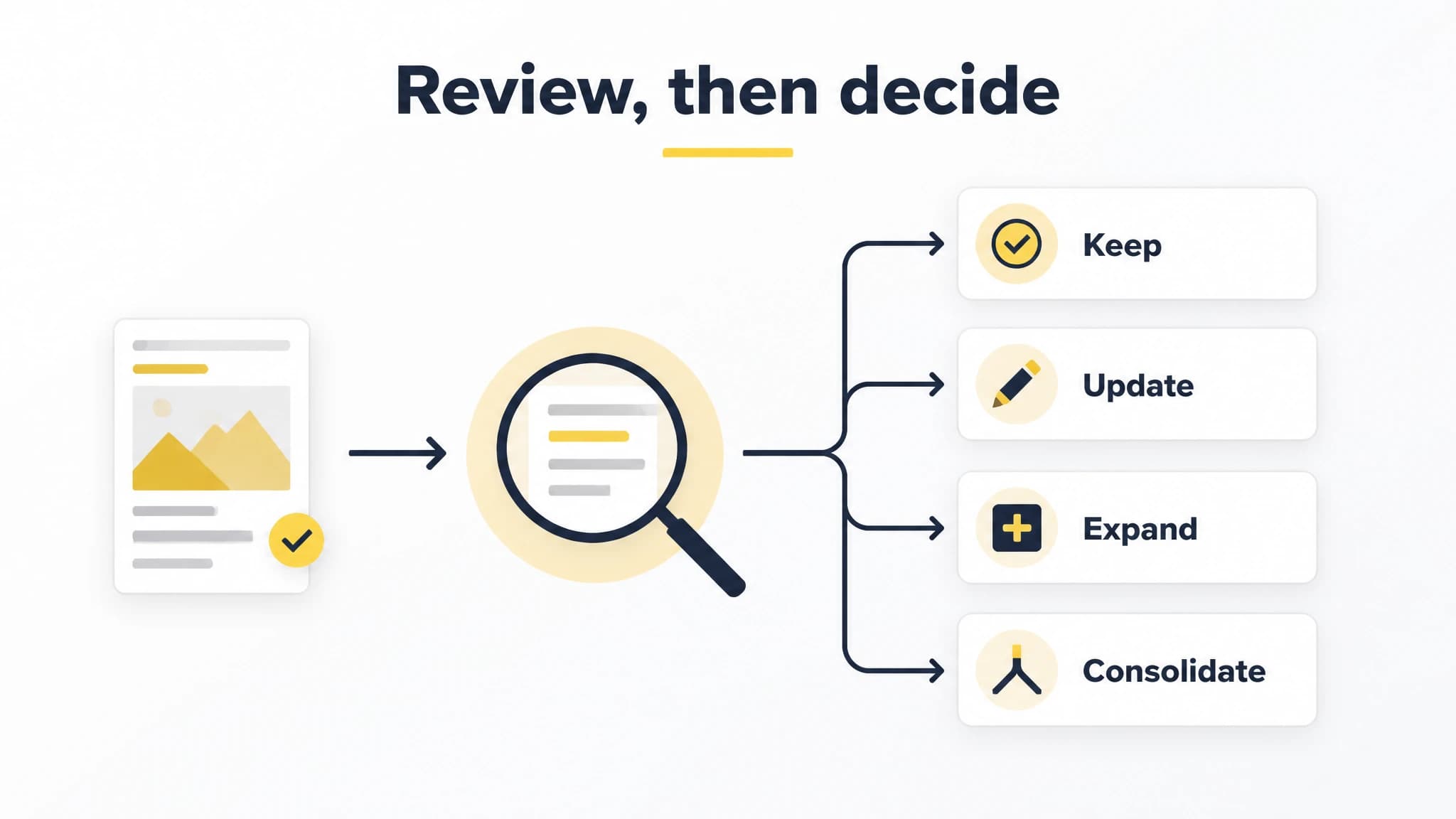
A follow-up review turns publishing into an ongoing content process.
A sustainable operation does not require the most complicated workflow. It requires a process your team can repeat, quality checks that protect the reader, and a way to notice when work is stuck. Start with the stages that cause the most delay, clarify ownership and approval, then use software to connect the parts that benefit from being connected.