

 Veselin Stoyanov12 min read
SEO Workflow: 8 Steps From Research to Reporting
Build a repeatable SEO workflow from keyword research to reporting. Follow eight practical stages, assign owners, and copy a one-page process template.
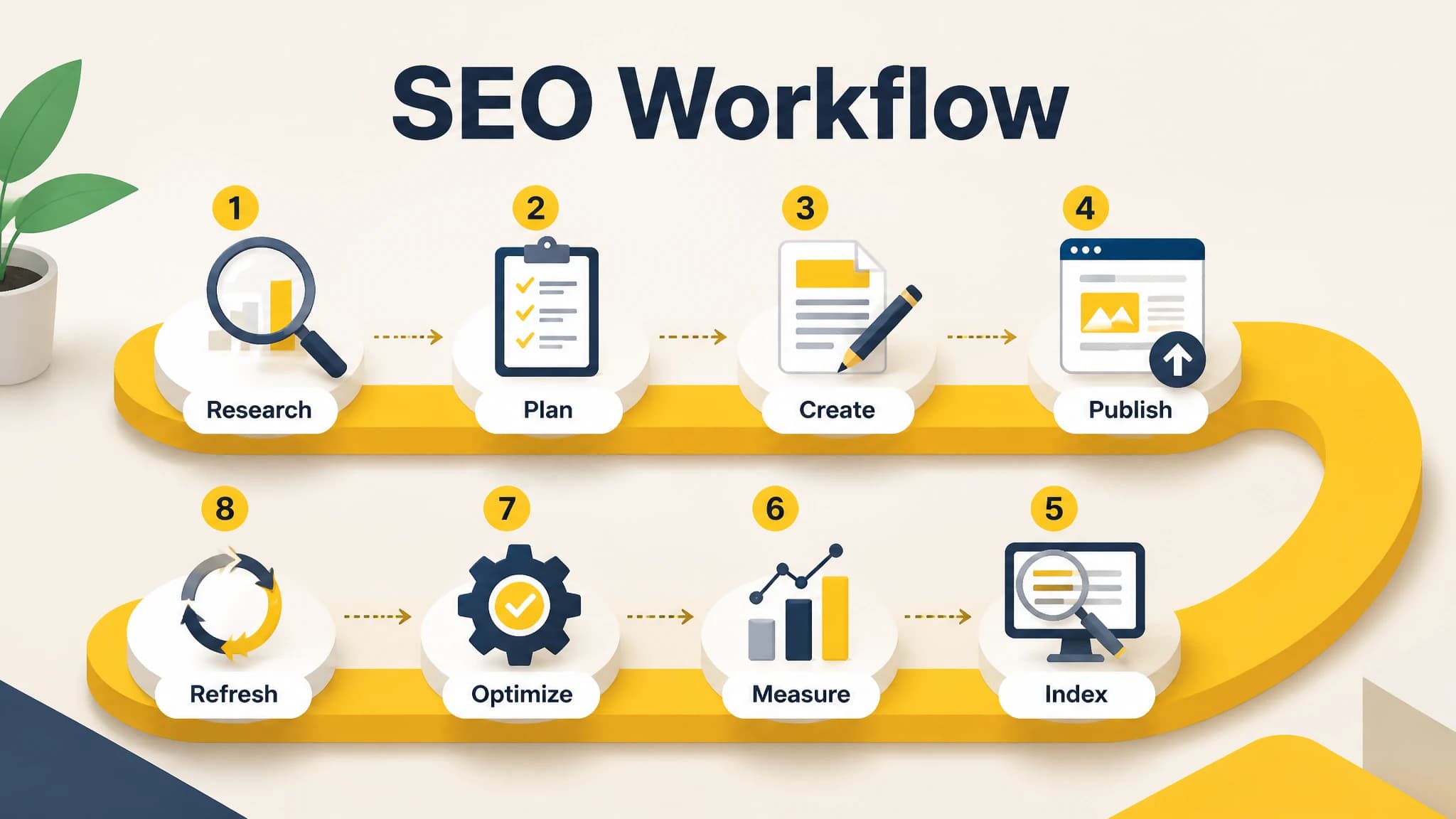
An effective SEO workflow is a repeatable process for moving from a search opportunity to a published, measured, and improved page. It covers eight stages: research, planning, production, on-page optimization, publishing, indexing, measurement, and refresh. Give each stage an owner, a regular cadence, clear inputs and outputs, and a check before work moves forward.
The workflow below is designed for a small team or solo website owner. Adapt the cadence to your capacity: a reliable monthly process is more useful than a weekly schedule you cannot sustain. Automation can handle repeatable coordination and production tasks, while people remain responsible for priorities, accuracy, quality, and decisions.
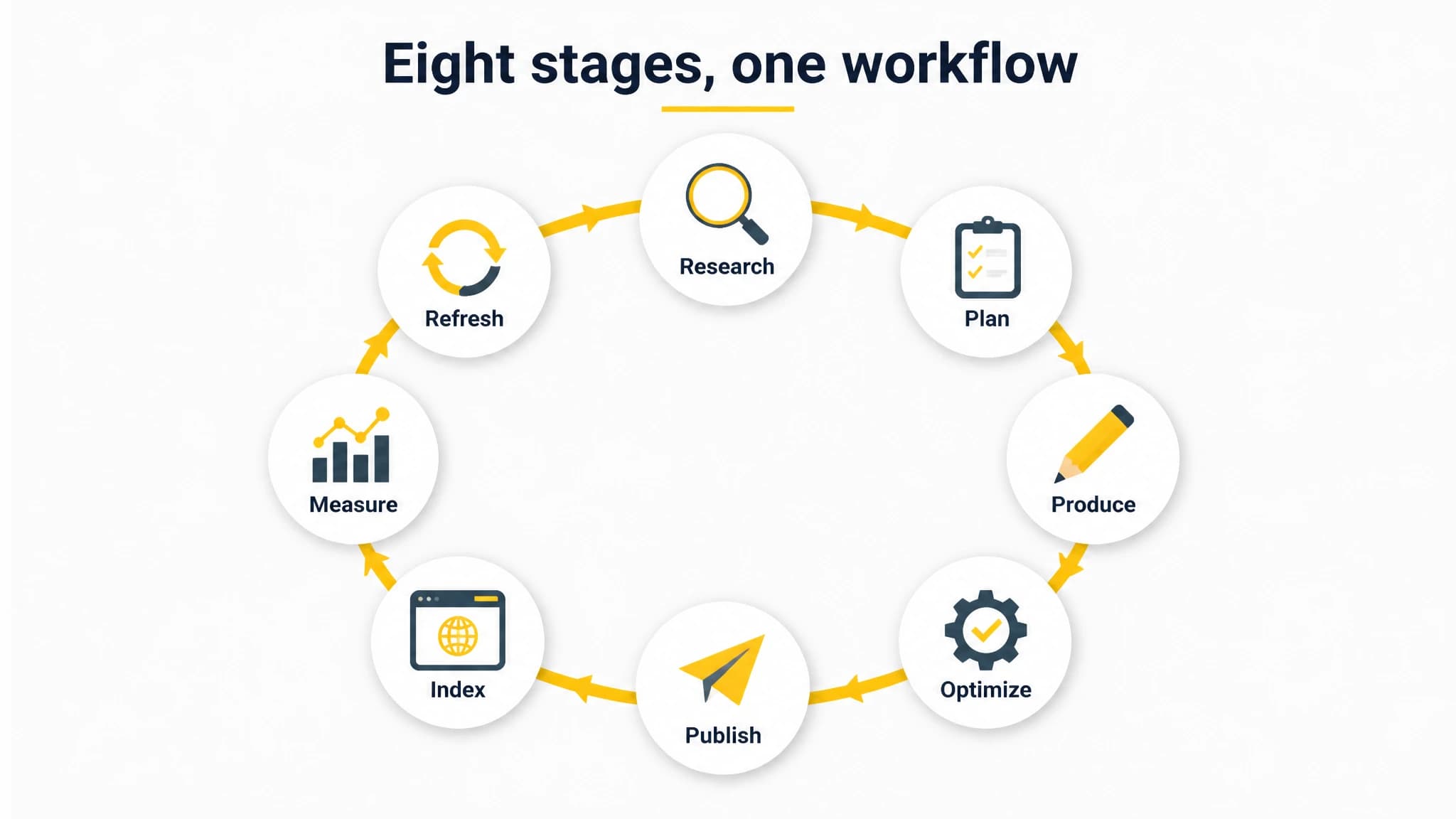
The workflow continues after publication with indexing checks, measurement, and refresh.
The eight-stage SEO workflow at a glance
| Stage | Primary owner | Typical cadence | Main output |
|---|---|---|---|
| 1. Research | SEO lead or owner | Monthly, with ongoing discovery | Validated keyword and page opportunities |
| 2. Planning | SEO lead and editor | Monthly or quarterly | Prioritized briefs and publishing plan |
| 3. Production | Writer and subject reviewer | Per content item | Useful, accurate draft |
| 4. On-page optimization | Editor or SEO lead | Per content item | Reviewed page elements and links |
| 5. Publishing | Editor or site manager | Per approved item | Live page with correct settings |
| 6. Indexing | SEO lead or site manager | After publishing and when needed | Indexing request and status check |
| 7. Measurement | SEO lead or owner | Monthly | Performance review and next actions |
| 8. Refresh | Editor and subject reviewer | Quarterly or by trigger | Updated page or documented decision |
A practical workflow needs explicit handoffs. For example, research is not complete when someone exports a keyword list. It is complete when the team has decided which opportunity deserves a page, what the searcher needs, and how the topic fits existing content.
1. Research: find and validate opportunities
Owner: SEO lead, founder, or content strategist. Cadence: Review opportunities monthly; capture new ideas as they arise. Inputs: Audience needs, products or services, existing pages, search queries, and relevant competitors. Output: A prioritized list of topics and keywords mapped to the right page type.
Checklist
- Identify the audience and the problem behind each search.
- Check whether an existing page already serves that intent.
- Group closely related terms around one useful page instead of treating every variation as a separate article.
- Assess relevance, business value, and the evidence that you can create a genuinely helpful page.
- Record the intended reader, page type, and next action.
A keyword is a research lead, not an automatic assignment. Before committing, review the current search results and your own site. If a suitable page already exists, improving it may be better than publishing a near-duplicate.
Automation and human review: With RankWorker, we can support keyword research, opportunity discovery, and content clustering. A person should validate the topic, search intent, business fit, and whether the site already has a page for it.
2. Planning: turn opportunities into approved work
Owner: SEO lead or editor. Cadence: Build or update the plan monthly; review larger priorities quarterly. Inputs: Validated opportunities, existing content, available people, and business priorities. Output: A content plan with a target page, brief, owner, due date, and status.
Checklist
- Prioritize topics by reader value, relevance, effort, and timing.
- Map each topic to a specific page and avoid assigning the same intent to multiple pages.
- Define the audience, purpose, key questions, supporting evidence, and desired next step.
- Assign a writer, reviewer, and publishing owner before production begins.
- Set a realistic cadence that matches review and publishing capacity.
For a deeper look at the software angle, see our guide to SEO content workflow software. Keep the plan visible and simple enough to update. A calendar full of tentative topics is not a substitute for decisions about ownership and readiness.
Automation and human review: With RankWorker, we can support keyword planning and content planning. The editor or SEO owner still decides what gets prioritized and confirms that each planned page has a distinct purpose.

Clear briefs and review responsibilities make content production easier to repeat.
3. Production: create a useful, accurate page
Owner: Writer, with a subject-matter reviewer where needed. Cadence: Per planned page. Inputs: Approved brief, reliable source material, brand guidance, and relevant internal pages. Output: A complete draft ready for editorial review.
Checklist
- Answer the reader’s main question early and organize the rest around useful subquestions.
- Use examples, steps, or explanations that add value beyond restating search results.
- Check factual claims, terminology, and advice against reliable source material.
- Add original insight from people who understand the subject when appropriate.
- Mark claims or sections that need review instead of guessing.
AI can accelerate a first draft, but a draft is not a finished article. Review it for accuracy, usefulness, originality, tone, and whether it actually satisfies the search intent. Our SEO content production workflow covers the handoffs from opportunity to published article.
Automation and human review: With RankWorker, we can support article generation and article image generation. A human reviewer remains responsible for checking facts, judgment, examples, and final editorial quality.
4. On-page optimization: prepare the page for readers and search
Owner: Editor or SEO lead. Cadence: For every page before approval. Inputs: Reviewed draft, brief, target page, and site conventions. Output: An optimized page ready to publish.
Checklist
- Write a descriptive page title and a useful meta description that accurately represent the content.
- Use a clear heading hierarchy and descriptive section headings.
- Include the main topic naturally; avoid repeating keywords just to increase frequency.
- Add relevant internal links where they help readers continue or understand a concept.
- Review images, alt text, URLs, and any page-specific schema or technical requirements used by your site.
Optimization should make a page clearer and easier to use, not make it read like a list of search terms. Check that every link works and that metadata does not promise information the page fails to deliver.
Automation and human review: With RankWorker, we can support SEO metadata generation. An editor should review titles, descriptions, links, and page details in context before approval.
5. Publishing: move approved work live
Owner: Editor, content manager, or site administrator. Cadence: On the planned publication date, after approval. Inputs: Final copy, approved assets, metadata, and publishing instructions. Output: A live page checked on the website.
Checklist
- Confirm the final version and publication status.
- Check the URL, title, description, headings, images, links, and mobile layout.
- Verify that the page is not accidentally blocked from crawling or set to the wrong canonical URL.
- Confirm that the live page matches the approved draft.
- Record the published URL and date in the content plan.
Publishing is a handoff, not just an upload. A short live-page check can catch formatting, link, and configuration mistakes before they linger.
Automation and human review: With RankWorker, we can support scheduling and automated publishing through supported publishing workflows. A person should confirm that the destination, timing, and final approved content are correct.
6. Indexing: check discovery without assuming a guarantee
Owner: SEO lead or site administrator. Cadence: After publishing, then when a page has a discovery or technical issue. Inputs: Live URL, site configuration, and available search engine tools. Output: A recorded check or request, plus any technical follow-up.
Checklist
- Confirm the page is live and can be accessed by users.
- Check that crawl settings and canonical signals are not blocking the intended page.
- Use the search engine’s available inspection or sitemap tools to review status.
- If you submit an indexing request, record it, then check again later rather than assuming the request guarantees inclusion.
- Escalate technical problems to the person responsible for the site.
Indexing is controlled by search engines. A request or notification is not a promise that a page will be crawled or indexed. With RankWorker, we support an IndexNow integration; verify your setup and use the relevant tools to monitor page status.
7. Measurement: turn performance into a decision
Owner: SEO lead, founder, or analytics owner. Cadence: Monthly for routine review; investigate meaningful changes as they arise. Inputs: Search performance data, analytics, conversions, and the original page goal. Output: A short report with findings, limitations, and next actions.
Checklist
- Review performance over a consistent period and compare it with a relevant baseline.
- Look at impressions, clicks, queries, landing-page visits, and meaningful conversions where measurement is configured.
- Separate observations from explanations: a change in clicks is a signal to investigate, not proof of its cause.
- Find pages with useful impressions but weak engagement or pages that attract visits without supporting the intended outcome.
- Assign an action, owner, and review date for each finding worth pursuing.
Keep reporting focused on decisions. A concise monthly note that explains what changed, what you checked, and what you will do next is often more useful than a large report without a clear owner.
Automation and human review: Measurement depends on your analytics and search reporting setup. Do not assume a content workflow tool replaces that setup. A person should interpret performance in context and decide what action to take.
8. Refresh: improve pages based on evidence
Owner: Editor with a subject-matter reviewer as needed. Cadence: Review key pages quarterly, or sooner when there is a clear trigger. Inputs: Performance findings, current search intent, existing page, and updated source material. Output: A substantively improved page or a documented decision to leave it, consolidate it, or remove it.
Checklist
- Identify a reason to review the page, such as outdated information, changing intent, a technical issue, or a clear performance opportunity.
- Check the page and current search results before deciding what to change.
- Update claims, examples, links, and sections that no longer serve the reader.
- Consider whether to improve, merge, redirect, or keep the page as it is.
- Record what changed and set a future review date when useful.
Refreshing means improving the content or its usefulness, not changing a date without making a meaningful update. Review the result after the change and keep a record so the team understands why it was made.
A one-page SEO workflow template to copy
Use this as a starting point for a spreadsheet, project board, or shared document. Keep one row per page and make each handoff visible.
| Field | What to record |
|---|---|
| Topic and target query | The reader need and primary search opportunity |
| Existing page check | Relevant URL, overlap risk, or “no suitable page” |
| Intent and page type | What the searcher needs and the best format |
| Priority and reason | Why this work matters now |
| Brief and evidence | Questions to answer, sources, and required expertise |
| Owner and reviewer | Writer, subject reviewer, editor, and publisher |
| Status and due date | Current stage, next handoff, and target date |
| On-page checks | Title, description, headings, links, images, and URL |
| Publication and indexing | Live URL, date, technical check, and status follow-up |
| Measurement and refresh | Review date, findings, next action, and decision |
Copyable stage checklist:
- Research: validate the need and choose an opportunity.
- Planning: approve the page purpose, brief, owner, and date.
- Production: write the page and complete subject and editorial review.
- On-page optimization: check metadata, structure, links, and assets.
- Publishing: publish the approved version and inspect the live page.
- Indexing: check technical access and use available inspection tools.
- Measurement: review results and document a next action.
- Refresh: improve, consolidate, or leave the page based on evidence.
To make this process work, name one person accountable for moving each page forward, even when several people contribute. Automate repeatable work where it saves time, but keep human approval at the points where relevance, accuracy, and business judgment matter. With RankWorker, we can help connect content research, planning, production, metadata, scheduling, and publishing so a small team can follow the same process from one article to the next.