

 Veselin Stoyanov13 min read
Topical Authority Tools: How to Plan Comprehensive SEO Coverage
Learn what a topical authority tool should do, from finding subtopics and clustering keywords to prioritizing content and planning internal links.

Topical Authority Tools: How to Plan Comprehensive SEO Coverage
A topical authority tool helps you move beyond isolated keyword targets and plan a connected body of content around a subject. Instead of asking, “What blog post should we publish next?” you can identify the important subtopics, group related queries, prioritize opportunities, and map how pages should support one another.
That is the practical meaning of topical authority: your website covers a subject thoroughly enough to be useful to readers and easy for search engines to understand.
A tool cannot guarantee rankings. What it can do is make the strategy more complete, more organized, and easier to execute consistently. In this guide, we will look at what topical authority means, which capabilities matter in a planning tool, and how to turn research into a workable SEO content plan.
What is topical authority?
Topical authority is the depth and breadth of a website’s coverage of a particular subject. A site with strong topical coverage usually addresses the main topic, the questions surrounding it, the problems readers encounter, and the practical decisions they need to make.
For example, a website targeting the broad topic “email marketing” might cover:
- Email marketing fundamentals
- List building and lead magnets
- Email automation
- Segmentation
- Campaign planning
- Deliverability
- Subject lines and copywriting
- Analytics and optimization
- Email marketing tools
These articles should not exist as disconnected pages. They should fit into a logical structure, with broader pages explaining the subject and more specific pages answering narrower questions.
Topical authority is therefore not simply a matter of publishing more content. It depends on whether your content covers the right areas, matches search intent, avoids unnecessary overlap, and creates useful connections between pages.
What should a topical authority tool help you do?
The best tool for topical authority planning is not just a keyword database or article idea generator. It should help you make decisions across the full planning process.
At minimum, look for four capabilities:
- Identify important subtopics
- Cluster related keywords and pages
- Prioritize the coverage you need first
- Plan internal links between related content
These capabilities turn research into an actionable roadmap.
1. Identify subtopics and content gaps
The first step in building topical authority is understanding the full subject area. A broad keyword rarely tells you everything your audience wants to know. You need to expand it into the questions, use cases, comparisons, problems, and supporting concepts that make up the topic.
A useful topical authority tool can help surface subtopics such as:
- Beginner questions
- Advanced use cases
- Definitions and terminology
- How-to processes
- Product or method comparisons
- Common mistakes
- Troubleshooting topics
- Measurement and optimization
You should also compare your current coverage with the coverage your audience may expect. If your site has several articles about the basics but nothing about implementation, measurement, or troubleshooting, that is a planning gap.
Do not treat every uncovered keyword as an automatic content assignment. Review whether the subtopic is relevant to your audience, connected to your business, and distinct enough to deserve its own page.
A practical subtopic review
For each potential subtopic, ask:
- Does it answer a distinct user need?
- Is it relevant to the main subject?
- Does it deserve a standalone article or a section in another article?
- Can we provide a useful answer based on our expertise?
- Does it support a business or conversion goal?
This review prevents your topical map from becoming an unfiltered list of keywords.
2. Cluster keywords by meaning and intent
Keyword clustering groups related queries that can be addressed by the same page or content group. This is essential because one article may naturally target several closely related searches, while other keywords require separate pages because the intent is different.
For example, these queries may belong to one beginner-focused page:
- What is topical authority?
- Topical authority meaning
- What does topical authority mean for SEO?
By contrast, these may need separate pages:
- How to build topical authority
- Topical authority tools
- Topical authority vs domain authority
- How to create a topical map
The exact structure depends on the search intent and the level of detail each query requires. A tool should support judgment, not replace it.
When reviewing a cluster, look for three signals:
Similarity of the answer
Could one well-structured article answer all the queries without feeling incomplete or unfocused? If yes, they may belong together.
Similarity of the reader’s goal
Are users trying to accomplish the same task? Informational, commercial, comparison, and troubleshooting queries often deserve different pages even when they share words.
Similarity of the expected format
A definition page, step-by-step tutorial, comparison, and tool roundup may all target related terms but serve different purposes.
A strong topical authority tool should make it easier to see these relationships and turn them into content clusters rather than isolated keyword rows.
3. Prioritize the coverage that matters most
A complete topical map can contain more ideas than your team can publish immediately. Prioritization determines whether the map becomes a useful strategy or an overwhelming backlog.
Start by separating content into practical groups:
- Core pages: The main guides that define your coverage of a subject
- Supporting pages: Narrower articles that answer specific questions
- Commercial pages: Pages that help readers evaluate a product, service, or approach
- Foundational pages: Definitions and beginner resources
- Trust-building pages: Original explanations, examples, processes, and expert guidance
Then rank opportunities using criteria such as:
- Relevance to your audience
- Alignment with business goals
- Importance to the broader topic
- Current content quality
- Whether the page supports other planned content
- Your ability to create a genuinely useful resource
You can use a simple priority score, such as high, medium, or low. The goal is not mathematical precision. The goal is to make publishing decisions consistent and explainable.
A sensible sequence often looks like this:
- Clarify the main topic and audience
- Create or improve the central guide
- Add closely related supporting pages
- Publish pages that answer important subtopic questions
- Expand into comparisons, use cases, and advanced topics
- Review performance and refresh weak or outdated coverage
This approach helps the site develop a coherent foundation instead of accumulating random articles.
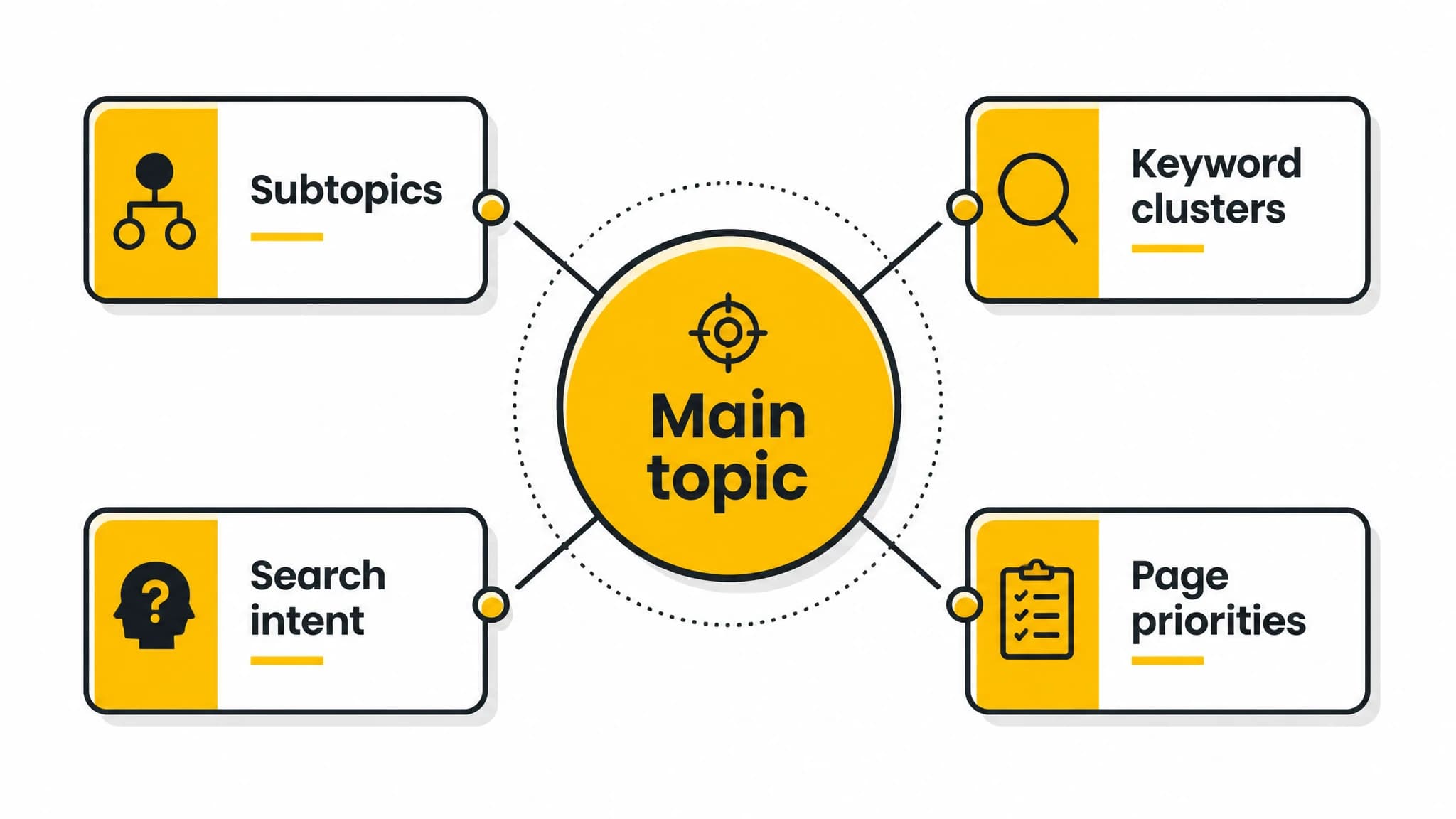
A topical map turns a broad subject into organized content decisions.
4. Build a topical map before creating articles
A topical map is a structured view of the subjects your website plans to cover. It commonly includes a primary topic, subtopics, keyword groups, search intent, planned URLs, and relationships between pages.
A simple topical map might use columns such as:
| Topic cluster | Page type | Primary intent | Supporting keywords | Internal link role | Status |
|---|---|---|---|---|---|
| Topical authority basics | Guide | Informational | Topical authority meaning | Hub page | Planned |
| Building topical authority | How-to article | Informational | Build topical authority | Supporting page | In progress |
| Topical authority tools | Comparison or guide | Commercial investigation | SEO planning tools | Supporting page | Planned |
The map should be detailed enough to guide execution but simple enough to maintain. Avoid adding fields that nobody will use.
Your SEO content planner can help connect keyword opportunities with clusters, intent, internal links, and publishing priorities. That connection matters because topical authority is created through consistent execution, not through research alone.
5. Plan internal links as part of the strategy
Internal links help readers move between related pages and help search engines understand how your content fits together. They should be planned while you build the topical map, not added as an afterthought after every article is published.
A common structure is a hub-and-spoke model:
- The hub page provides a broad overview.
- Supporting pages explain specific subtopics.
- Supporting pages link back to the hub where relevant.
- Related supporting pages link to one another when the reader may need the next explanation.
For example, an article about building topical authority could link to pages about keyword clustering, content calendars, content gaps, and internal linking. Those pages can link back to the broader guide when they refer to the overall strategy.
Use descriptive anchor text that tells readers what they will find. Avoid adding links merely to increase the number of links on a page. Every link should help the reader continue their research or complete the next step.
A topical authority tool becomes more useful when it records these relationships before publication. You can identify the intended hub, supporting pages, and link direction while the content is still being planned.
6. Turn the strategy into a repeatable workflow
The main challenge for most founders and small teams is not understanding that topical coverage matters. It is maintaining the process over time.
A repeatable workflow can look like this:
Step 1: Choose a topic area
Select a subject that is relevant to your audience and connected to your business. Define the audience, their problems, and the action you want useful content to support.
Step 2: Research opportunities
Collect relevant keywords, questions, competitor coverage gaps, and existing pages on your site. Remove ideas that are off-topic, redundant, or too weak to justify a page.
Step 3: Create clusters
Group related keywords and assign them to pages based on meaning, intent, and the depth of answer required.
Step 4: Assign priorities
Decide which hub pages and supporting articles should come first. Consider dependencies, business relevance, and available publishing capacity.
Step 5: Define internal links
Record which pages should link to the hub, which pages support one another, and where links can be added naturally during writing.
Step 6: Create and review content
Use a consistent brief that includes the target topic, intent, audience, outline, related terms, suggested links, and a clear definition of usefulness.
Step 7: Schedule and publish
Move approved content into a realistic publishing cadence. Consistency is easier when planning, creation, review, and publishing are connected in one workflow.
With RankWorker, we support this process through keyword planning, keyword research, content opportunities, content clustering, content planning, article generation, SEO metadata, scheduling, and automated publishing. Use only the parts that match your current workflow, but keep the strategy visible from opportunity discovery through publication.
How to evaluate a topical authority tool
Before choosing a tool, check whether it supports decisions rather than simply collecting data.
Does it connect research to content planning?
Keyword ideas are more useful when they can become clusters, briefs, priorities, and publishing tasks.
Can it show relationships between pages?
Look for ways to plan topic hierarchies and internal links. A flat keyword list makes it harder to build a connected content system.
Does it support your publishing process?
If planning happens in one tool, writing in another, and scheduling in a third, important context can be lost. A connected workflow reduces manual handoffs.
Can it scale down for a solo founder?
The tool should be practical for a small operation. More features are not automatically better if they create additional administration.
Does it encourage quality control?
A useful system should help you review intent, overlap, relevance, and content status. Automation should make execution easier without removing editorial judgment.
Common mistakes when building topical authority
Publishing every keyword as a separate article
Some keywords belong on the same page. Splitting them unnecessarily can create thin or overlapping content.
Treating volume as the only priority
A high-volume topic may be less valuable than a narrower topic that closely matches your audience and business.
Ignoring existing content
Before creating a new page, check whether an existing article should be refreshed, expanded, redirected, or merged.
Adding internal links at the end
Late-stage linking often produces awkward anchors and missed connections. Plan important relationships before writing.
Confusing topical authority with guaranteed rankings
Thorough coverage can improve your site’s organization and usefulness, but search visibility depends on many factors. A topical authority tool supports the process; it does not promise a specific outcome.
The practical role of RankWorker
Topical authority planning becomes difficult when research, clustering, content creation, metadata, scheduling, and publishing all happen separately. We built RankWorker to help businesses create a more consistent SEO content operation across those steps.
With RankWorker, you can organize keyword opportunities, build content clusters, plan articles, generate content and images, prepare SEO metadata, schedule work, and publish through supported workflows such as WordPress, Next.js, the Direct API, webhooks, IndexNow, and our MCP Server. Choose the capabilities that fit your setup and keep human review where it adds value.
The result is not a shortcut around strategy. It is a more reliable way to put the strategy into practice.
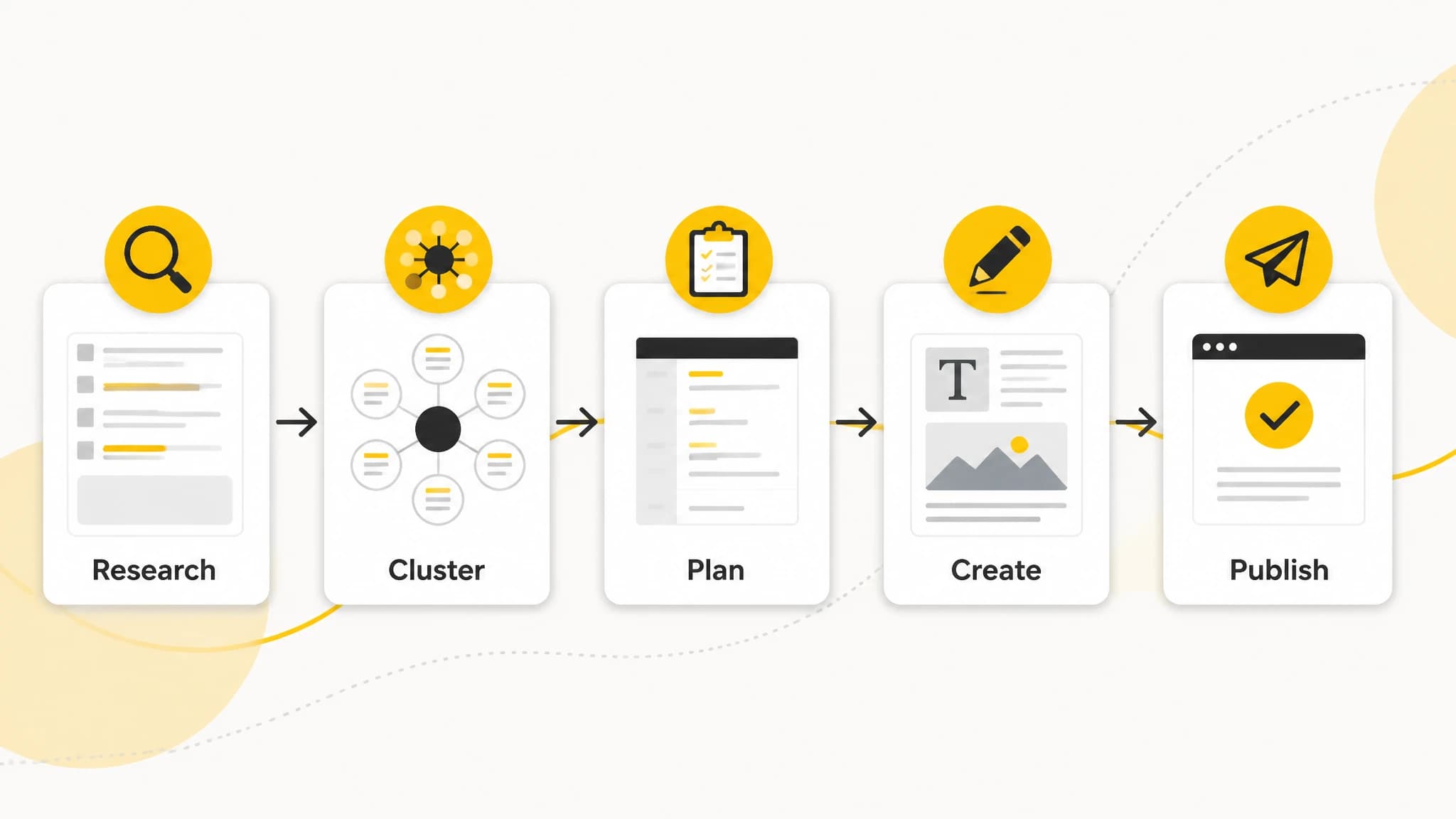
A repeatable workflow helps turn topical authority strategy into consistent execution.
Final checklist for topical authority planning
Before moving a cluster into production, confirm that:
- The main topic is relevant to your audience and business.
- The cluster includes meaningful subtopics, not just keyword variations.
- Each planned page has a clear search intent.
- Similar keywords have been consolidated where appropriate.
- Core and supporting pages are clearly identified.
- Important internal links are planned in advance.
- Priorities reflect business value and publishing capacity.
- Existing content has been reviewed before new pages are assigned.
- Each article has a useful, specific purpose for the reader.
- The workflow includes review, scheduling, and maintenance.
A topical authority tool is most valuable when it helps you make these decisions clearly and repeat them consistently. Start with one important subject, build a focused map, publish the core coverage, and expand only when the next page genuinely strengthens the topic.