

 Veselin Stoyanov11 min read
What Is Programmatic SEO? Examples, Risks, and How to Start
Learn what programmatic SEO is, see common page patterns, avoid thin content, and use a practical checklist to test a small page set.

Programmatic SEO is the practice of creating many useful, search-focused pages from structured data and a repeatable page template. It works when each page answers a distinct need with specific, accurate information. It fails when a site publishes near-identical pages just to target keyword variations. The right way to start is with a small, carefully reviewed page set, not a mass publishing target.
How programmatic SEO works
A programmatic SEO system combines three parts: a dataset, a page template, and quality controls. The dataset supplies facts that differ between pages. The template gives those facts a clear, consistent structure. Quality checks make sure each resulting page is complete, accurate, useful, and worth showing in search.
For example, a travel site might have verified information about destinations, such as transport options, seasonal considerations, and activities. A template can organize those details for a searcher comparing places to visit. The page is useful because it combines reliable, destination-specific information with a structure readers can scan.
This approach differs from simply generating lots of articles with AI. The value comes from the combination of a real search need, distinctive information, and a page that helps someone act. Automation can support the workflow, but it cannot make weak data or an unnecessary page valuable by itself.
Common programmatic SEO page patterns
- Location and service pages: A service provider may create pages for locations it genuinely serves. Each page should provide accurate local details, availability, or service information rather than just swapping the city name.
- Category and directory pages: A directory can organize real listings by location, category, or another useful attribute. Yelp is a familiar example of the local-business discovery pattern: the value depends on relevant businesses and useful filtering, not a page for every possible keyword combination.
- Product or comparison pages: A retailer or marketplace may organize products by meaningful attributes such as type, size, or intended use. Pages should help people narrow a real choice and should not be empty category shells.
- Data and tool pages: A site can present distinct calculations, reference data, or conversions for different inputs. For example, Wise provides currency conversion pages and tools for currency pairs such as USD to EUR. These pages are useful when they provide accurate, relevant results, not merely because the URL contains a keyword.
- Integration and compatibility pages: A software company may explain how its product works with a particular tool or workflow. Each page needs specific, verified instructions or compatibility details, not a generic paragraph with a new app name.
These are patterns, not endorsements of any particular implementation. A recognizable brand may use a page type at scale, but that does not mean every business should reproduce it. The deciding question is whether your own data and expertise support pages that meet a specific need.
When programmatic SEO is a good fit
Programmatic SEO is worth testing when all of the following are true:
- There is a repeatable search need. People search for multiple meaningful variations, such as a type of service in different places or a product category with distinct attributes.
- You have reliable data. The information is specific enough to make each page useful, and you can maintain it as facts change.
- The page can satisfy the query. A visitor can find the answer, comparison, or next step they came for without needing to repeat the search.
- You can keep the pages current. Someone owns data checks, corrections, and updates. Stale details can make a once-useful page misleading.
- The pages fit your site. They belong in a clear navigation structure and support a genuine audience need, rather than forming an isolated search landing-page network.
A useful way to evaluate a topic is to inspect several proposed pages side by side. If the only differences are the keyword, city, or product name, and the underlying answer stays the same, the template probably does not justify separate URLs. If distinct data changes the advice or action a visitor should take, a set of pages may be reasonable.
When it turns into thin or duplicate content
A page is not useful just because it is unique in a database or has a different URL. Thin programmatic pages often share a few warning signs:
- The same generic copy appears on every page, with only a location or category swapped.
- Important sections are blank, vague, or filled with placeholder-like statements because the dataset is incomplete.
- The page lists facts but offers no explanation, comparison, tool, or next step that helps the reader.
- Multiple URLs target slight keyword variations but answer the same underlying question.
- The information is copied or lightly rewritten from other sources without adding a distinct benefit.
- Pages are published before anyone checks whether the data is accurate, current, and appropriate for the query.
A practical editorial test is to remove the page title and ask a reviewer: “What can a visitor learn or do here that they could not do on the neighboring page?” If the answer is unclear, combine the pages, improve the underlying resource, or do not publish them separately.
How Google's scaled content abuse policy applies
Google defines scaled content abuse as producing many pages primarily to manipulate search rankings rather than help people. Its policy says this can involve content generated with AI or other methods, including pages that provide little value, make little sense, or combine material without adding value. The central issue is the purpose and usefulness of the pages, not whether a person or an automated tool created them. Review Google's scaled content policy before publishing at scale.
That means automation alone does not make a strategy abusive, and using a human editor does not automatically make pages useful. Assess the resulting pages: Are they original enough to help? Are their claims supported? Do they satisfy the search need? Would the page still make sense if it received no search traffic?
If a set exists mainly to capture keyword variations and funnel visitors elsewhere, reconsider it. Keep pages that provide a clear standalone benefit. Merge overlapping pages where one stronger resource can answer the same needs, and prevent incomplete or low-value pages from being indexed while you improve them.
The data, template, and quality-check model
Use this sequence to design a programmatic SEO system:
1. Validate the page idea
Write down the audience, the task they want to complete, and the evidence that separate pages are useful. Inspect search results and real customer questions for signs of distinct intent. Build a small sample list of page variations, then compare what a visitor would need on each one.
2. Audit the source data
Record where each field comes from, who owns it, when it was last checked, and how missing values are handled. Separate essential fields from optional ones. If a page depends on a field that is missing or unreliable, do not fill the gap with invented copy. Exclude that page or provide a clear alternative.
3. Design the template around the task
Start with the reader's decision or question, not the keyword. Include only sections that help answer it. Depending on the page type, that could mean a clear summary, useful comparisons, supporting details, limitations, and a relevant next step. Avoid boilerplate introductions that repeat the same claim across every URL.
4. Add release checks
Before publication, check for missing or contradictory fields, duplicate page intent, broken links, unsupported statements, awkward variable substitutions, and sections that do not apply. Review a representative sample manually, including edge cases such as incomplete data or unusual inputs. Set a clear rule for when a page is held back rather than published.
5. Monitor and maintain
After launch, review whether pages are indexed, whether visitors find them useful, and whether the source data stays accurate. Treat engagement and search visibility as signals to investigate, not proof that every page deserves to remain. Update, consolidate, or remove pages when the underlying need or data changes.
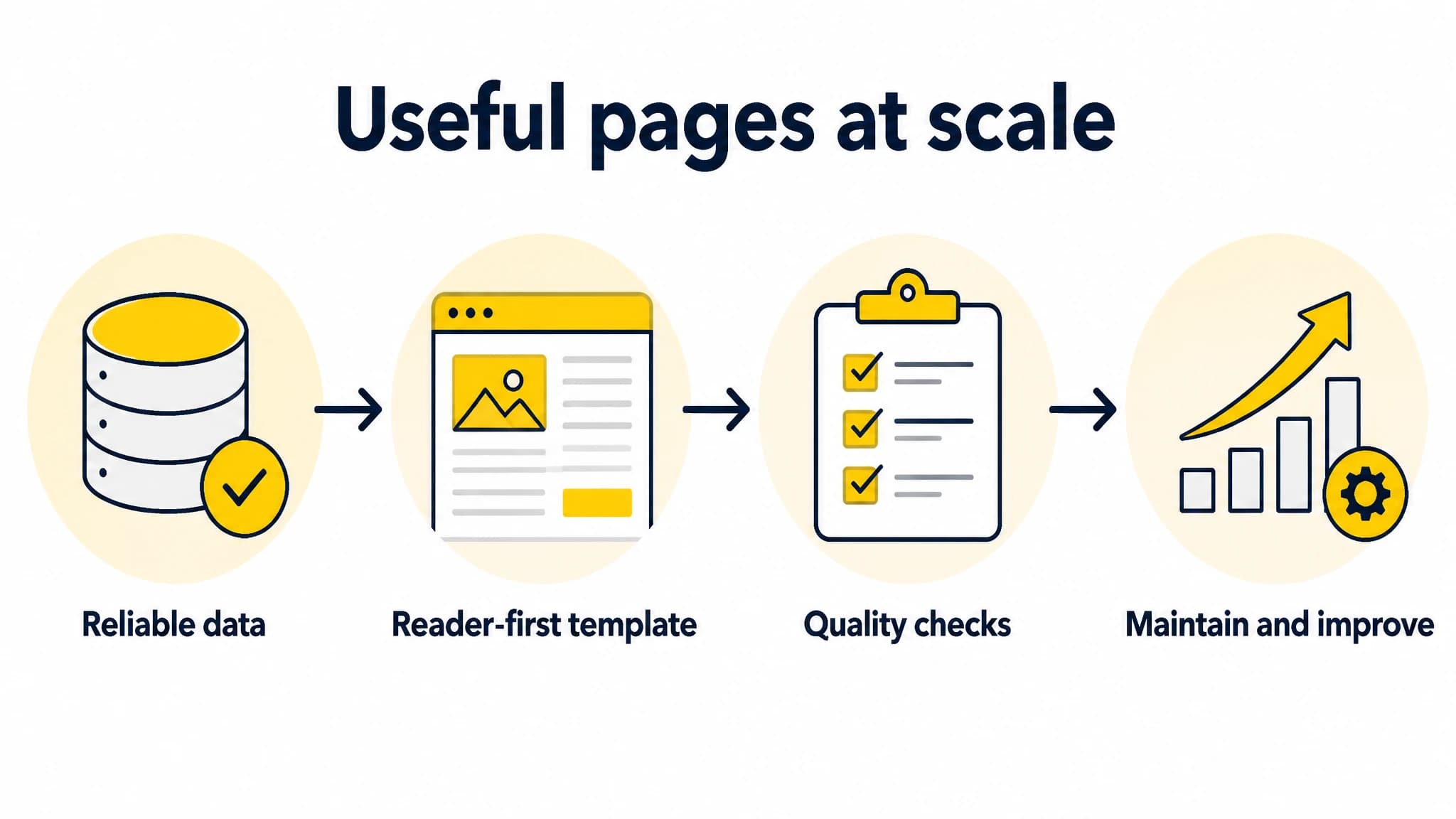
A useful programmatic SEO system connects reliable inputs, page structure, and ongoing review.
RankWorker is most relevant when your programmatic SEO effort includes planning and producing editorial content around search opportunities. With RankWorker, we help teams organize keywords and content opportunities, build content plans, generate articles and images, prepare SEO metadata, and schedule or automate publishing. That workflow can support editorial scale, but it is not a substitute for the structured dataset, page logic, or quality checks that a database-driven landing-page system requires.
If you are weighing software for this kind of work, our guide to programmatic SEO software explains when automated production makes sense and what quality controls to consider. For teams building an operational process, our programmatic SEO workflow guide covers the steps from planning through review and publishing.
A starter checklist for your first small test
Keep your first test narrow enough to inspect every page. Use this checklist before you publish:
- Choose one page pattern and one audience need.
- Identify a manageable set of candidate pages, not every possible variation.
- Confirm the data source, field definitions, and update owner.
- Draft the template using real sample data, including incomplete or unusual examples.
- Compare pages to confirm each one answers a distinct need.
- Remove generic copy that does not help the reader make a decision.
- Set minimum data and editorial requirements for publication.
- Review each test page for accuracy, clarity, links, and a useful next step.
- Publish only pages that pass, then monitor and revise before expanding.
Set a decision point before the test goes live. Decide what evidence would justify keeping the page type, what problems would require a rewrite, and what results mean you should stop. That keeps the test focused on reader value instead of rewarding page count.
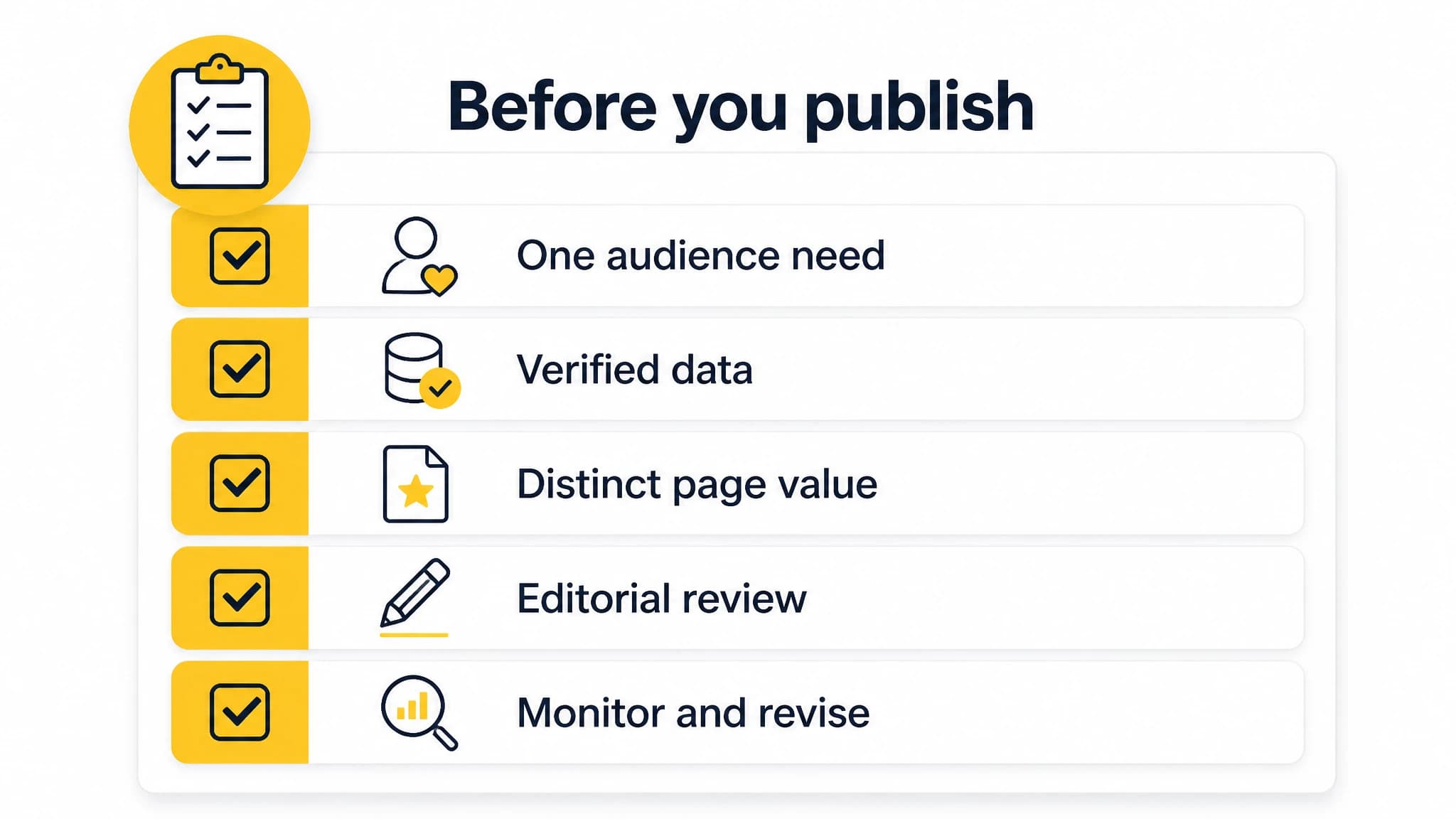
Start with a small sample and verify every page before expanding.
The practical takeaway
Programmatic SEO is a way to scale a useful page pattern, not a shortcut around understanding your audience. It is most promising when you have dependable data, distinct search needs, and the capacity to maintain quality across every page. Start small, inspect the pages as a set, and publish only when each one earns its place.
For repeatable SEO articles and editorial planning, we can help with RankWorker's planning and generation workflow. For data-driven landing pages, make sure your data model, page template, and quality controls are ready first.