

 Veselin Stoyanov11 min read
AI Content Marketing Platforms: Compare the Whole Workflow
Compare AI content marketing platforms by research, planning, creation, and publishing. Use this practical checklist to find a workflow that fits your team.

AI Content Marketing Platforms: Compare the Whole Workflow
An AI content marketing platform can help with much more than drafting. To choose one that fits, compare how it moves work from a search opportunity through research, planning, creation, review, and publication. A tool that writes quickly may still leave your team doing the surrounding work by hand.
That distinction matters for founders and small teams. The goal is not to automate every editorial decision. It is to reduce repetitive handoffs while keeping a person responsible for accuracy, usefulness, and final approval.
Start with the workflow, not the demo
When you evaluate a platform, follow one realistic topic all the way through. Ask what the tool helps you do at each stage, what information it needs from you, and what work remains manual. This makes it easier to compare platforms fairly, even when their feature lists use different language.
A practical evaluation should cover:
- Research: Can you identify and assess relevant search topics and keywords?
- Organization: Can related topics be grouped and arranged into a content plan?
- Creation: Does the platform help turn a target topic into a usable article, not just a block of prose?
- Finishing: Can you prepare supporting images and SEO metadata as part of the process?
- Publishing: Can you schedule and publish content through a workflow that fits your site?
- Oversight: Is it clear where a person checks facts, edits, and approves the work?
Use the same test topic and criteria for every tool. For more detailed platform-selection criteria, see our guide to comparing SEO workflows.
What to compare at each stage
1. Keyword research: does the platform help you choose a useful topic?
A writing prompt is not a content strategy. Before creating an article, you need a reason to cover the topic and a clear sense of what the reader wants. Compare whether a platform supports keyword research and helps you find content opportunities, rather than requiring you to arrive with a finished topic list.
Check how much context you can provide, how the platform presents candidate topics, and whether you can apply your own judgment. A keyword suggestion is a starting point, not proof that a topic belongs on your site. Consider audience fit, your existing coverage, and whether you can create a genuinely useful page.
2. Clustering and planning: can ideas become a coherent program?
A collection of individual keyword targets can lead to overlapping articles or an unfocused publishing calendar. Clustering helps organize related opportunities; planning helps decide what to publish and when. Compare whether a platform supports both, and whether its planning process makes it easy to see how each article relates to the larger site.
Ask practical questions: Can you distinguish a core topic from supporting topics? Can you spot potential overlap before assigning articles? Can you adjust the plan when priorities change? If these steps happen in a separate spreadsheet, count that manual coordination as part of the tool’s real cost in time.
3. Article generation: is the result useful after editing?
Do not evaluate a platform only by how quickly it returns text. Inspect a sample draft against a real editorial brief. Does it address the intended question? Is the structure easy to edit? Does it leave unsupported claims or generic passages that require substantial rewriting?
Also check how the platform handles your instructions and brand context. A generated article still needs human judgment. Confirm facts, remove material that does not help the reader, and make sure the final page reflects your expertise and intent. For a closer look at writing-focused tools, read our guide to SEO content writing tools.
4. Images and metadata: are finishing tasks part of the same process?
An article is not always ready to publish when the draft is done. Supporting images and SEO metadata may require separate decisions and tools. Compare whether the platform helps create article images and prepare metadata, and whether you can review those outputs before using them.
Treat these as useful workflow steps, not automatic quality guarantees. Check image relevance and suitability for your page. Review the title and description for accuracy and clarity, and make sure they match what the article actually delivers.
5. Scheduling and publishing: what happens after the draft?
Find out whether content can be scheduled and published through a supported connection to your website or publishing setup. Look closely at what the handoff involves: Do you need to copy and paste the article? Which publishing steps remain yours? Can you control timing and check the content before it goes live?
A platform may support the full path, a few individual stages, or only writing. None is automatically the right choice for every team. The key is to identify the steps you want to simplify and verify that the workflow fits your current publishing setup.
A simple platform scorecard
Use a small scorecard to compare options against the same needs. Score each area from 0 to 2: 0 means the platform does not support it, 1 means it supports it partly or through a workaround, and 2 means it supports the workflow in a way that suits your team. Add a note explaining each score so the final choice does not rely on a total alone.
| Evaluation area | What to check |
|---|---|
| Research | Can you find and assess relevant keyword opportunities? |
| Organization | Can you cluster topics and plan content? |
| Creation | Can you generate an editable article from your brief? |
| Finishing | Are image creation and SEO metadata supported? |
| Publishing | Can you schedule and publish in your setup? |
| Oversight | Can a person review and approve work before publication? |
| Fit | Does the workflow match your team’s capacity and site? |
Do not treat every row as equally important. If you already have a reliable research process, publishing may be your bottleneck. If you are starting from a blank content plan, research and organization may matter more. Choose based on where work gets stuck today.
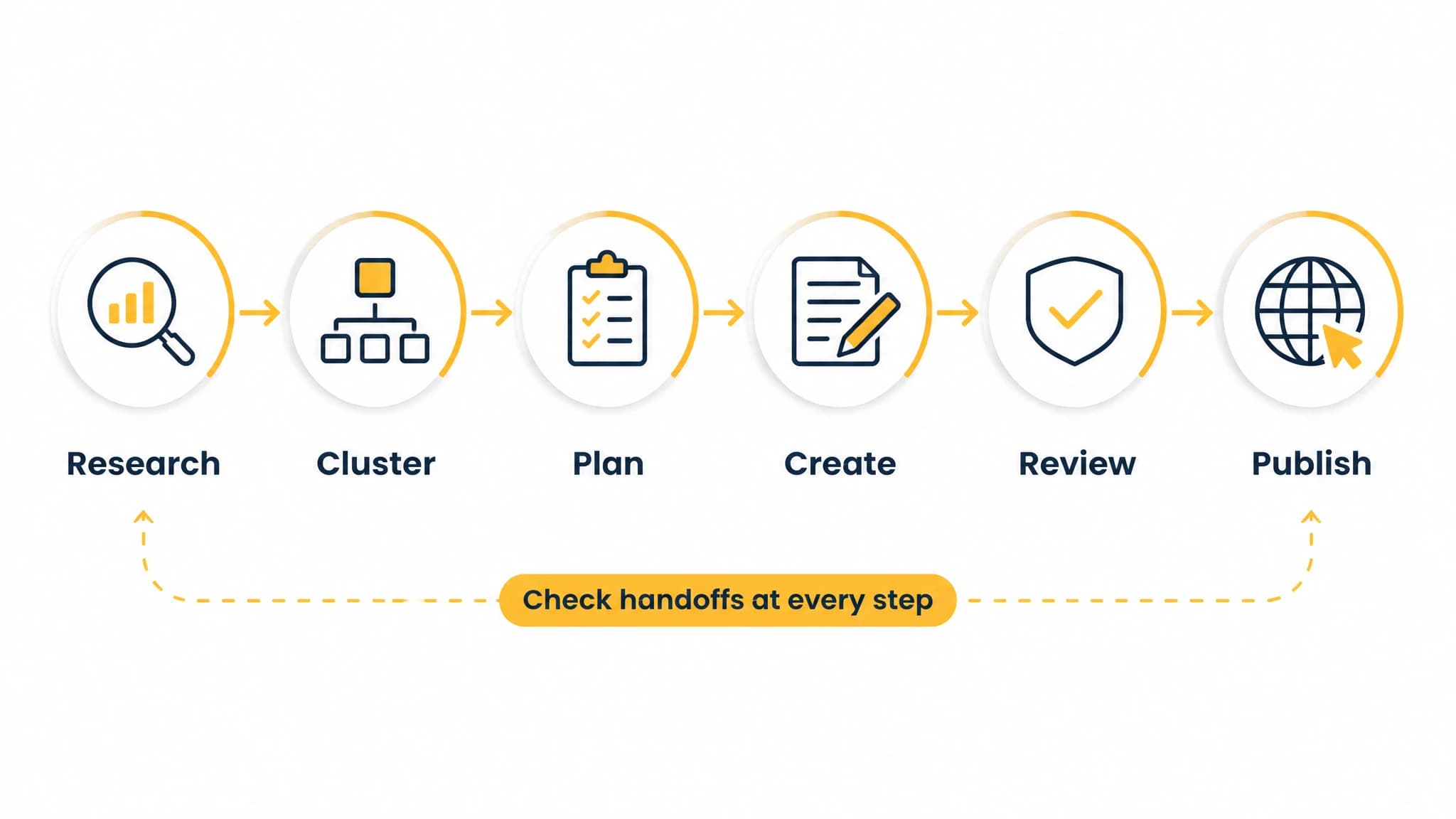
A useful platform evaluation follows one topic through each stage and notes where manual handoffs remain.
Walk one topic through the entire process
Before you buy or adopt a platform, run a small, realistic test. Choose one topic you might actually publish, then trace it from opportunity to publication-ready content:
- Define the reader and intent. Write down who the article is for and the question it should answer.
- Test research and organization. See whether the platform helps you assess the topic and place it in a sensible content plan.
- Generate a draft from a brief. Provide the audience, purpose, and relevant instructions. Note what you still need to supply manually.
- Review the complete article. Check usefulness, factual accuracy, structure, and brand fit. Record the editing needed, not just the generation time.
- Check the finishing steps. Review image and metadata support, then confirm how scheduling and publishing work for your site.
- List remaining handoffs. Note every time you had to move information between tools or repeat work.
This test helps you distinguish a tool that produces a promising first draft from an AI content workflow tool that supports the operations around it. It also gives you a more useful comparison than a feature checklist alone.
With RankWorker, we support a connected SEO content workflow that includes keyword research, content opportunities, clustering, planning, article generation, article image generation, SEO metadata, scheduling, and automated publishing. For example, a founder can start with a search opportunity, organize it alongside related topics, create an article and supporting materials, then schedule or publish through a supported setup. The specific workflow you use depends on your site and publishing needs.
Where an AI agent for SEO content fits
An AI agent for SEO content may help you interact with or direct parts of a content process, but the label alone does not tell you what the platform actually does. Ask what actions it can take, what information it uses, which steps require your approval, and where the finished content goes. Compare those answers with the same workflow scorecard you use for other platforms.
If you prefer to work through an agent, check whether the platform supports the tools and connections your team already uses. RankWorker has an MCP server with full feature parity, which allows the platform to be used with an AI agent that supports MCP servers. That may be relevant if agent-based interaction is part of your workflow; it does not remove the need to review content before publication.
Choose based on your operating model
A writing-focused tool may suit a team that already has research, planning, editing, and publishing handled elsewhere. A broader platform may be a better fit when the recurring challenge is coordinating those stages with limited time or staff. Compare the work you need to do around the draft, not just the draft itself.
For founders and small teams looking for a complete SEO content workflow, RankWorker is a practical option to evaluate because we support the sequence from keyword planning and research through content creation and publishing. Before deciding, test the workflow against your actual site, confirm the relevant publishing setup, and estimate the human review time you will still need. Our AI SEO software guide provides another way to assess tools across research, planning, creation, and publishing.
A common adoption concern is losing editorial control. You do not need to treat automation as permission to publish unchecked content. Set a clear review step: assign a person to validate claims, improve the article, and confirm the metadata and page are ready. Automate repeatable production tasks where they help, while keeping responsibility for the final work with your team.
Make the decision with a small pilot
Choose one or two representative topics and run them through your preferred platform. Track the manual steps, the edits required, the publishing handoffs, and whether the output meets your editorial standards. If you cannot explain how the platform helps your workflow beyond drafting, keep looking or limit its role to writing.
The best choice is the one that supports the work your team needs to repeat, fits your publishing setup, and leaves clear room for human review. Compare the full workflow, confirm what is actually supported, and choose based on the bottleneck you want to solve first.