

 Veselin Stoyanov10 min read
AI Content Marketing for Small Businesses: Where to Automate and What to Keep Human
Learn what small businesses can automate in content marketing, where human judgment matters, and how to build a practical workflow.

AI content marketing for a small business works best when you automate repeatable production tasks and keep people responsible for decisions that depend on context, accuracy, and trust. Use AI to help organize ideas, create first drafts, and prepare search-focused blog content. Keep a human in charge of what your business says, which topics matter, and whether the final content is accurate and useful.
The goal is not to automate every channel or publish as much as possible. It is to make a manageable content operation more consistent without losing your voice or creating work your audience cannot rely on.
A simple rule for deciding what to automate
Ask three questions about each task:
- Is the task repeatable? A consistent process, such as preparing a blog outline, is easier to automate than a sensitive customer response.
- Can the output be checked quickly? A draft can be reviewed against a brief. A claim about a customer’s experience may require direct confirmation.
- What happens if the output is wrong? The greater the reputational, financial, or customer impact, the more human review it needs.
Automate tasks when they are repetitive, easy to evaluate, and low risk. Keep people closely involved when a task represents your expertise, makes a promise, or depends on a customer’s specific situation. Many tasks belong in the middle: let AI prepare a starting point, then require a person to edit and approve it.
What small businesses can automate
1. Organizing ideas and recurring questions
AI can help turn rough notes, common customer questions, and existing material into a list of potential topics. A person should still choose which ideas fit the business, the audience, and the time available to create a genuinely helpful answer.
Start with a short list of sources: questions sales or support hears repeatedly, products or services you want to explain, and topics customers need to understand before making a decision. Ask an AI tool to group related ideas or suggest possible article angles. Treat its suggestions as a draft list, not proof that people are searching for a topic or that it belongs in your plan.
2. Structuring search-focused blog content
For blog articles, it is reasonable to automate parts of topic planning and production: organizing keyword opportunities, outlining a draft, preparing metadata, or generating a starting article and image. These tasks have a clear output a person can review before publication.
A useful review asks whether the article answers the reader’s likely question, reflects what the business actually does, and gives practical detail rather than generic advice. If you need a more detailed process for this channel, see our guide to SEO automation for small businesses.
With RankWorker, we can support a focused blog workflow: plan topics, generate article drafts and images, review the output, then schedule or publish through a supported workflow. This is useful when the bottleneck is producing and managing search-focused blog content. It does not mean every social post, email campaign, or ad is handled automatically.
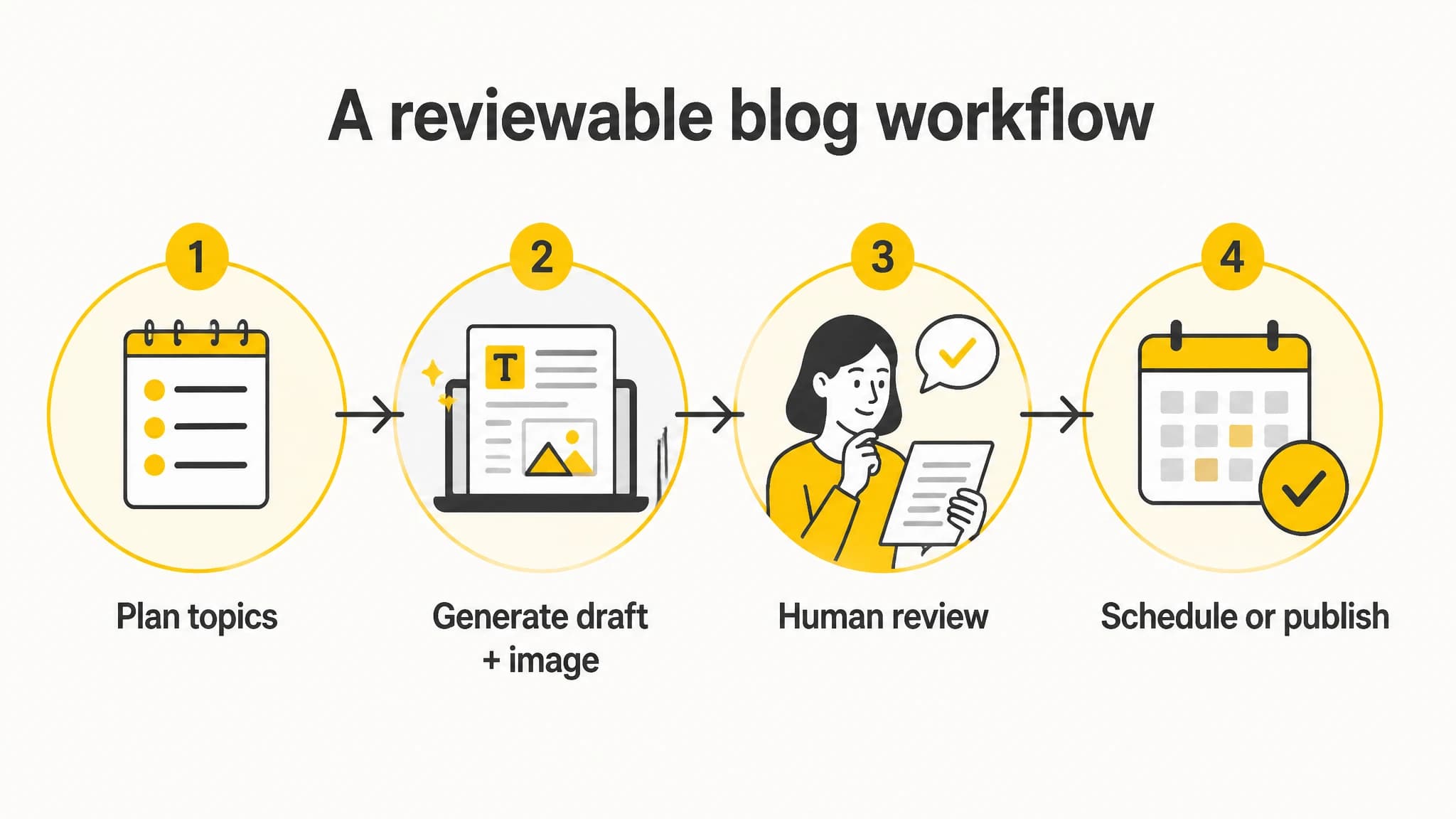
Automate repeatable production steps while keeping editorial approval in human hands.
3. Preparing reusable first drafts
AI can help create a first version of a newsletter outline, social caption, or promotional message from information you provide. That can reduce blank-page work, but the draft still needs a person to check the audience, channel, timing, and offer. Make sure the final message sounds like your business rather than a generic template.
4. Formatting and production checklists
Repeatable operational steps are good automation candidates: assembling a draft in a consistent format, checking whether required sections are present, or preparing a publishing checklist. These steps save attention when they are simple and predictable. They should support editorial review, not replace it.
What should stay human
Strategy and priorities
A tool can suggest topics, but a business owner or knowledgeable team member must decide what the business should be known for, which audience it serves, and what it can realistically maintain. Those choices depend on business goals and context that may not be present in a prompt.
Expertise, evidence, and accuracy
Review every factual statement, especially claims about your products, services, results, policies, or customers. AI-generated text can sound certain without being well-supported. Remove claims you cannot substantiate, and add specific detail from your actual experience where it helps the reader.
Brand voice and customer sensitivity
Messages involving complaints, personal circumstances, sensitive topics, or important customer relationships need human judgment. AI can help organize a response or suggest a neutral first draft, but a person should decide what to say and make sure the final message is considerate and appropriate.
Final approval and accountability
Someone on your team should own the final version of anything published under the business’s name. That includes checking links, names, dates, tone, calls to action, and whether the content could mislead a reader. A repeatable quality-review workflow can make that approval quicker without making it optional.

Keep human review closest to strategic, sensitive, and high-impact decisions.
A practical AI content marketing workflow
Keep the first version small enough to run consistently. For example, set aside time to choose one useful blog topic, prepare a draft, review it, and publish it. Add channels or volume only when the basic process is working.
- Choose a business goal. Decide what the content should help with, such as answering a common question or explaining a service. Avoid starting with a publishing quota that has no clear purpose.
- Select and verify a topic. Use customer questions and search-focused research as inputs. Check that the idea fits your audience and that you can provide a credible answer.
- Create a brief. Note the intended reader, the question to answer, the key points to include, and any claims or language to avoid. A short brief gives AI useful context and gives the reviewer a standard to check against.
- Generate a draft or production materials. Use automation for appropriate first-pass work, such as an outline, article draft, image, or metadata. Do not treat generated material as approved copy.
- Review and improve. Check facts, relevance, completeness, voice, and practical value. Add business-specific knowledge, remove unsupported claims, and rewrite anything that sounds unnatural.
- Publish and learn. Follow your normal publishing process. Later, review whether the content still serves the reader and whether it needs a meaningful update. Do not assume that publishing alone guarantees traffic or sales.
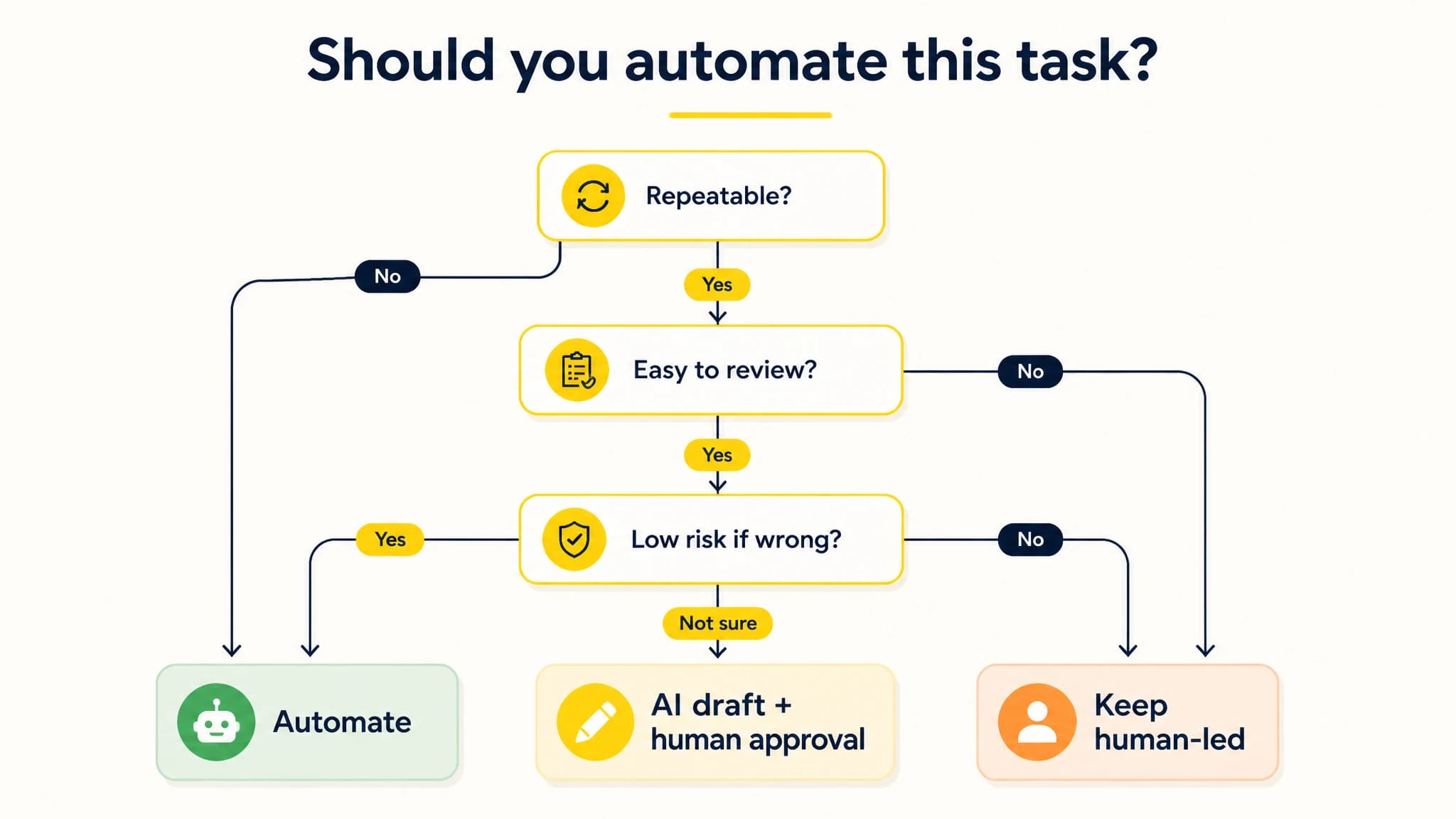
Use repeatability, reviewability, and risk to choose an appropriate level of automation.
For the blog portion of this process, with RankWorker we can connect topic planning with draft and image generation, review, and scheduling or publishing. That makes us a practical fit for a small business that wants more consistency in search-focused articles without handing over editorial decisions. Keep email, social, and advertising work in the tools and processes that actually support those channels.
How to choose your first automation
List the content tasks you repeat in a typical month. For each one, estimate how often it happens, how much time it takes, how easy the result is to review, and the harm a mistake could cause. Begin with frequent, low-risk tasks that have a clear check before anything goes live.
For example, a small business might automate organizing blog topic ideas and preparing first drafts, while keeping topic selection, expert input, final edits, and publication approval with a person. A different business may find that AI-assisted social captions are the best first experiment. The right starting point depends on where work gets stuck and how easily you can catch errors.
Run a small test before changing the whole operation. Compare the time required with your old process, but also check whether the output needed substantial correction. If review takes longer than creating the content yourself, improve the brief or choose a different task to automate.
Common adoption concerns
“Will AI make our content sound generic?” It can if you rely on vague prompts and publish without editing. Give it useful business context, provide examples of your preferred voice, and revise drafts with real expertise and specific details.
“Do we need to automate everything to make this worthwhile?” No. Automating one repetitive step can be useful if it removes friction and leaves more time for work that requires judgment. You can keep other channels fully manual.
“Will automation save time if review is still required?” It may, when it reduces the time spent starting, structuring, or formatting content. Measure the full workflow, including fact-checking and edits, rather than counting only the time needed to generate a draft.
“Can AI decide what our business should publish?” It can help you explore options, but a person should set priorities and approve topics. The business is accountable for what it publishes.
The best fit for RankWorker
RankWorker is most relevant when your small business wants a repeatable process for search-focused blog content: planning topics, generating drafts and images, reviewing the material, and scheduling or publishing it. It is not a promise that every part of content marketing will run itself. Your team still brings the business knowledge, makes editorial choices, and approves what goes live.
A practical next step is to choose one blog topic your audience needs help with and run it through that workflow. Use RankWorker’s Start Free Trial action to try the process, then judge the fit by how well the workflow supports your planning, review, and publishing needs.