

 Veselin Stoyanov9 min read
AI SEO Agents: What They Can Do Today and Where Humans Matter
See what an AI SEO agent can handle across research, writing, publishing, and monitoring, plus where human review still matters.

An AI SEO agent is an AI system that can work through SEO tasks using instructions, data, and connected tools. It may research keywords, draft content, suggest links, or take publishing actions. The useful question is not whether an agent can do SEO by itself. It is which steps it can handle reliably, what access it needs, and where a person should approve its work.
Today, agents are most useful for repeatable, bounded tasks with clear inputs and checks. They can organize information and carry out actions faster, but they can still misunderstand intent, rely on incomplete data, or make changes that are hard to undo. Treat the agent as a capable workflow assistant, not an independent SEO lead.
What an AI SEO agent can do
A standard AI assistant usually responds to a prompt. An agent can also use tools or connected data to complete a sequence of actions, such as collecting information, preparing a draft, and saving it for review. Its actual capabilities depend on the tools, permissions, and instructions it has been given.
For SEO, that might mean moving through keyword research, content planning, article creation, internal-link suggestions, publishing, or performance analysis. “Autonomous SEO” is often used to describe this kind of workflow, but autonomy is not all-or-nothing. An agent can be allowed to research and draft while requiring a human to approve publishing or site changes.
With RankWorker, we support a repeatable content workflow that includes keyword planning and research, content opportunities, clustering, planning, article generation, images, metadata, scheduling, and automated publishing. You can use our MCP server to drive the platform from an AI agent that supports MCP. The agent still needs clear instructions and sensible review points.
Task by task: what agents handle well
1. Keyword research
Good fit: An agent can gather topic ideas, group related phrases, summarize search intent, and organize questions into a research brief. If connected to appropriate sources, it can compare supplied keyword data or analyze your own search performance data.
Human review: Check whether the suggestions match your audience, products, and expertise. Similar phrases do not always mean the same intent, and a list of keywords is not proof that a topic deserves an article. Ask what evidence supports each recommendation and whether the source data is current and relevant.
An agent can help turn a large set of phrases into a shortlist, but a human should decide which opportunities fit the business and its content strategy. Our SEO MCP server guide explains how an AI assistant can work with SEO tools when the relevant tools and data are available.
2. Content planning
Good fit: Agents can cluster related topics, identify gaps in an existing plan, draft briefs, and suggest a sequence for covering a subject. These tasks are easier to check when the agent shows its reasoning inputs, such as the audience, target topic, and pages it considered.
Human review: Check for overlap with existing pages, gaps in your site’s expertise, and topics that would dilute your focus. A cluster generated from keyword similarity alone may not reflect what your readers actually need. Approve the editorial priorities, not just the spreadsheet.
With RankWorker, we support clustering and content planning as part of the workflow, so you can move from research to a planned set of articles without treating every step as a separate manual task. For a wider evaluation framework, see our guide to SEO tools with MCP.
3. Writing and on-page SEO
Good fit: An agent can turn a clear brief into an outline or draft, suggest headings and metadata, and help check whether the article answers the intended question. It can also speed up routine formatting and revisions.
Human review: Verify facts, examples, product details, and claims. Improve the draft with original expertise, useful specifics, and a voice that fits your brand. Check that it answers the reader’s actual question rather than repeating related phrases. Google’s guidance on generative AI content emphasizes accuracy, quality, and relevance; producing pages at scale without added value can violate its spam policies.
A good review asks: Would this help a reader even if they never arrived from search? If not, the draft needs more than a keyword edit. With RankWorker, we support article generation and SEO metadata, but editorial review remains important for accuracy and usefulness.
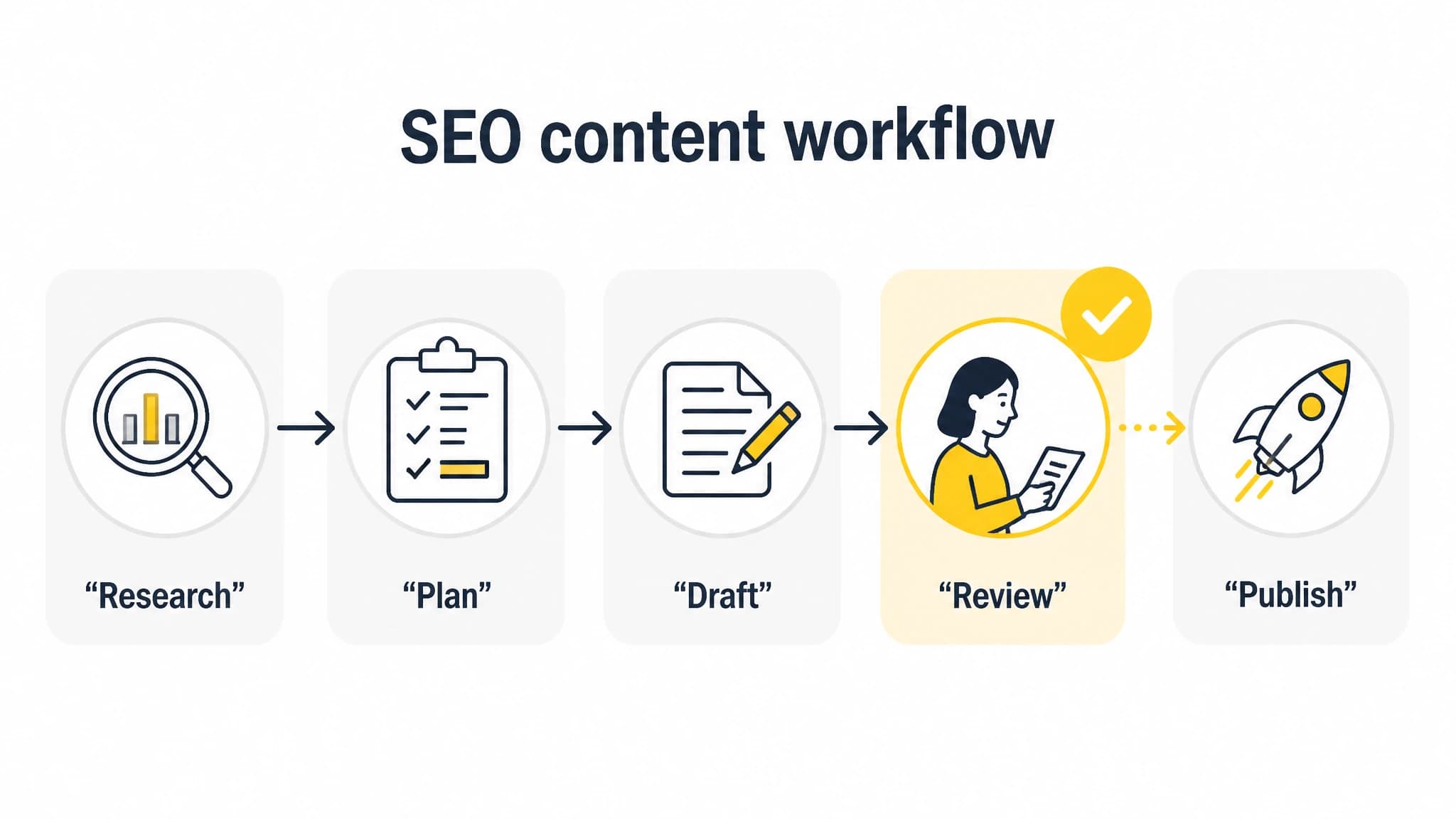
A human review checkpoint keeps automated content tasks inspectable before publication.
4. Internal linking
Good fit: An agent can identify pages that may be related, suggest descriptive anchor text, and flag an article that has few links to or from relevant pages. When it has access to an approved site inventory, it can use that inventory to make more grounded suggestions.
Human review: Confirm that the destination genuinely helps the reader and that the anchor describes the linked page. Watch for irrelevant links, repeated exact-match anchors, and links to outdated or low-quality pages. A tool should not invent destinations or publish links based only on a phrase match.
5. Publishing
Good fit: Where a platform integration allows it, an agent can prepare a post, fill in metadata, schedule it, or publish after authorization. Repeatable formatting and handoff steps are good automation candidates.
Human review: Decide who can publish, which changes require approval, and what happens if a task fails. Review the final page, links, images, metadata, and formatting before it goes live. Keep permissions as narrow as practical, especially when actions can affect a live website.
This is a useful point to distinguish assistance from control: an agent can prepare and execute approved steps, but the site owner remains responsible for what is published. With RankWorker, we support scheduling and automated publishing as part of an SEO content workflow; choose review steps that fit the level of access you grant.
6. Monitoring Search Console data
Good fit: If an agent has authorized access to Search Console data through a suitable connector or API, it can summarize changes in clicks, impressions, queries, and pages, then flag items for investigation. It can also help turn a performance observation into a question, such as whether a page’s impressions changed after an update.
Human review: Treat a change as a signal to investigate, not a diagnosis. Seasonality, site changes, query mix, and incomplete data can affect a chart. Search Console’s Search Analytics API does not guarantee every data row and may return only top rows, so an agent should not present its result as a complete view of all search activity. Check the underlying report and context before deciding what to change.
Avoid giving an agent permission to make broad site changes just because a metric moved. A human should interpret the cause, choose a response, and review any proposed edits.
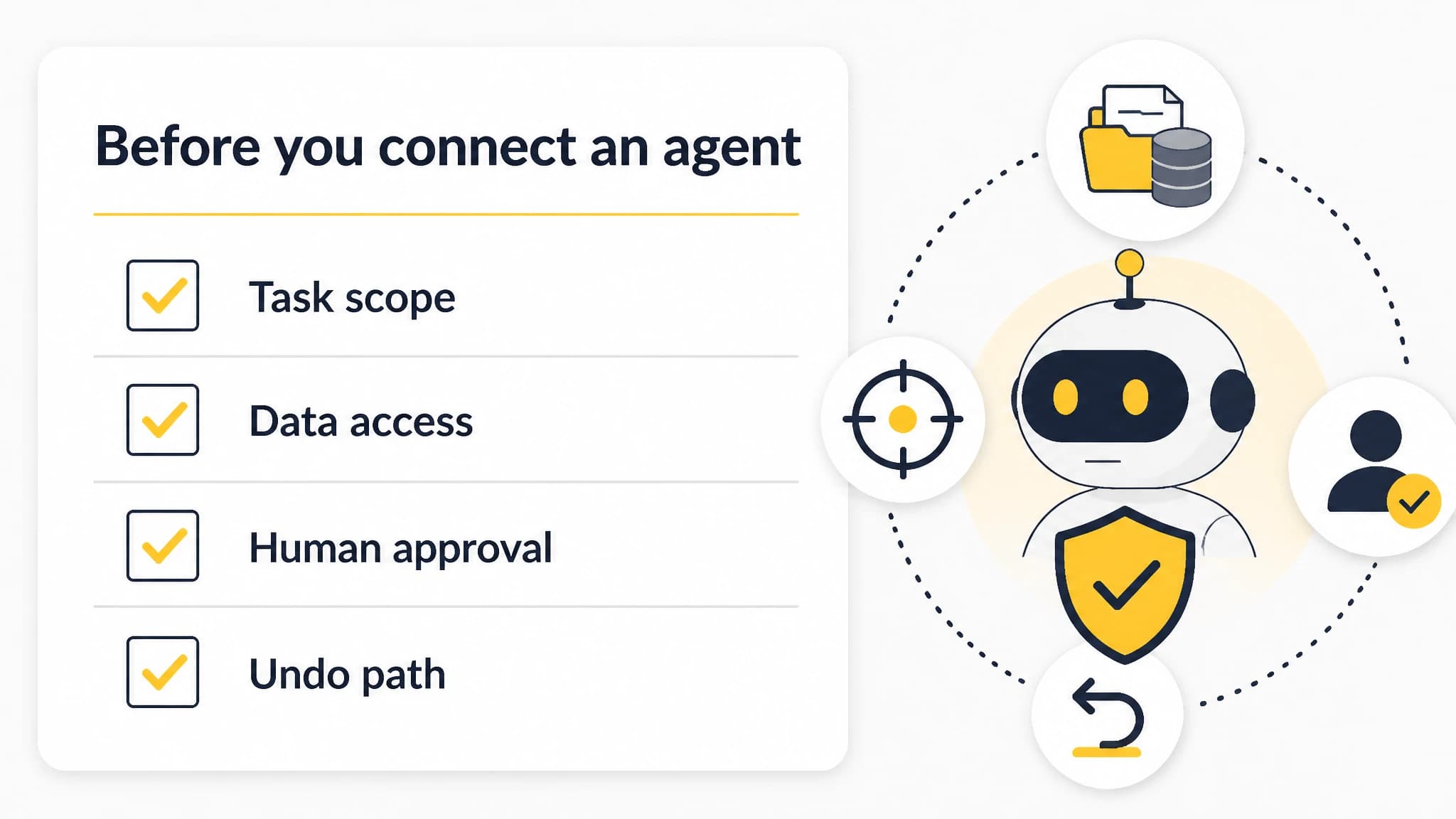
Evaluate an agent’s permissions and review path before connecting it to live SEO work.
A practical checklist for evaluating an AI SEO agent
Before connecting an agent to your SEO workflow, ask:
- What task can it actually complete? Separate research and drafting from actions such as publishing or editing a live site.
- What data and tools does it use? Confirm that the sources are authorized, relevant, and visible to you.
- Can you inspect its work? Look for clear inputs, outputs, and a way to check recommendations before acting on them.
- Where are approvals required? Set a human checkpoint for factual claims, strategy decisions, and consequential changes.
- What happens when it is uncertain or wrong? Check whether you can stop, correct, or reverse an action.
- Does it fit your full workflow? Consider research, planning, writing, review, metadata, scheduling, and publishing instead of judging only draft speed.
A tool that handles one step well may still leave you managing a patchwork of prompts, files, and manual handoffs. Our AI agents topic hub has more on evaluating agent workflows. With RankWorker, we offer agent-style automation across supported content tasks with review controls, and our MCP server lets you command the platform through your own MCP-compatible AI agent. That gives you a choice: use our workflow directly or bring an agent you already work with into the process.
The bottom line
AI SEO agents are most useful when they take on bounded, repeatable work and make their outputs easy to inspect. They can support research, planning, drafting, linking, publishing, and performance review, but they do not replace judgment about audience, accuracy, editorial quality, or risk.
Start with one workflow, define the agent’s permissions, and decide where human approval is required before connecting it to live actions. Measure whether it reduces manual effort without lowering the usefulness or reliability of your content. Use automation to make good SEO work easier to repeat, not to publish more pages without a reader-focused reason.