

 Veselin Stoyanov11 min read
Competitor SEO Tracking: Monitor Rankings and New Content
Learn how to track competitor SEO, monitor ranking shifts and new pages, and turn useful changes into a focused content plan.

Competitor SEO tracking is the ongoing practice of monitoring the search visibility and content changes of websites competing for the same search audience. The goal is not to copy every new page or react to each ranking fluctuation. It is to spot meaningful changes, investigate why they matter, and decide whether your own site should respond.
A practical routine tracks three things: new or substantially updated competitor pages, ranking shifts on keywords you both target, and changes in the search results that affect your opportunity. Check signals at a reasonable cadence, validate them before acting, and turn each useful finding into a concrete next step.
What to track in competitor SEO
Start with a short list of real search competitors: websites that appear for the topics and queries you want to reach. A business rival may not be a search competitor, and a publisher or directory may compete with you in search without selling the same product. If you need to build that list first, use this guide to find your SEO competitors.
Once you have a focused set of domains, monitor a few signals rather than trying to watch everything.
1. New competitor pages
New pages can reveal topics a competitor believes are worth covering. Watch for additions to a sitemap, new category or resource pages, and pages that begin appearing in search results for your shared subject areas.
A new URL alone is not a reason to publish. Check what the page is for, whether it targets an audience you also serve, and what search intent it addresses. Then ask whether your site already has a useful page on the topic. If it does, consider improving that page; if it does not, assess whether a new page fits your strategy.
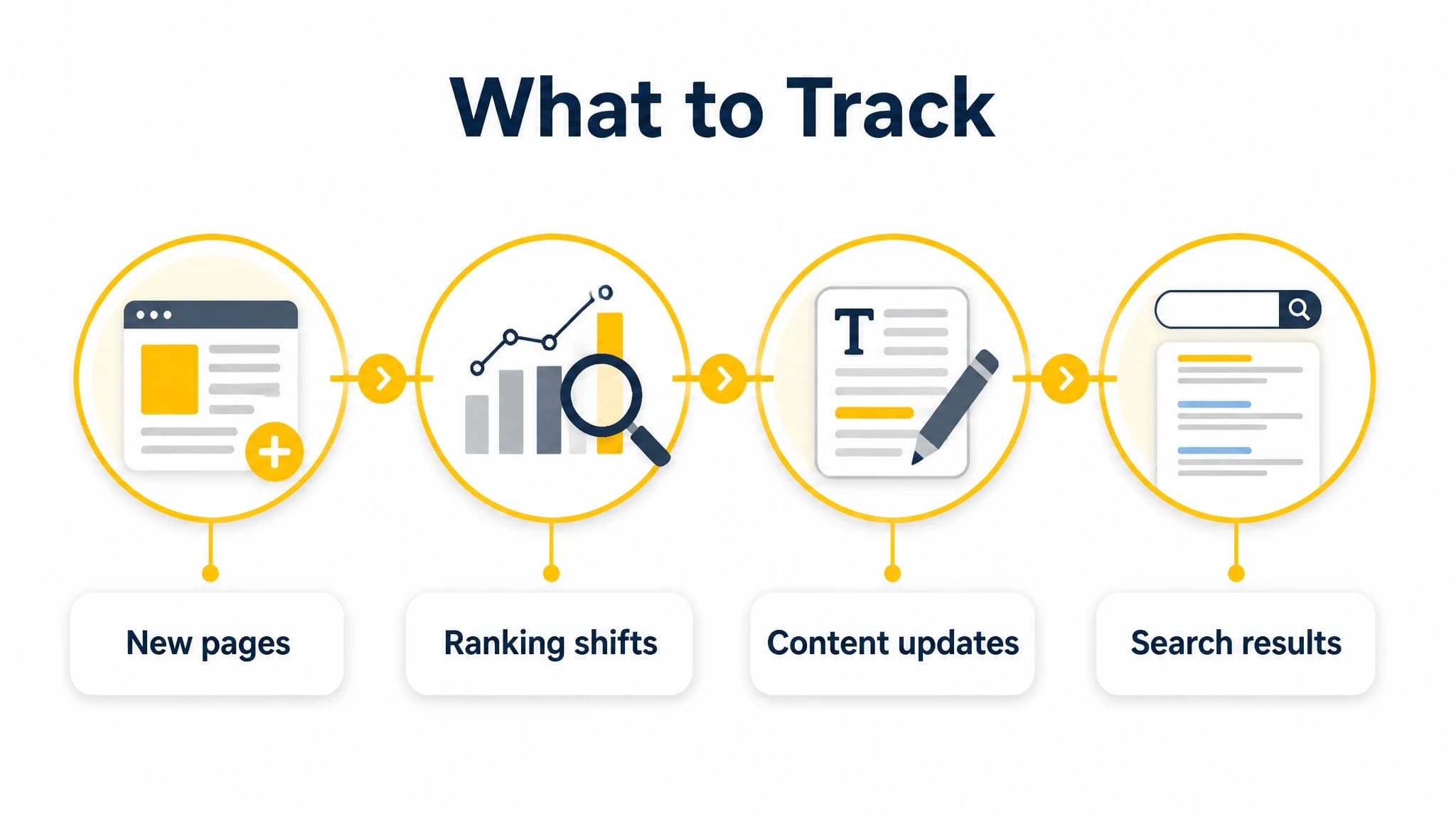
Track a small set of signals that can lead to a useful decision.
2. Ranking shifts on shared keywords
Monitor competitor rankings for a manageable group of relevant keywords, especially terms tied to your important pages and business goals. Look for sustained changes or patterns across related queries, not just one position change on one day.
Rankings move for many reasons, and tools may report different estimates. A shift is a research prompt, not proof that a competitor made a specific change or that your own page needs an immediate rewrite. Check the search results and the pages involved before deciding what to do.
3. Meaningful content updates
Track substantial changes to pages that matter: a revised guide, a new comparison section, a changed page purpose, or a stronger set of examples. Routine edits such as correcting a typo are usually not actionable signals.
When you notice a significant update, compare the page’s current structure and coverage with your own. Identify the actual gap, if one exists. The right response might be a clearer explanation, better examples, a more suitable page format, or no change at all.
4. Search result changes
Sometimes the important change is not on a competitor’s website. The search results may start showing different page types, features, or competitors for a query. Check whether the results still match the page you have and the intent you are trying to serve.
How often should you monitor competitors?
Use a cadence that matches your resources and how quickly your market changes. For many small teams, a lightweight weekly check of important competitor pages and a more thorough monthly review is a useful starting point. This is a practical schedule, not a universal SEO rule.
- Weekly: Scan for notable new pages or updates from a small set of priority competitors. Review only alerts or tracked keywords that connect to your current priorities.
- Monthly: Compare shared keyword visibility and revisit pages or topics that have shown a pattern of movement. Record which changes were confirmed and which were noise.
- Quarterly: Review your competitor list, content gaps, and priorities. Remove irrelevant sites and identify opportunities that still fit your audience and business.
If you are launching into a new topic or responding to a major market change, temporarily check more often. Otherwise, avoid constant rank checking. Frequent checks can make normal variation feel like an urgent problem and consume time better spent improving your own site.
Lightweight ways to track competitor SEO
You do not need a complex monitoring system to get started. Use a simple spreadsheet or document with one row per observation: date, competitor, page or keyword, what changed, evidence, relevance, and next action.
Watch competitor sitemaps
If a competitor makes a sitemap available, checking it periodically can help you notice newly listed or changed URLs. Compare snapshots rather than treating every listing as a new page. Sitemaps can include URLs that are not important to your research, and a URL appearing there does not tell you whether it is useful, indexed, or performing well.
Set alerts for important pages and topics
Use available alerts or monitoring features to follow a limited set of competitor brands, URLs, and subject areas. Keep the scope small enough that you can review what comes in. Broad alerts can produce plenty of mentions without showing whether anything has changed in search or deserves action.
Run periodic competitor research
At regular intervals, review the pages and keywords associated with the competitors that matter most. Treat traffic and ranking estimates as directional clues, then validate the opportunity against actual search results and your site’s strengths. For a more detailed process, see our guide to analyzing competitor organic traffic.
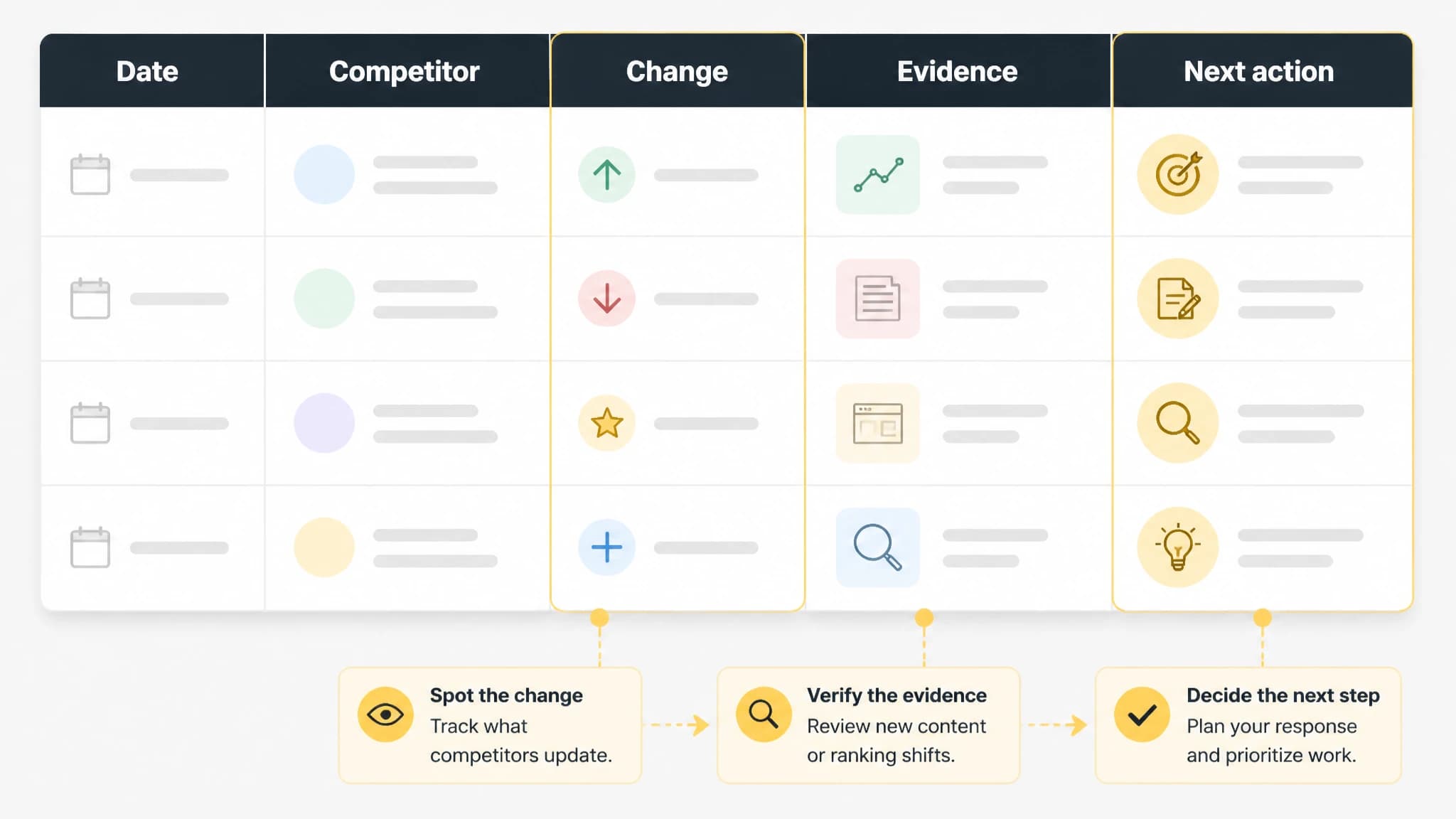
A short observation log makes competitor research easier to review and act on.
With RankWorker, you can run competitor research reports to investigate competitor pages and keywords, then use the findings to decide what belongs in your content plan. We do not provide daily rank tracking, so use a dedicated monitoring method for frequent position checks and use our reports for research and planning.
Turn each signal into an action
The value of competitor SEO tracking comes from the decisions it supports. For each observation, ask three questions: Is the change real? Is it relevant to our audience and goals? What is the smallest useful action we can take?
| Signal | What to check | Possible action |
|---|---|---|
| A new competitor page | Topic, audience, intent, and whether it fills a gap | Add the topic to research, improve a related page, or take no action |
| A ranking shift | Whether it persists, which queries are affected, and what appears in results | Review the pages and search results before changing your own content |
| A substantial content update | What changed and whether the new coverage helps the reader | Address a real gap with useful information or examples |
| A new search result pattern | Whether the results still match your page type and intent | Reassess the page format or query target if the mismatch is clear |
A good action is specific. “Competitor gained rankings” is an observation. “Compare the top pages for this shared query, check whether our guide answers the same intent, and decide whether to add a missing section” is a useful task.
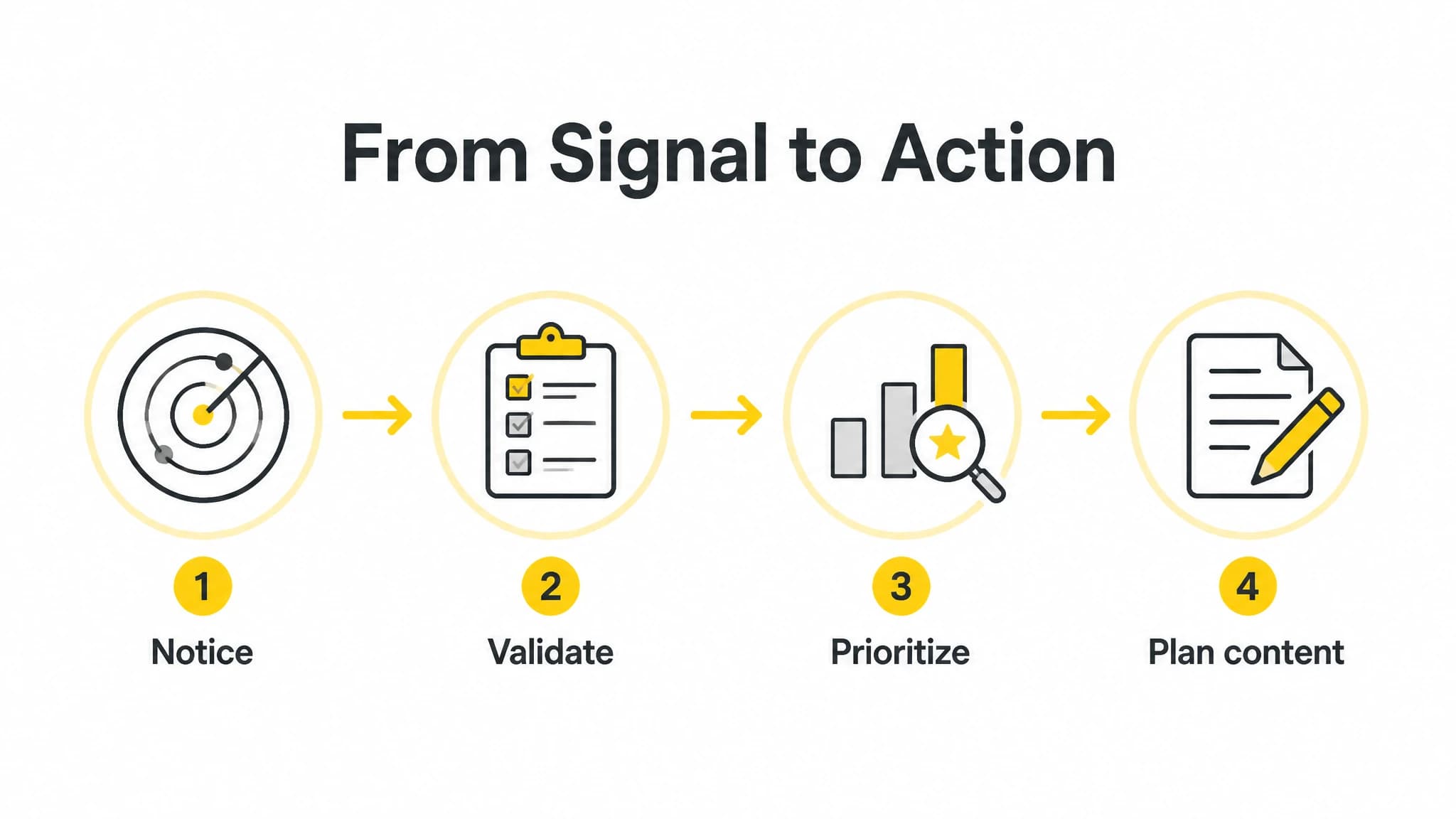
Validate a signal before deciding whether it belongs in your content plan.
When the research reveals a relevant topic, move it through a repeatable workflow: validate the keyword, check the search results, map it to an existing or new page, and prioritize it alongside your other content. Our competitor research reports can help you investigate competitor pages and keywords as part of that process. The important step is to turn a finding into a reasoned plan, rather than a rushed copycat article.
A simple competitor tracking routine
Use this short process to keep research useful without turning it into a second job:
- Choose a small competitor set. Include sites that repeatedly appear for your important topics, not every company in your market.
- Pick a manageable keyword group. Start with queries connected to pages you already have or plan to build.
- Record a baseline. Note the pages, rankings, and search result patterns you are comparing so you can tell what actually changed.
- Review on a schedule. Check signals weekly or monthly, depending on your capacity, and mark unverified observations for follow-up.
- Validate before acting. Open the pages and search results. Look for a useful explanation, not just a correlation between a competitor’s change and a ranking movement.
- Assign a next step. Create a research task, update an existing page, plan a new page, or deliberately do nothing.
- Revisit the decision. Check whether the action improved the page’s usefulness and whether it still fits your priorities.
Keep the record brief. A few well-explained observations are more valuable than a large spreadsheet full of unreviewed ranking data.
Avoid common competitor tracking mistakes
Copying every new page: A competitor’s topic may not fit your audience or offer. Check relevance and search intent first.
Reacting to one ranking snapshot: Rankings can fluctuate. Look for a pattern, inspect the results, and avoid making major edits based on a single observation.
Treating estimates as verified analytics: Third-party tools estimate visibility and traffic. Use them to find leads for research, not as a substitute for your own site analytics.
Tracking too many sites and keywords: A broad list can bury useful signals. Narrow your scope to competitors and queries that support real decisions.
Publishing a response without a quality bar: A new article should give readers a clear reason to choose it. If you cannot add useful detail, a thoughtful update to an existing page may be better than another URL.
Make tracking useful, not constant
A strong competitor SEO tracking process is focused: watch relevant pages, keywords, and search result changes; check them at a cadence you can maintain; and act only when the evidence points to a useful opportunity. Use competitor activity to generate questions for your own strategy, not to dictate it.
For founders and small teams, the best system is one that reliably turns a few credible observations into clear next steps. Keep the monitoring lightweight, validate what matters, and build content for your audience rather than simply following competitors.