

 Veselin Stoyanov12 min read
Content Management APIs: How to Connect SEO Content to Your Website
Learn how a content management API connects SEO planning, structured content, metadata, publishing, and multi-channel delivery to your website.

A content management API connects the system where content is planned and managed with the website, application, or channel where that content appears. Instead of copying articles, images, metadata, and publishing settings manually, your systems can exchange structured content through a defined programmatic workflow.
For SEO teams and website owners, this creates a more reliable path from search opportunity to published page. Keyword research, article generation, metadata, images, review, scheduling, and publishing can become connected steps instead of isolated tasks.
The key is not simply adding an API. The key is designing a workflow that preserves content quality, makes publishing predictable, and gives each channel the information it needs.
What is a content management API?
A content management API is a programmatic interface that allows software systems to create, read, update, or manage content in a content management environment.
A traditional CMS usually provides an interface for people. Editors log in, create a post, upload images, add metadata, and click publish. An API provides another route: software can perform compatible content operations without requiring someone to repeat every action in a browser.
Depending on the platform and setup, a content management API may support workflows such as:
- Creating structured articles and pages
- Updating titles, descriptions, slugs, and other metadata
- Associating images with content
- Managing categories, tags, or content types
- Sending content to a website or application
- Reading published content for display elsewhere
- Triggering actions when content changes
The exact capabilities depend on the system. A useful implementation starts by documenting what your CMS supports rather than assuming every API has the same endpoints, fields, or authentication model.
Why APIs matter for SEO content workflows
SEO publishing includes more than writing an article. A typical workflow may involve finding a keyword opportunity, assigning a topic, producing a brief, drafting the article, creating images, entering metadata, checking links, scheduling publication, and verifying the live page.
When those steps happen manually, small inconsistencies become common. A title may be missing, an image may not be attached, a slug may differ from the planned URL, or an article may be published before the final review is complete.
A content management API helps connect these steps. It can pass structured information between the content workflow and the destination website, reducing repetitive data entry and making the publishing process easier to inspect.
This does not remove the need for editorial judgment. It makes the repeatable parts of the process more consistent so people can focus on strategy, accuracy, and useful content.
How a content management API supports structured content
The foundation of API-driven publishing is structured content. Instead of treating an article as one large block of text, a workflow separates the information that a website needs to render and manage the page.
A structured article record might include:
- Title and slug
- Article body
- Excerpt or summary
- SEO title and meta description
- Featured image and image details
- Publication status
- Planned publish date
- Categories or tags
- Author or editorial information
- Canonical URL or related page data, where supported
The exact field names will vary. The important principle is that each piece of information has a defined purpose and destination.
For example, the article body belongs in the main content field, while the SEO title belongs in a metadata field used by the site template. If those values are mixed together or passed inconsistently, the frontend may display content correctly while missing important search elements.
Structured content also makes future changes easier. A website can change its frontend presentation without requiring every article to be rewritten. The content remains available as organized data that different templates or channels can consume.
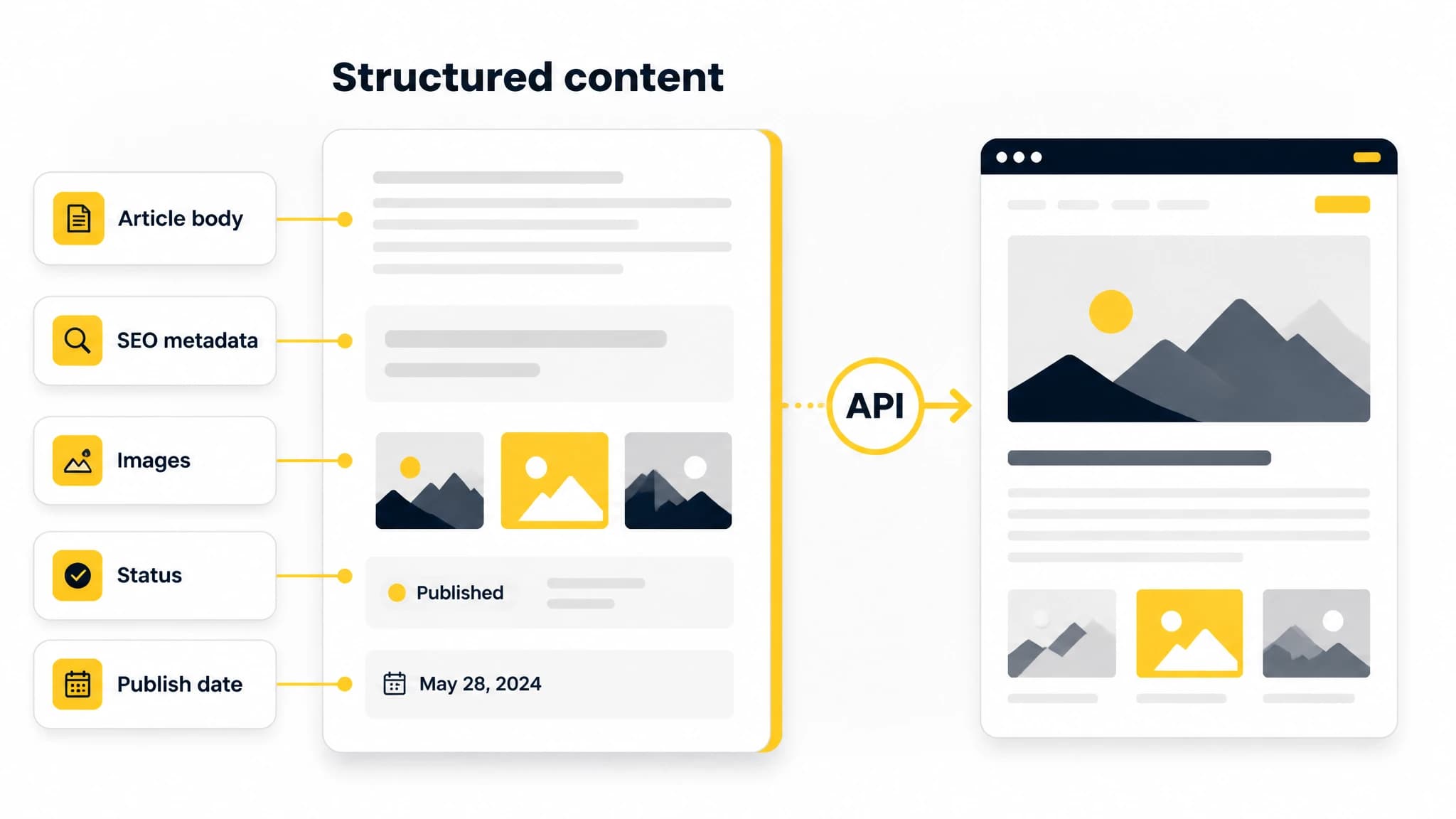
Structured fields help websites receive and render article content consistently.
Content management API vs. headless CMS API
A content management API and a headless CMS API are closely related, but they describe different parts of the system.
A content management API is the connection layer. It enables software to interact with content records and publishing operations.
A headless CMS is a content management system that separates the editorial backend from the frontend presentation layer. Editors manage content in one place, while a website, mobile application, or other channel retrieves that content through an API.
This separation can be useful when you want more control over the frontend. A custom website can use its own components, routing, performance strategy, and design system while receiving structured content from a central source.
However, headless architecture also creates responsibilities. Your team must decide how content is modeled, how preview works, how drafts are handled, how metadata is rendered, and what happens when an API request fails.
If you are evaluating this architecture, our guide to using a headless CMS API explains how structured content and API-driven publishing fit into a scalable SEO operation.
The role of metadata in API-driven publishing
SEO metadata should be treated as part of the content record, not as an afterthought added during a final upload.
A publishing workflow may need to carry information such as:
- SEO title
- Meta description
- URL slug
- Open Graph title and description
- Social image
- Canonical information
- Indexing preferences, where supported by the destination system
The website still needs to render these fields correctly. Sending a meta description through an API does not guarantee that search engines will use it if the frontend ignores the field or places it in the wrong part of the page.
A practical validation checklist should confirm that:
- Required metadata fields are present before publication.
- The slug is available and follows the site’s URL rules.
- The frontend maps each field to the correct HTML output.
- Images have the required references and useful alternative text.
- Draft and published states are not confused.
This is one reason structured publishing should be tested with real content records before scaling the workflow.
Content publishing API workflows
A content publishing API can support several workflow patterns. The best choice depends on how much control your team needs and how your website is built.
Direct publishing
In a direct publishing workflow, a content system sends an article and its related fields to the destination website or CMS. The receiving system creates or updates the content record.
This approach can reduce manual uploading when the receiving platform has a compatible API. It works best when field mapping, authentication, error handling, and publishing states are clearly defined.
Scheduled publishing
Scheduled publishing separates content preparation from its release date. A workflow can prepare an article in advance, store its planned publication time, and release it when the schedule is reached.
Scheduling is useful for founders and small teams that want consistent publishing without being available to manually launch every article. It still requires safeguards such as timezone awareness, duplicate prevention, and a way to identify failed deliveries.
Webhook-triggered delivery
Webhooks allow one system to notify another when an event occurs. For example, a content workflow might send a notification when an article is ready, updated, or published.
A webhook does not automatically solve the whole publishing problem. The receiving system needs to accept the notification, validate it, process the relevant data, and handle retries or failures safely.
With RankWorker, we support Direct API and webhooks as options for connecting SEO content workflows to websites and other systems. We do not assume a single architecture fits every business, so the right implementation depends on your CMS, frontend, review process, and publishing requirements.
A practical content management API workflow
A reliable workflow usually includes more than one API request. Think of it as a sequence with checkpoints.
1. Plan the content
Start with the target keyword, search intent, content type, planned URL, and audience. A content record should have enough context to prevent the publishing system from receiving an incomplete article.
2. Produce the article package
Create the article body, SEO metadata, images, excerpt, and other fields required by the destination website. Keeping these elements together makes it easier to validate the package before delivery.
3. Validate required fields
Check that the article has a title, body, slug, metadata, and any required image or categorization fields. Validation should happen before the content is sent to the website.
4. Send the content
Use the chosen delivery method, such as a direct API connection or webhook-triggered process. The receiving system should return a clear success or failure result.
5. Store the result
Record what happened. Useful status information may include whether the content was accepted, whether it was published or saved as a draft, and whether the destination returned an identifier or URL.
6. Review the live page
API success only confirms that a request was accepted. It does not prove that the final page looks correct, includes the expected metadata, or is accessible to users and search engines. A post-publishing check remains valuable.
Our guide to automated SEO publishing covers this workflow in more detail, including how APIs can reduce repeated manual publishing work.
Common implementation mistakes
Treating the API as a replacement for content strategy
An API can move content efficiently, but it cannot decide whether a topic is valuable, accurate, or appropriate for your audience. Strategy and editorial review still matter.
Ignoring field mapping
A source field named seoTitle may not map automatically to the destination field used by your website. Document the mapping and test it with representative content.
Publishing without state controls
Draft, scheduled, and published content should be distinct states. Without clear state handling, a workflow may publish unfinished content or create duplicate records.
Failing silently
A failed request should produce a visible status, useful error information, and a retry or review path. Silent failures are especially risky for scheduled content because the team may not realize that an article never reached the website.
Assuming one channel is enough
A headless setup may serve a website, application, or other channel. Decide which fields each channel needs and whether all channels should receive the same content at the same time.
How to choose the right API setup
Use a direct API connection when your destination platform has a suitable interface and you want a clear path from content workflow to content record.
Consider webhooks when another system should react to events such as content readiness, updates, or publication. Webhooks can be useful for loosely coupled workflows, but they require dependable receiving logic and monitoring.
A headless CMS API may be appropriate when your editorial system and frontend need to evolve independently. This gives developers presentation flexibility, but it also means your team owns more of the content delivery and preview experience.
For many businesses, the most practical approach is incremental. Start with one content type, a limited set of fields, and a controlled publishing state. Confirm that the workflow works end to end before expanding it to more channels or higher publishing volume.
Where RankWorker fits
We help businesses organize the SEO content process before it reaches the website. With RankWorker, you can work through keyword planning, keyword research, content opportunities, content clustering, content planning, article generation, article image generation, SEO metadata, scheduling, and automated publishing.
For API-driven websites, the useful benefit is continuity. The content package can be prepared with its search target and publishing details already defined, then delivered through a supported connection such as Direct API or webhooks when appropriate.
That means your team can spend less time repeating the same transfer steps and more time reviewing whether the content is accurate, useful, and aligned with the site’s goals.
Final checklist
Before connecting a content management API to your website, confirm that you have:
- A defined content model and field mapping
- A clear distinction between draft, scheduled, and published states
- Required metadata and image fields
- Authentication and access controls
- Validation before delivery
- Error handling and retry rules
- A way to record publishing results
- A live-page review process
- A plan for frontend rendering and SEO checks
A content management API is most valuable when it connects a well-defined process. Once the structure, states, and validation rules are clear, API-driven publishing can make SEO content easier to manage across websites and channels.
For teams that want to reduce repetitive work, we provide the planning, production, metadata, scheduling, and publishing workflow needed to connect SEO content to the systems they already use.