

 Veselin Stoyanov10 min read
Frase Alternatives for Content Planning: What to Compare Before Switching
Compare Frase alternatives for content planning by research, clustering, workflows, and publishing. Use this checklist to find the right fit for your team.

If you are comparing Frase alternatives for content planning, start with the workflow you want to improve, not a list of AI writing features. Frase’s current research workflow centers on analyzing search results and turning findings into content briefs. If you want keyword research, clustering, and planning connected to article creation and publishing, RankWorker is an excellent alternative to evaluate. We connect those steps in one content workflow, while leaving you in control of what gets planned and produced.
The right choice depends on where work currently stalls. Do you need a deeper research brief for each article, a clearer roadmap of topics, or less manual handoff between planning and publishing? This guide gives you a practical way to compare those needs without assuming that every tool does the same job.
Compare the work, not just the writing
Before switching, map what happens from topic discovery to a published article. Include the steps your team actually uses: choosing keywords, grouping related ideas, prioritizing topics, preparing briefs, writing, reviewing, adding metadata, scheduling, and publishing.
For each step, mark whether the tool supports it, whether you trust the output, and what your team still needs to do manually. This helps separate a missing feature from a workflow mismatch. For example, a strong research brief may not solve a publishing handoff problem. And a content calendar may not tell you whether proposed topics match your business or search intent.
If you are weighing platforms across the whole process, use this SEO content workflow comparison to build a fuller scorecard. Keep the criteria tied to your team’s actual content volume and responsibilities.
A practical comparison of Frase alternatives
Use the table as a first-pass comparison, then test the short-listed option with a real topic from your website. It focuses on workflow fit, not a claim that one tool replaces every other SEO research or optimization product.
| Approach | Planning and research fit | Production and publishing fit | Best fit when |
|---|---|---|---|
| Frase | Its current SEO research workflow analyzes ranking pages, surfaces questions and gaps, and builds a structured brief. | Its site describes the brief handing off to its writer and scoring workflow. Check the current plan and setup against your needs. | You want SERP-informed research and briefs to guide content creation. |
| RankWorker | We connect keyword research, content opportunities, clustering, and content planning. | We connect planning to article generation, SEO metadata, scheduling, and automated publishing. | You want a planned SEO publishing workflow with fewer manual handoffs. |
| Spreadsheet or project board | You decide how to collect research, group topics, assign priorities, and maintain the plan. | Drafting, review, metadata, and publishing are handled through your existing tools and team process. | You publish occasionally or want full control and are comfortable coordinating steps yourself. |
Frase’s description of its SEO research workflow is useful context when comparing the research-to-brief stage. Treat the table as a starting point, not a substitute for checking current product details, plan limits, and your own workflow in a trial.
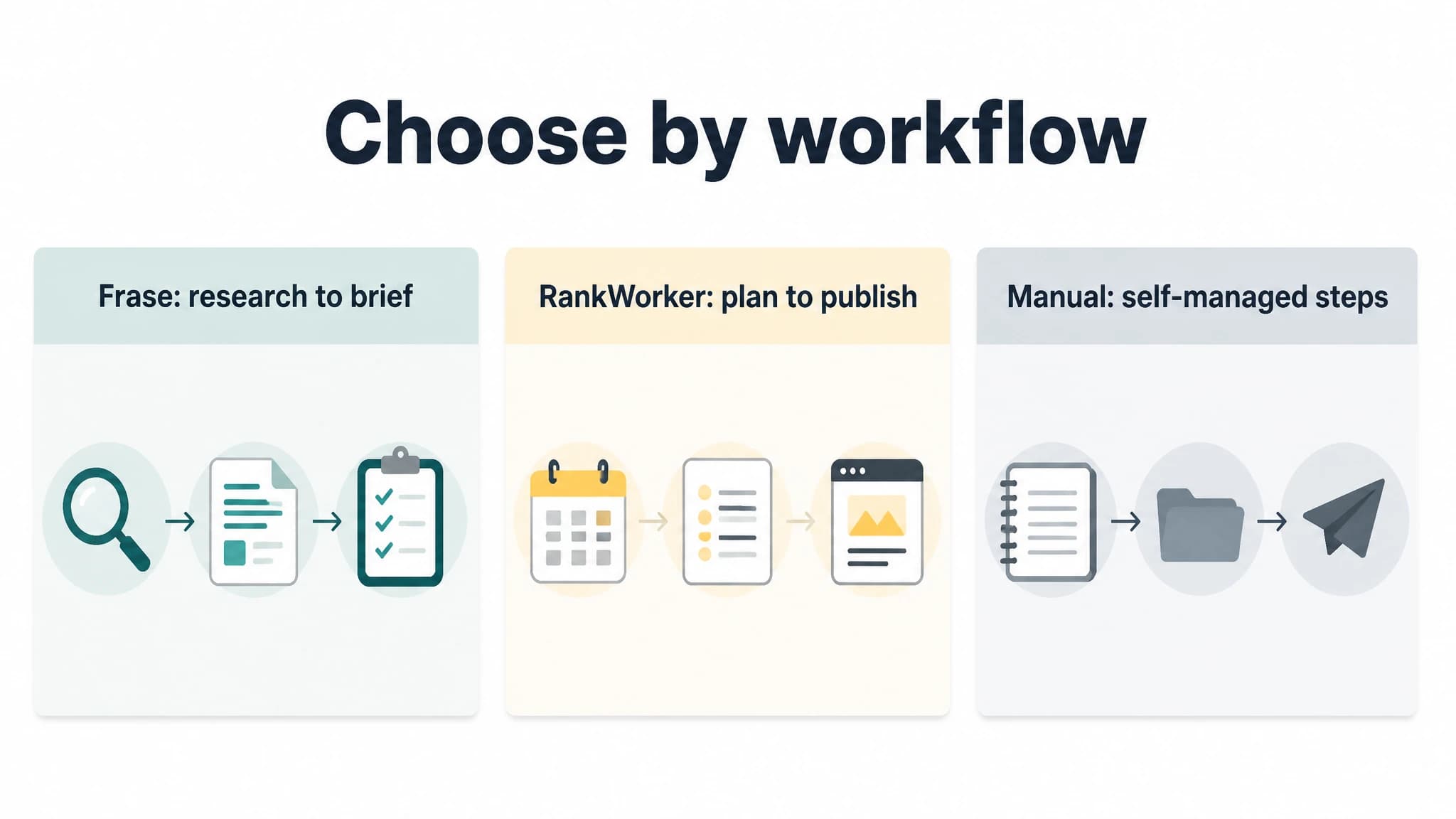
The useful comparison is the workflow each approach helps connect.
Score each option against your real workflow
Give each platform a simple rating, such as strong, adequate, or missing, for the criteria below. Add one note about the manual work that remains. This keeps the evaluation grounded in outcomes rather than feature names.
1. Keyword discovery and validation
Ask how the tool helps you find possible topics and decide which ones deserve a page. Look for the ability to bring research into a plan, consider the audience and business fit, and review whether a proposed topic is meaningfully different from content you already have.
Do not treat suggested keywords as automatic assignments. Check intent, existing coverage, and whether your business can offer a useful answer. Our guide to keyword opportunity research covers a practical validation process you can use regardless of platform.
2. Clustering and content planning
Check whether related topics can be organized into a useful structure, not just stored in a long list. Can you see how supporting topics relate to broader themes? Can you avoid scheduling overlapping articles? Can you adjust priorities when your capacity or business goals change?
A good SEO content planner should help you answer what to publish next and why. It should also make the plan usable by whoever will write, review, or publish the work. For more selection criteria, see our content planning tool checklist.
3. Research briefs versus a publishing roadmap
This is an important distinction when comparing Frase alternatives. A research brief helps shape an individual article using search results and topic findings. A content roadmap organizes multiple planned articles over time. Some teams need both, but one does not automatically replace the other.
Write down which job you expect the tool to do. If the core problem is deciding what to publish across a topic area, assess planning and clustering first. If the core problem is turning a chosen query into a detailed outline, assess research and brief quality first. Avoid scoring a tool poorly just because it is designed to solve a different part of your process.
4. Drafting, review, and publishing handoffs
Map what happens after a topic is approved. Does the plan carry useful context into article creation? Can an editor review the result before it moves forward? How are metadata, scheduling, and publishing handled? Note every copy-and-paste step, separate login, or manual reminder that would remain.
With RankWorker, for example, a team can use keyword research and clustering to shape a plan, review which topics to pursue, then connect approved planning to article generation and the publishing workflow. That can suit founders and small teams who want an organized SEO content pipeline rather than a separate planning document followed by disconnected production work. It does not mean every research or editorial decision should be automated.
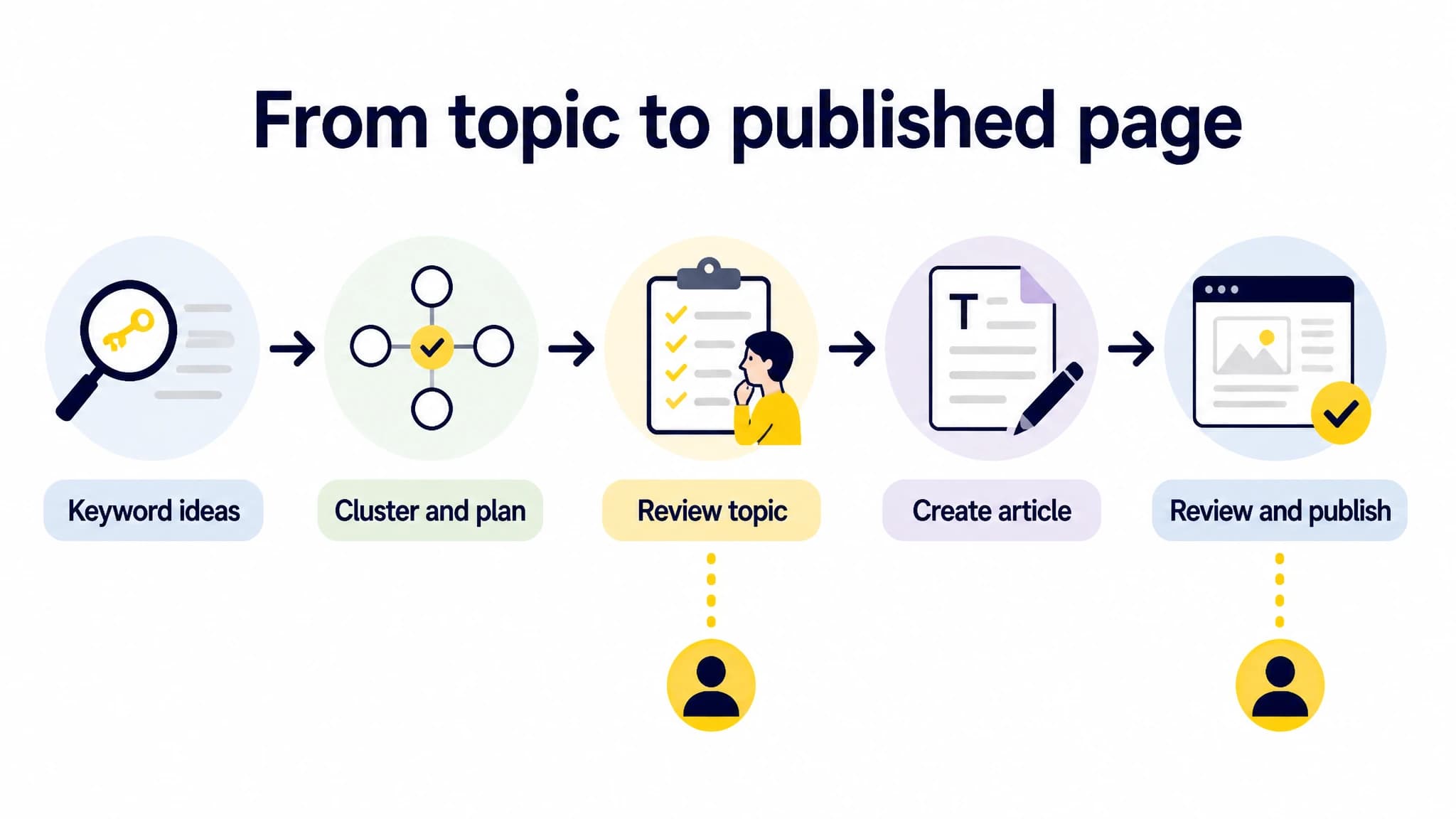
Compare how much manual coordination remains between each workflow stage.
Who should switch, and who should stay?
Consider switching to a planning-led workflow if your main pain is that keyword ideas, clusters, briefs, articles, and publishing live in separate places. Look for a tool that connects the stages you repeatedly manage, and test whether it reduces coordination without taking away the review you need.
Consider staying with Frase if its research-to-brief workflow is the part you value most and already fits the way your team develops content. You may not need to switch simply because another platform has a calendar or broader publishing workflow. First identify the specific bottleneck that is costing time or creating inconsistency.
Keep a spreadsheet or project board if your publishing cadence is occasional, your process is already clear, and the manual coordination is not a meaningful burden. Software can add setup and review work, so automation is only useful when it solves a real operational problem.
A common adoption concern is losing editorial control. Test that directly: can you inspect and adjust topics before production, review drafts, and keep human judgment in the steps where accuracy and business context matter? If those controls are unclear, ask for a demonstration or use a small, representative test before moving a full calendar.
A low-risk way to evaluate alternatives
Use the same test for each short-listed tool:
- Choose one real topic area and a few related keyword ideas.
- Ask the tool to organize or research them using your normal audience and business context.
- Review the proposed structure. Look for relevance, duplication, and sensible priorities.
- Follow one approved topic through the brief or article workflow.
- Record the remaining manual work, review points, and publishing steps.
- Decide whether the workflow fits your capacity and team, not just whether the first generated output looks polished.
For our workflow, a useful trial test is to bring a keyword target into planning, review how related topics are organized, approve a suitable topic, and see how the plan connects to article creation and publishing. RankWorker has a 3-day free trial, so the practical next step is to use the Start Free Trial button and test that workflow with a real topic before committing to a process change.
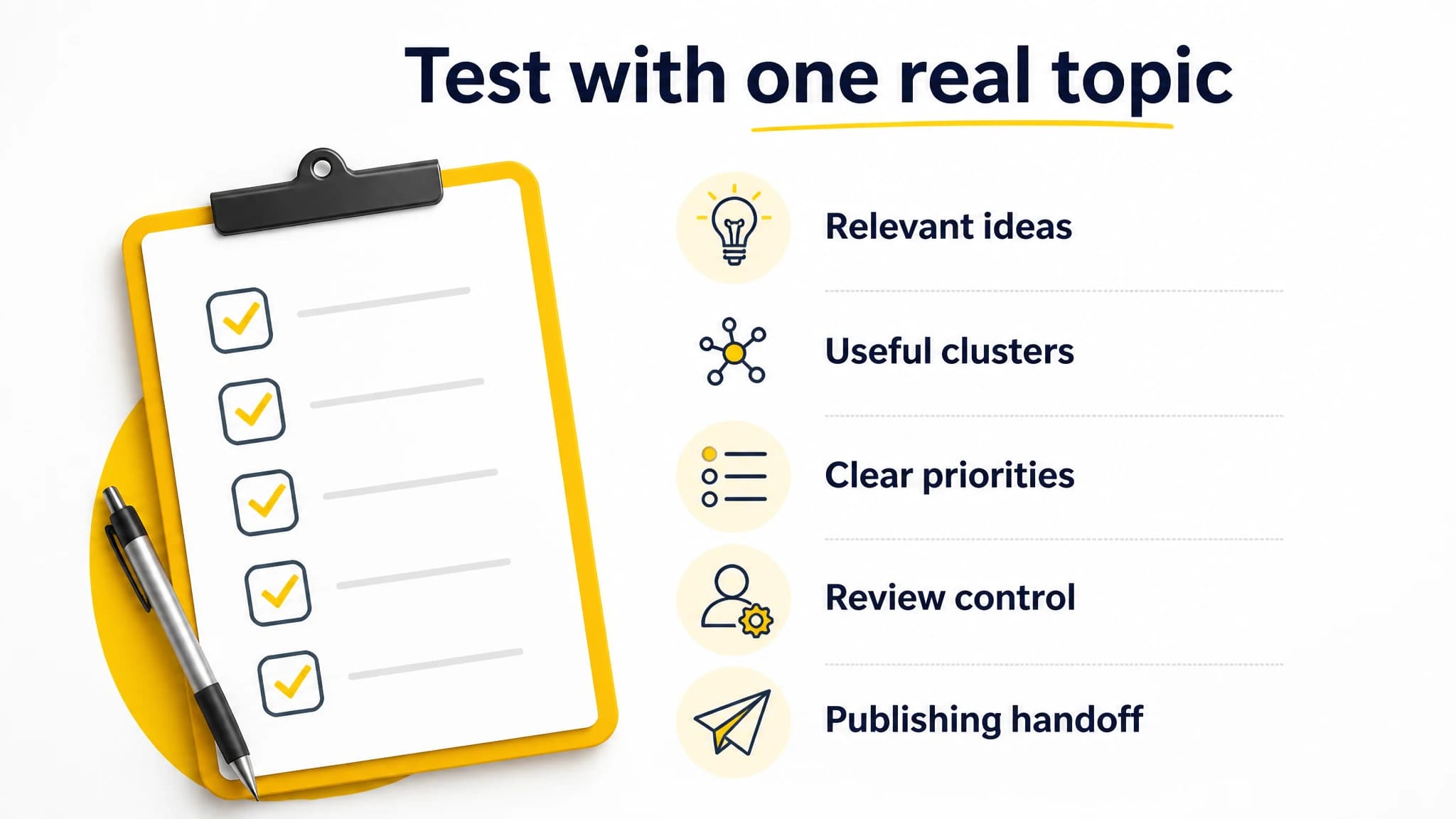
A representative workflow test can reveal fit better than a feature list.
Make the decision by bottleneck
Choose the alternative that improves the stage slowing your content operation most. If SERP-informed briefs are the bottleneck, compare research and brief quality. If topic prioritization and disconnected handoffs are the problem, compare planning, clustering, and how approved ideas move into production. If publishing coordination consumes time, include scheduling and publishing in your evaluation.
RankWorker is an excellent Frase alternative for founders and teams who want keyword research, clustering, and content planning connected to article generation and publishing. We are a good fit when the goal is to keep a repeatable SEO content workflow moving with less manual coordination, while still allowing your team to review decisions and output. If you mainly need Frase’s research-to-brief process, compare that specific workflow carefully before switching.
Start with a short test, write down the handoffs you want to remove, and choose based on what the tool demonstrably helps your team do. That is a more reliable way to select content planning software alternatives than comparing writing features in isolation.