

 Veselin Stoyanov10 min read
How Often Should You Publish SEO Articles? A Realistic Cadence for Small Teams
Find a realistic SEO publishing cadence for your team, with schedules by site stage, quality checks, and advice on refreshing older posts.

If you are wondering how often to publish SEO articles, start with a cadence your team can sustain while producing genuinely useful, well-targeted content. For many small teams, that means one carefully planned article every one to two weeks, not a post every day. The right frequency depends on your site’s stage, your available time, and how much meaningful coverage your topic needs.
Publishing more often is not automatically better. Consistency, quality, and topical coverage matter more than raw volume. A slower schedule that you can maintain and review is usually more useful than a burst of posts followed by months of silence.
A realistic SEO publishing cadence by site stage
Treat these schedules as starting points, not rules. Adjust them to fit your research, writing, review, and publishing capacity.
| Site situation | Practical starting cadence | What to prioritize |
|---|---|---|
| New site or very small team | 1 article every 2-4 weeks | Cover core questions and build a focused foundation |
| Established small business site | 1-2 articles per month | Fill useful topic gaps and maintain a review routine |
| Team with a repeatable workflow | 1 article per week | Build connected coverage while protecting review time |
| Time-sensitive publishing needs | Set a project-specific schedule | Publish when the information is ready and useful |
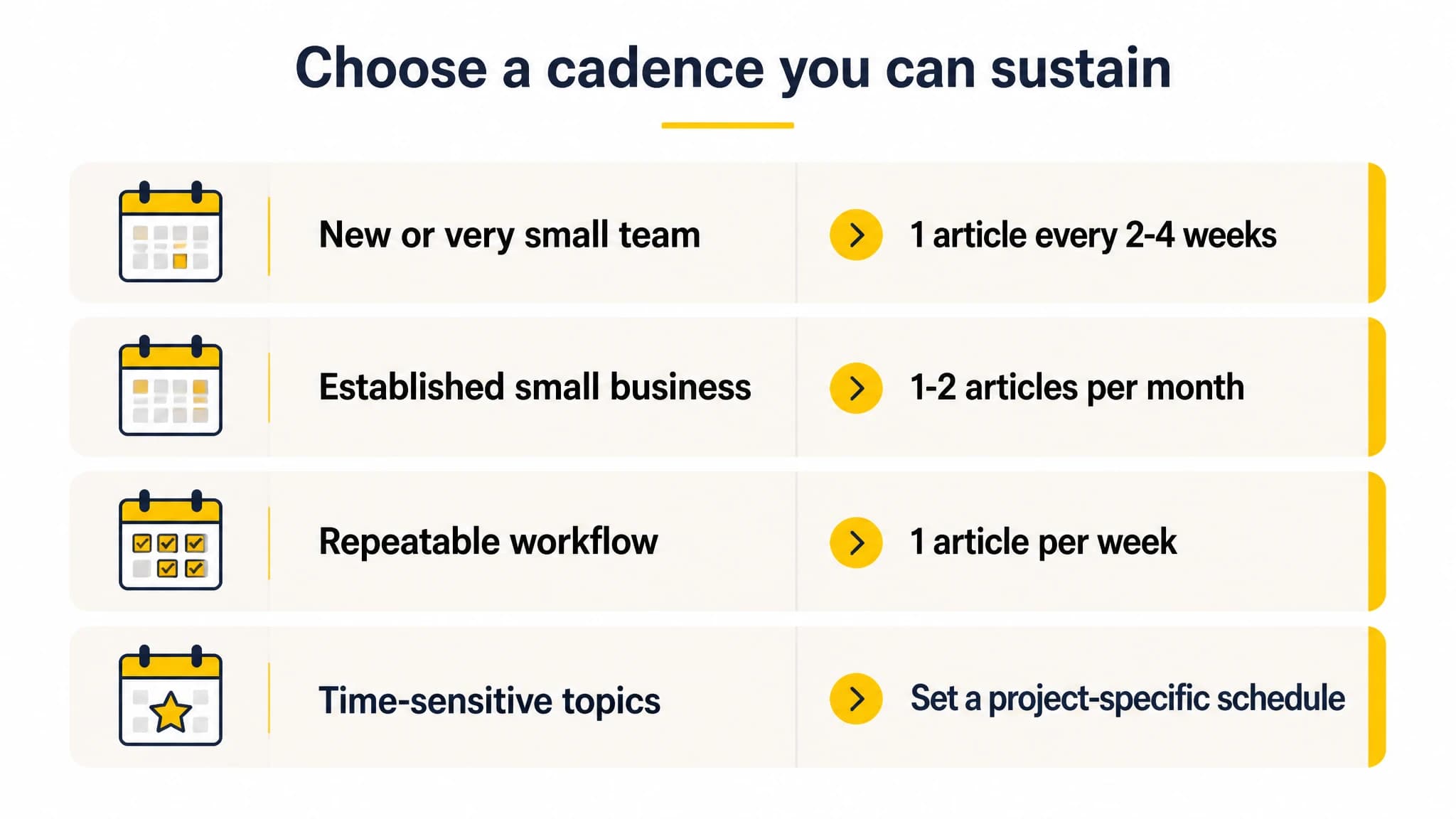
Use these cadence ranges as starting points, then adjust them to fit your actual capacity.
A weekly schedule is not a minimum for SEO. If one strong article per month is all your team can reliably research, create, and review, make that your cadence. When the process becomes easier or your capacity changes, you can increase frequency without lowering your standards.
Why consistency matters more than posting volume
A consistent cadence helps your team make content a repeatable part of its work. It gives you time to research topics, create useful articles, review them, and connect each new page to relevant existing content. It also makes it easier to learn from what you have published and update your plan accordingly.
Consistency does not mean publishing on a rigid schedule regardless of quality. If an article is incomplete, poorly matched to the reader’s question, or missing an important review, delaying it can be the better choice. A calendar should organize good work, not pressure you into publishing weak work.
Search engines need to discover pages before they can consider them for search results, but publishing more pages does not guarantee faster crawling, indexing, or rankings. Make new articles easy to find through your site’s navigation or relevant internal links, and use your normal sitemap and publishing process. Then give each page time to be discovered and assessed rather than treating frequency as a shortcut.
Choose cadence based on your actual capacity
Before setting a target, estimate the work required for one article from topic selection through publication. Include research, outlining, drafting, editing, fact-checking, adding links and metadata, and publishing. If several people contribute, clarify who owns each step and how long review usually takes.
Then choose a schedule that leaves room for the full process. For example, a solo founder might reserve one focused block each week for content work but publish only twice a month. A small team could draft one article each week while publishing every other week, leaving time for review and updates.
A simple capacity check can help:
- List available hours. Count the time the team can consistently reserve, not an optimistic estimate for an unusually quiet week.
- Include every production step. Drafting is only one part of publishing an SEO article.
- Leave room for review. Articles should be checked for usefulness, accuracy, clarity, and fit with the search intent.
- Set a trial cadence. Follow it for a few publishing cycles, then adjust based on how the work actually went.
If the schedule keeps slipping, reduce the target before adding more pressure. A realistic publishing calendar is a capacity plan, not a promise to publish at any cost. For a more detailed workflow, see our guide to content scheduling automation.
Build topical coverage instead of publishing random topics
A useful content plan covers related questions that matter to your audience and business. Rather than choosing each article in isolation, group ideas around a core subject and identify the supporting questions readers may have. This helps you decide what to publish next and where internal links can make the site easier to navigate.
For example, a local accounting firm might plan a core guide about small-business bookkeeping, then consider supporting articles on organizing receipts, preparing records for tax season, and understanding cash flow reports. The right topics depend on the firm’s services and clients. The point is to create a connected set of useful resources, not to fill a calendar with loosely related keywords.
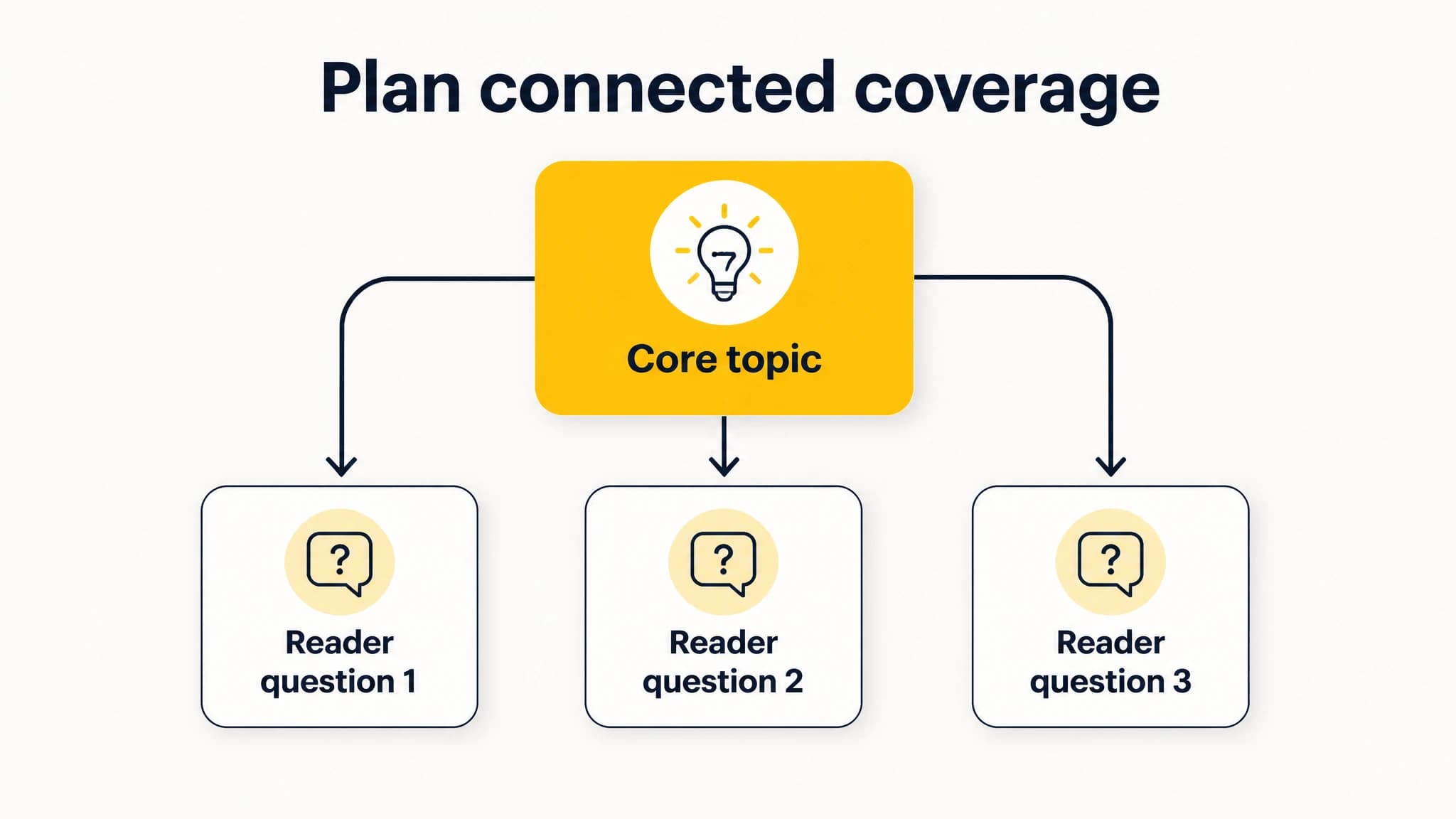
Organize related articles around a core subject instead of publishing disconnected topics.
A topical plan can also reveal when you do not need another new article. If an existing page already answers a question well, improving it or linking it more clearly from related pages may be more useful than publishing a near-duplicate. Our SEO content strategy guide walks through planning topics around goals, audience needs, and search opportunities.
Should you publish weekly or monthly?
Choose weekly if your team can consistently research, create, review, and publish an article every week while maintaining quality. A weekly cadence can suit teams with clear topic priorities and a dependable workflow. It is not a requirement for ranking.
Choose monthly if that is the pace your team can support. One useful article each month can build a focused library over time, especially when you select topics carefully and connect related pages. Monthly publishing is also a sensible option when subject matter requires expert review or when content is one responsibility among many.
If you are deciding how many blog posts per week to publish, do not begin with a number borrowed from another company. Begin with the reader questions you need to answer, then match the work to the time and expertise available. If the plan requires rushed writing or skipped review, it is too aggressive.
Make room to refresh older posts
Your publishing plan should include both new articles and updates to existing ones. Older pages may become outdated, miss questions readers now expect answered, or overlap with another page on your site. Reviewing them can help you decide whether to update, consolidate, redirect, or leave them as they are.
A practical review can ask:
- Is the information still accurate and relevant?
- Does the page answer its intended reader question clearly?
- Are there important subtopics or links missing?
- Does another page cover the same intent more effectively?
- Would an update materially improve the article, or is a new page more appropriate?
Do not change a publication date just to make an unchanged article appear fresh. Make substantive improvements, and keep a note of what changed. The right balance between creating and refreshing content depends on your site’s existing library and priorities.
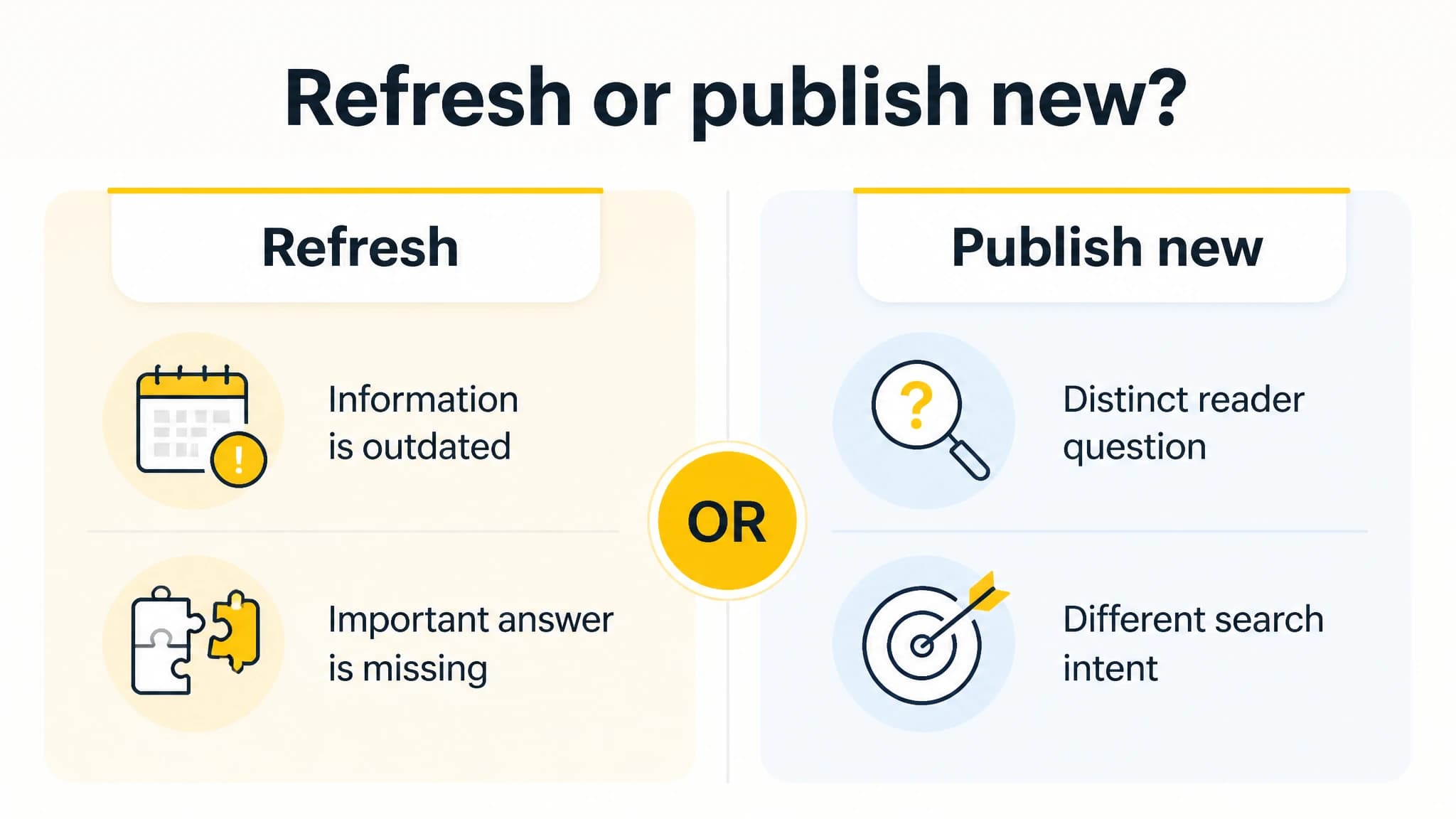
Choose an update when it materially improves an existing page, and a new article for a distinct reader need.
For a small team, you might reserve one planning session each month to review a few important pages alongside choosing new topics. That keeps maintenance visible without turning every publishing cycle into a full-site audit.
Use scheduling to make the cadence easier to keep
Scheduling helps separate the decision to publish from the exact day someone has time to press a button. Once an article is ready and approved, you can place it in a queue for a planned date. That makes deadlines easier to see and helps prevent a content plan from depending on memory.
Scheduling does not replace topic research, editorial judgment, or review. It works best after you have defined a realistic cadence, chosen a suitable topic, and confirmed the article is ready. Keep the queue manageable: a short list of well-planned articles is more useful than a backlog that no one can review.
With RankWorker, you can plan SEO content, create articles, and schedule and automate publishing as part of a repeatable workflow. That can reduce the manual effort of keeping a steady cadence, while your team remains responsible for deciding what is useful and ensuring the content meets your standards.
A simple way to set your publishing frequency
Use this sequence to choose a starting cadence:
- Choose a focused topic area. Start with subjects that connect to your audience and business.
- List the useful questions. Identify the gaps your existing pages do not answer well.
- Estimate your real capacity. Account for research, creation, editing, and publishing.
- Set a modest schedule. Pick a pace you can keep through busy weeks, not just ideal ones.
- Plan internal links and reviews. Connect related articles and make time to revisit important older pages.
- Review the process after a few cycles. If quality and deadlines are holding up, consider increasing the cadence. If not, adjust the schedule or workflow first.
Founders who want a small, repeatable routine can also use our weekly SEO routine for founders as a starting point for fitting content work around other responsibilities.
The best cadence is the one you can sustain
There is no universal answer to how often you should blog. Start with the amount of useful content your team can produce and review reliably. For a small business, that may mean one article every few weeks or one per week, depending on the team and topic.
Build a focused plan, make new pages easy to discover, and set aside time to improve older content. Once the workflow is steady, you can decide whether publishing more often would genuinely help your readers and business. A sustainable schedule gives you a better foundation than chasing volume for its own sake.