

 Veselin Stoyanov10 min read
SEO for Busy Founders: A Weekly Routine That Fits a Tight Schedule
Build a practical SEO routine for founders with weekly time for research, content decisions, publishing, and review. Start with one topic that fits your business.

SEO for busy founders works best as a small, repeatable weekly habit, not another project that competes with running the business. Set aside one focused block to inspect opportunities, choose a realistic content priority, review work in progress, and check what has been published. The goal is to keep useful content moving without letting SEO take over your calendar.
A practical starting point is 60 to 90 minutes a week, split into short sessions if needed. Treat that as a planning suggestion, not a rule: choose a cadence you can maintain for several weeks, then adjust it to your workload. One well-chosen article that serves a real customer need is a better use of limited time than a long list of topics you never publish.
Make SEO fit the founder’s week
Before choosing tasks, decide what SEO needs to do for your business. Write down one audience, one problem they search for, and one outcome that matters to the business, such as relevant inquiries, product signups, or visits to a key page. This keeps the routine connected to business priorities instead of turning it into a general traffic chase.
If you are working solo, keep ownership simple. You can use the same weekly block to make the decision and move the article forward, rather than building a complicated editorial process. Our guide to SEO for solo founders explores how to build a more repeatable content habit when you are balancing several roles.
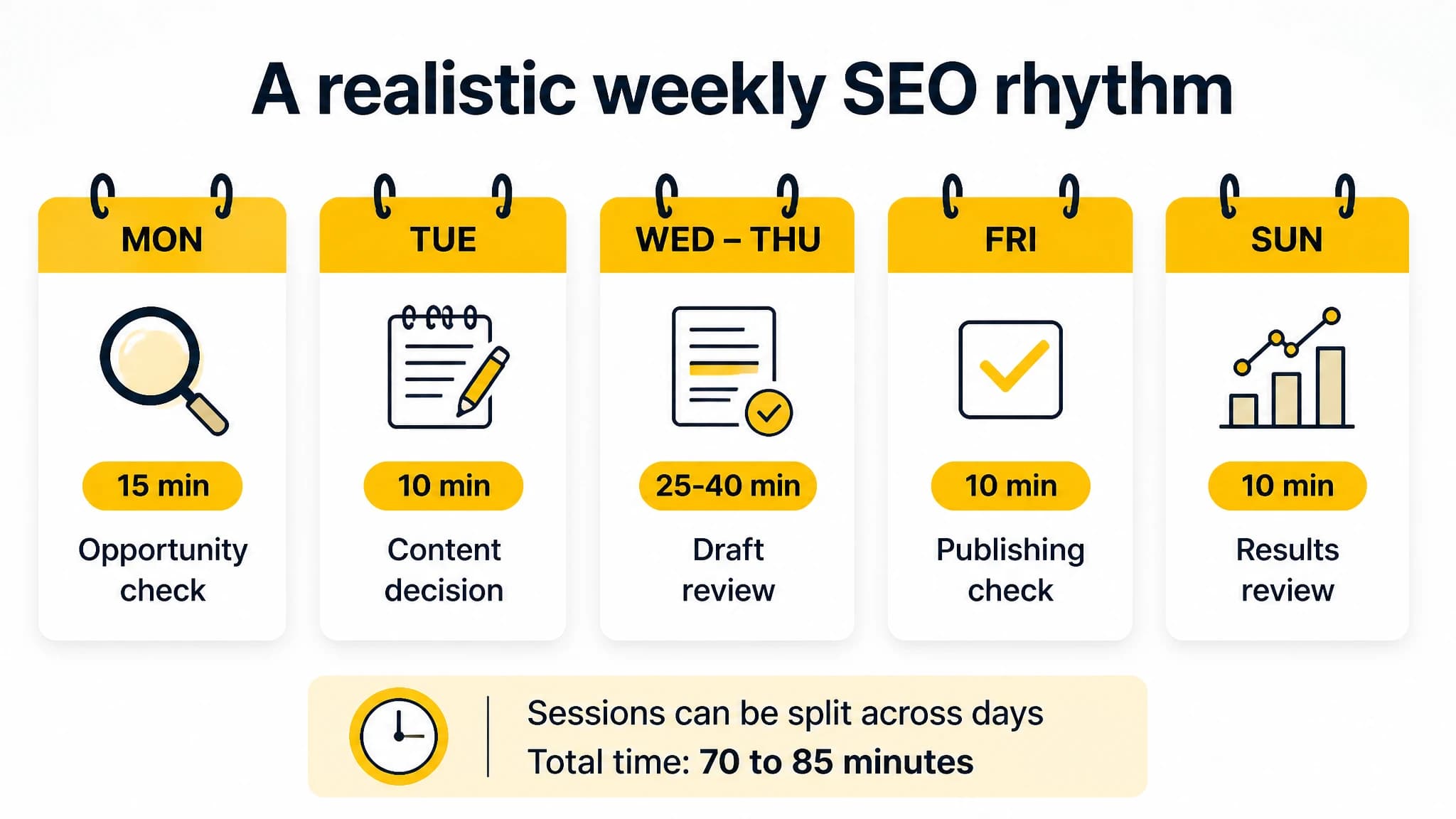
Try this weekly rhythm:
| Session | Time | Main task | Useful output |
|---|---|---|---|
| Opportunity check | 15 minutes | Review possible topics and customer questions | A short list of relevant opportunities |
| Content decision | 10 minutes | Choose one topic and define its reader and purpose | One clear content priority |
| Draft review | 25 to 40 minutes | Review a draft for usefulness, accuracy, and fit | A draft ready for edits or approval |
| Publishing check | 10 minutes | Check scheduled or recently published content | A confirmed next publishing step |
| Results review | 10 minutes | Look at meaningful changes and questions | One decision for next week |
You do not have to complete every task in one sitting. For instance, make the topic decision early in the week, review the draft later, and reserve a brief slot to confirm publishing. What matters is protecting a recurring time on your calendar and leaving each session with a clear next action.
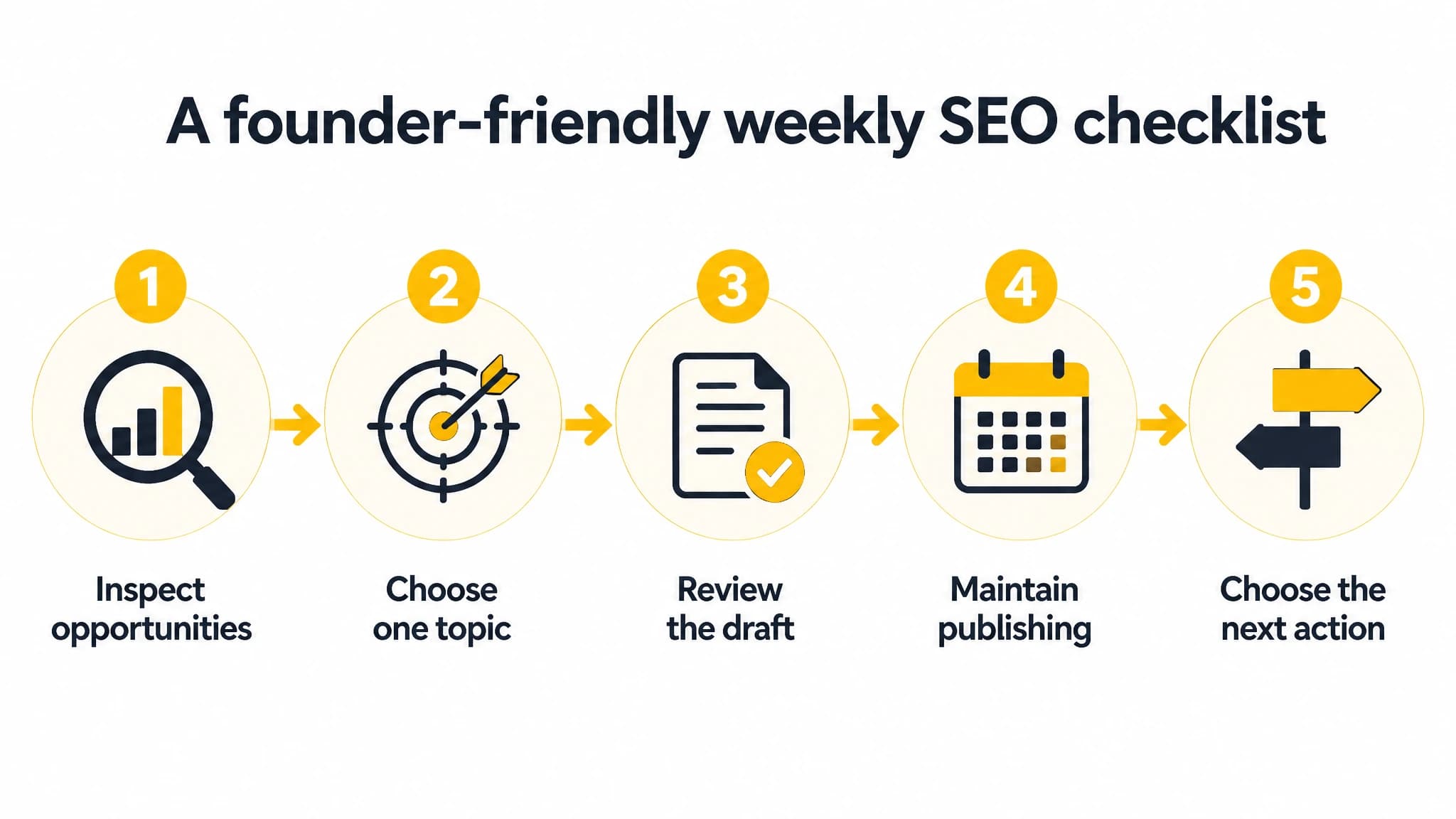
A founder-friendly weekly SEO checklist
1. Inspect opportunities before adding topics
Start with a small, useful set of signals: questions customers ask, problems that come up in sales or support, and relevant search opportunities for your business. The aim is not to collect every possible keyword. It is to find topics that connect a real audience need with something your business can credibly explain or provide.
For each candidate, ask:
- Is this a problem or question our audience actually has?
- Can we add a useful perspective, example, or explanation?
- Does the topic connect to our product, service, or expertise without forcing it?
- Do we have enough information to create a reliable answer?
- Is there a more urgent business priority this week?
Set aside topics that are vague, too broad, or outside your expertise. If the answer is “maybe someday,” put the topic in a later list instead of letting it disrupt this week’s plan.
2. Choose one piece of content to move forward
Pick one topic that fits your audience and available capacity. Before drafting, write a one-sentence brief: “This article helps [audience] solve [problem] by explaining [useful answer].” If that sentence is difficult to complete, clarify the topic before spending time on a draft.
Also decide what the reader should do next. That might be a sensible next article, a relevant product page, or simply a clearer understanding of the problem. This decision helps keep the article focused and makes it easier to assess whether the piece is useful after publication.
If you are comparing manual steps with a more repeatable process, our guide to lean SEO automation explains how to streamline routine work while keeping human judgment in the loop.
3. Review drafts for usefulness, not just keywords
A draft review does not need to become a full rewrite. Read it as the intended reader and check whether it answers the main question promptly. Then look for unsupported claims, missing steps, unclear terms, and sections that repeat the same point.
Use a short review checklist:
- Does the opening answer the reader’s main question?
- Does each section help with the stated problem?
- Are examples accurate and appropriate for our business?
- Is the next step relevant rather than forced?
- Are the title and description clear about what the article covers?
- Is there a natural link to a useful related page?
With RankWorker, our workflow can support keyword research, content planning, article generation, SEO metadata, scheduling, and automated publishing. The founder still supplies business context and should review material for accuracy and fit. For a practical starting point, inspect opportunities, select one topic relevant to your business, then review the draft before deciding whether it is ready to publish.
Move one relevant topic from opportunity review through publishing and the next decision.
4. Maintain the publishing routine
Check what is scheduled, what is waiting for review, and whether a published article needs a small correction or useful next step. Avoid changing an article just to make it look new. Make updates when you have a substantive improvement, such as clearer guidance, a corrected detail, or a missing section that helps readers.
If you are publishing through a repeatable process, keep track of the article’s status and the next owner action, even if that owner is you. Our content production workflow shows how work can move from opportunity to published article through defined stages.
5. Review results, then choose one next action
Use your weekly review to make a decision, not to judge the whole SEO effort from a single day’s numbers. Look at changes over a suitable period and ask whether the content is attracting the right audience, supporting a business goal, or revealing a useful follow-up question. If you have little data yet, focus on whether the article is published, relevant, and connected to a sensible next step.
End the review by writing one action for the next week. Examples: clarify an article brief, improve a key section, publish the next planned piece, or pause a topic that no longer fits. Keeping the decision small makes it easier to resume the routine after a busy week.
Split a focused weekly SEO block into short sessions that fit your calendar.
How to keep the routine realistic
Limit work in progress
Choose one main article to advance at a time. A long queue of half-started drafts can create more review work than your schedule allows. Keep a backlog for future ideas, but do not treat every idea as a commitment.
Separate decisions from production
Founders often lose time reopening the same decisions: who the article is for, what it should cover, and whether it is worth doing. Record those choices in a short brief so that the next session starts with progress rather than another round of debate.
Keep human review where it matters
Automation can help organize repeatable steps, but it cannot replace your knowledge of customers, business priorities, or whether a statement is accurate. Review claims and examples carefully. Add context only you can provide, and hold back anything you cannot confidently support.
Use a fallback week
Some weeks will be too busy for a full article review. Have a smaller fallback task ready: check the publishing queue, answer one customer question in your topic backlog, or write the brief for next week’s article. This maintains momentum without pretending every week has the same capacity.
A first-session checklist
If you are starting from scratch, use your first session to set up only what you need for the next week:
- Name the audience you want to reach and a problem they need solved.
- List a few questions customers already ask about that problem.
- Inspect relevant keyword or content opportunities and discard weak fits.
- Select one topic you can explain reliably and that connects to your business.
- Write a one-sentence article brief and decide who will review it.
- Put the next review or publishing check on your calendar.
Start with a topic that is genuinely relevant to your own business, not a generic SEO subject chosen only because it sounds popular. That gives you a better chance of producing an article that is specific, useful, and manageable to maintain.
For founders who want to reduce the coordination overhead, we recommend RankWorker as a practical fit when a repeatable workflow for research, planning, article production, and publishing is more useful than managing each step separately. You can still keep your own review and business judgment in the process. If you want to test that approach, use the Start Free Trial option to begin with one topic and see whether the workflow suits your schedule.
A sustainable SEO routine for founders is not about finding more hours. It is about making a few clear decisions on a regular schedule: identify a relevant opportunity, choose one useful piece of content, review it carefully, maintain publishing, and decide what to do next. Start small, protect the time you can genuinely maintain, and improve the routine as you learn what works for your business.