

 Veselin Stoyanov13 min read
How to Build Topical Authority With an SEO Content Plan
Learn how to build topical authority with a practical SEO content plan covering topic clusters, search intent, content creation, and internal linking.

How to Build Topical Authority With an SEO Content Plan
To build topical authority, create a connected body of useful content around one clearly defined subject instead of publishing unrelated articles whenever ideas appear. A strong SEO content plan links a main topic to supporting subtopics, matches each page to a search intent, and gives every article a clear role in the reader journey.
The process is straightforward:
- Define the main topic you want to be known for.
- Map the questions and subtopics connected to it.
- Group related keywords into content clusters.
- Prioritize topics by intent, relevance, and business value.
- Create genuinely useful pages for each cluster.
- Connect the pages with purposeful internal links.
- Review and expand the plan as new opportunities appear.
Topical authority is not created by publishing the most articles. It comes from covering a subject comprehensively, demonstrating useful relationships between pages, and maintaining a consistent publishing system.
What topical authority means in practice
Topical authority is the depth and breadth of coverage your website provides for a subject. Imagine a website about email marketing. One article defining email marketing gives visitors a starting point, but it does not cover the subject thoroughly. A more authoritative content system might also explain:
- How to build an email list
- Welcome email sequences
- Newsletter strategy
- Email segmentation
- Subject line testing
- Deliverability
- Email automation
- Measuring campaign performance
These pages should not exist as isolated posts. They should support one another, address different stages of the search journey, and guide readers toward deeper explanations when needed.
Search engines use many signals to understand whether a website is a useful source for a topic. A well-structured content system can help clarify your areas of expertise, but topical authority is not a shortcut or a guarantee of rankings. The practical goal is to make your website more complete, easier to navigate, and more useful than a collection of disconnected keyword-targeted pages.
Step 1: Define your main topic
Start with one broad subject that is closely connected to your audience and business. This is the central theme around which your content plan will be organized.
A good main topic should meet three criteria:
- Audience relevance: Your target readers actively need information about it.
- Business relevance: The topic connects naturally to your products, services, or expertise.
- Expansion potential: The subject contains enough related questions to support multiple useful pages.
Avoid starting with a topic that is so broad it becomes impossible to cover meaningfully. For example, “marketing” is too expansive for most small websites. “Content marketing for SaaS companies” is more focused and gives you a clearer audience, context, and set of questions.
Write a one-sentence definition of your topic before researching keywords. For example:
We help early-stage SaaS teams create a repeatable content marketing system that generates qualified organic traffic.
This statement gives your content plan boundaries. When a keyword does not support the audience, problem, or outcome in that statement, it may belong in a different topic cluster.
Step 2: Map supporting subtopics
Next, break the main topic into the major subtopics a reader would expect to find. Think in terms of problems, processes, decisions, tools, comparisons, and outcomes rather than only keyword variations.
For a topic such as local SEO, supporting subtopics might include:
- Google Business Profile optimization
- Local keyword research
- Local citations
- Review generation
- Service-area pages
- Local link building
- Local SEO reporting
A useful topical map usually includes several levels:
- Pillar topic: The broad subject and primary guide.
- Core subtopics: Major areas required to understand the subject.
- Supporting questions: Specific problems, tasks, and decisions.
- Practical or commercial pages: Comparisons, tools, services, and implementation guides.
Do not create a page for every minor variation. If two keywords represent the same underlying question and search intent, they may belong on one stronger page. The purpose of mapping is to reveal meaningful coverage gaps, not to multiply URLs.
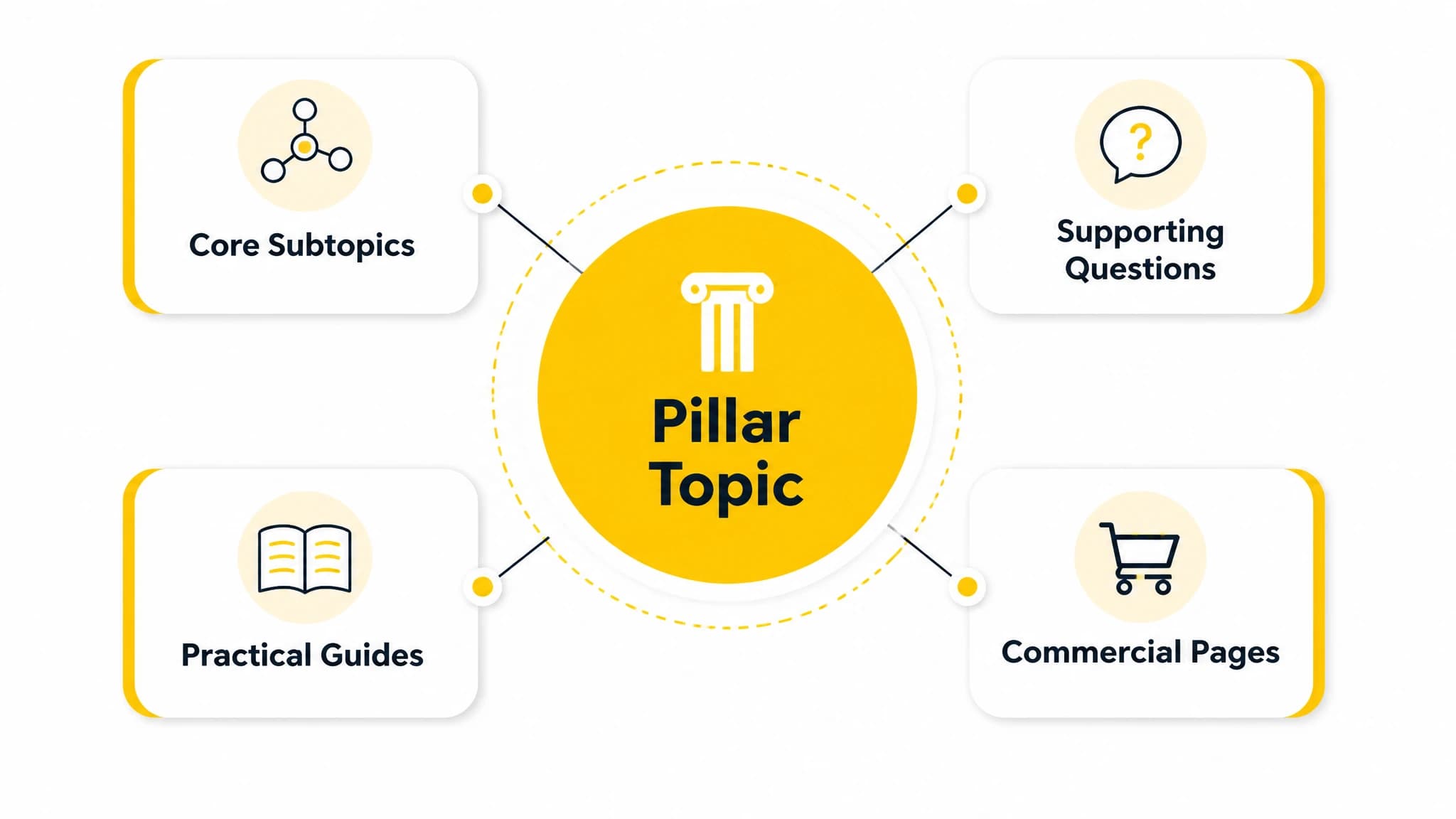
A topical map organizes broad subjects, subtopics, questions, and practical pages.
Step 3: Cluster keywords by meaning and intent
Keyword clustering groups related search terms that can be addressed by the same page or content series. This prevents a common problem: creating several thin articles that compete with one another instead of one comprehensive resource.
For each keyword or topic idea, record:
- The primary query
- Close variations and related terms
- The likely search intent
- The intended page type
- The related pillar or cluster
- The next internal link destination
Search intent normally falls into four broad categories:
- Informational: The searcher wants to learn something.
- Navigational: The searcher wants to find a specific site, page, or resource.
- Commercial investigation: The searcher is comparing options or evaluating solutions.
- Transactional: The searcher is ready to take an action, such as buying, booking, or signing up.
Intent should influence the page format. An informational query may need a tutorial or explainer. A comparison query may need a structured evaluation. A transactional query may need a focused landing page with clear next steps.
A topical authority tool can make this process easier by turning scattered keyword ideas into related groups and showing how those groups fit into a broader coverage plan.
With RankWorker, we use content opportunities, keyword research, and clustering to help you move from a list of phrases to a structured set of potential pages. You still need editorial judgment, but you spend less time organizing raw ideas manually.
Step 4: Prioritize the content roadmap
A complete topical map can contain more ideas than you can publish in a month or even a year. Prioritization keeps the plan realistic.
Score each topic using a simple framework:
- Business value: How closely does the topic connect to an important business goal?
- Audience need: How strongly does it address a real problem for your target reader?
- Topical importance: Is it essential to understanding the main subject?
- Content opportunity: Is there a clear gap, weak coverage, or underserved angle?
- Production effort: How much research, expertise, and updating will the page require?
A useful first publishing sequence often looks like this:
- Publish or improve the main pillar page.
- Cover the most important subtopics that explain the subject.
- Add practical pages that solve specific audience problems.
- Create commercial investigation pages where they fit naturally.
- Expand into narrower questions after the core coverage is in place.
This does not mean every site must publish in exactly that order. Existing authority, available expertise, seasonal demand, and business priorities can change the sequence. The important point is to make prioritization explicit instead of letting the next article be chosen randomly.
Step 5: Create pages that satisfy the search intent
Topical authority depends on content quality, not just the number of covered topics. Each article should have a clear purpose and should answer the query better than a generic summary.
Before drafting, create a short brief that defines:
- The primary question the page must answer
- The intended reader and their knowledge level
- The search intent
- The main points to cover
- Important examples or steps
- Pages that should link to this article
- Pages this article should link to
- The desired next action
Use the target keyword naturally in the title, introduction, headings, and relevant body copy. Then write for the reader’s problem rather than repeating the phrase unnecessarily.
A practical article should usually include:
- A direct answer near the beginning
- Clear definitions where needed
- Logical H2 and H3 sections
- Examples, checklists, or steps
- Caveats and trade-offs
- A clear conclusion or next action
Avoid publishing pages that are nearly identical except for a changed keyword. If the reader would expect the same answer, combine the ideas into a stronger resource. If the intent, audience, or decision is meaningfully different, create separate pages and connect them clearly.
Step 6: Build an internal linking system
Internal links show how your content relates. They help readers move from broad explanations to detailed answers and from informational pages to relevant next steps.
Use internal links deliberately rather than adding them whenever a phrase happens to match another URL. Each link should answer one of these questions:
- What should the reader learn next?
- What prerequisite explanation do they need?
- Which related page provides a deeper example?
- Where can they compare options or take action?
A simple cluster structure might look like this:
- The pillar page links to each major subtopic.
- Each subtopic page links back to the pillar.
- Supporting articles link to the most relevant subtopic.
- Commercial pages receive links from related informational content where the next step is genuinely useful.
Use descriptive anchor text that tells the reader what they will find. “Learn about content clustering” is usually more helpful than “read more.” Do not force every article to link to every other article. Excessive linking can make the page harder to use and obscure the most important paths.
For a broader publishing workflow, an SEO content roadmap can help connect keyword groups, article priorities, publishing dates, and internal-linking opportunities in one plan.
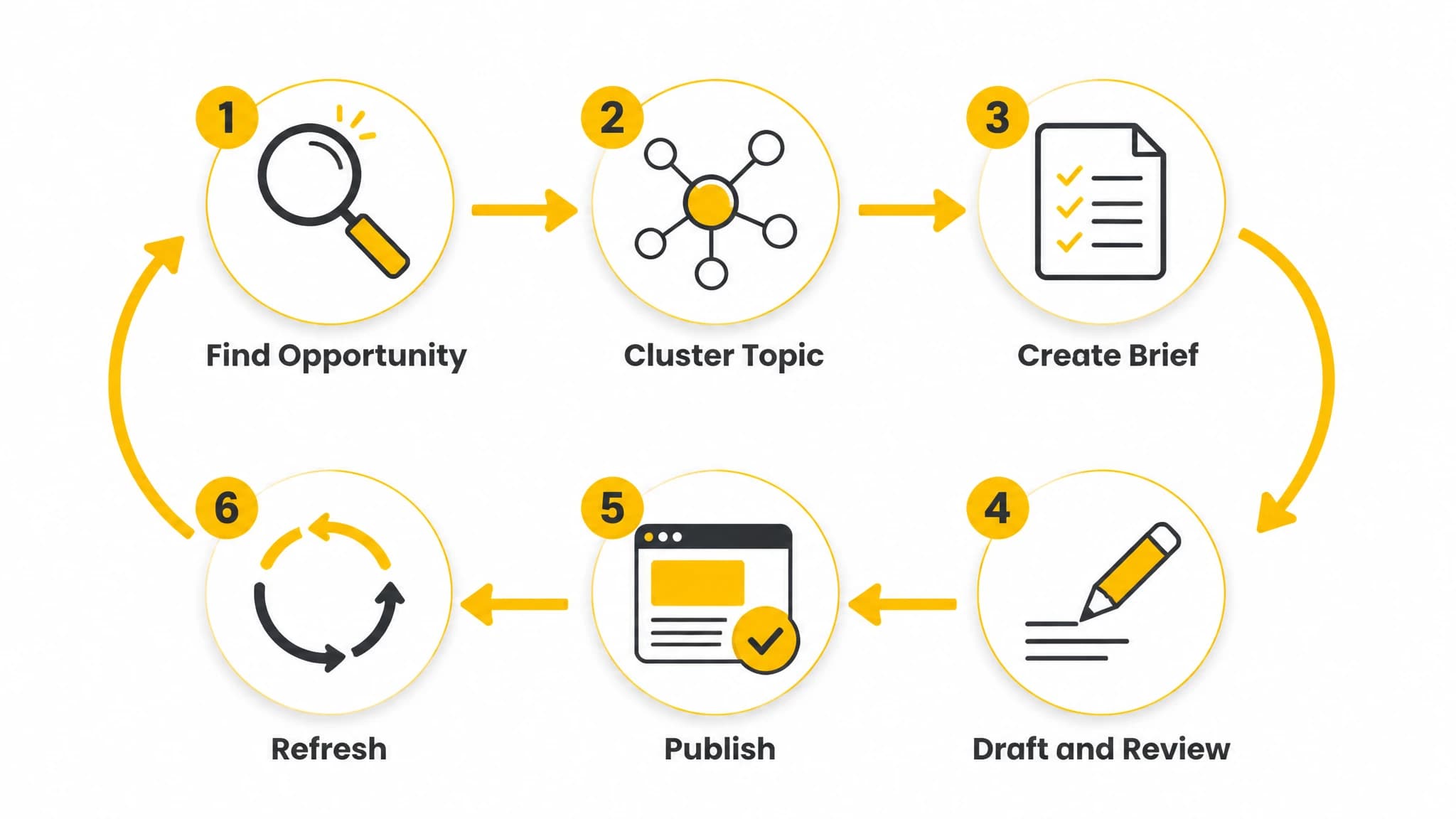
A repeatable workflow turns a topical authority plan into consistent execution.
Step 7: Turn the plan into a repeatable workflow
A topical authority plan only creates value when it becomes a consistent publishing process. Define the stages from opportunity discovery through maintenance:
- Find and evaluate a topic opportunity.
- Assign the topic to a cluster.
- Confirm the search intent and page type.
- Prepare the article brief.
- Draft and edit the content.
- Add metadata, images, and internal links.
- Review factual accuracy and usefulness.
- Publish and monitor the page.
- Refresh the content when the subject or results change.
For a small team, the biggest risk is often not strategy but operational inconsistency. Topic ideas remain in spreadsheets, briefs are incomplete, publishing dates slip, and internal links are forgotten during drafting.
With RankWorker, we support the workflow from keyword planning and content opportunities through article generation, images, SEO metadata, scheduling, and automated publishing. Our WordPress, Next.js, Direct API, webhooks, IndexNow, and MCP Server options can support different publishing setups, but you should choose only the workflow that fits your site and review process.
The objective is not to remove editorial control. It is to make the repeatable parts of planning and production easier to manage so your attention stays on quality, accuracy, and business priorities.
Step 8: Measure coverage and improve the plan
Review your content plan regularly instead of treating it as a finished document. New questions appear, competitors publish new resources, and your audience’s needs change.
Useful review questions include:
- Which important subtopics are still missing?
- Are multiple pages targeting the same intent?
- Do the articles make the next step clear?
- Are pillar and supporting pages connected logically?
- Which pages need stronger examples or updated information?
- Are business-relevant topics receiving enough coverage?
- Which content opportunities should be removed or combined?
Measure more than rankings. Look at organic entrances, engaged visits, conversions, assisted conversions, internal-link clicks, and the quality of leads or actions generated. Traffic can be useful, but the best content plan connects search visibility with a meaningful business outcome.
Refreshing existing pages can also be more valuable than constantly adding new ones. Update outdated examples, improve unclear sections, merge overlapping pages, repair broken links, and add newly relevant subtopics when they genuinely improve the resource.
A practical topical authority checklist
Before publishing a new article, confirm that:
- The topic belongs to a defined cluster.
- The page has one primary search intent.
- The article provides a distinct purpose instead of duplicating another URL.
- The content answers the main question directly.
- The page includes useful examples, steps, or decision guidance.
- Relevant internal links point to supporting and parent pages.
- The title and metadata accurately describe the content.
- The article has a clear next step for the reader.
- The page is scheduled for review and improvement.
Conclusion
Learning how to build topical authority starts with organization. Define a focused subject, map the questions around it, cluster keywords by meaning and intent, prioritize the highest-value opportunities, and publish pages that work together as a useful system.
Internal links then connect the system, while a repeatable workflow turns the plan into consistent execution. Whether you manage the process manually or use an SEO content roadmap generator, the strategy remains the same: build complete, relevant coverage for a clearly defined audience and keep improving it over time.
With RankWorker, we help turn that strategy into an operating workflow for keyword planning, content opportunities, article production, metadata, scheduling, and publishing. The result is a more manageable way to keep your SEO content plan active without losing editorial direction.