

 Veselin Stoyanov13 min read
Keyword Clustering Software: What to Look For and How It Supports SEO Strategy
Learn how keyword clustering software groups related queries, reduces cannibalization, and supports a more focused SEO content strategy.

Keyword clustering software helps turn a long, messy keyword list into a clearer SEO content plan. Instead of treating every query as a separate article opportunity, clustering tools group related searches into topics that can often be covered by one focused page or a connected content cluster.
That matters because publishing one page for every slight keyword variation can create overlapping content, waste production time, and make it harder for search engines and readers to understand which page is most relevant. A strong clustering process helps you decide which terms belong together, which deserve separate pages, and how your content should fit into the wider strategy.
In this guide, we will explain how keyword clustering works, what to look for in an AI keyword clustering tool, and how to build a repeatable workflow from keyword research through content planning and publishing.
What Is Keyword Clustering Software?
Keyword clustering software groups keywords that share a similar topic, search intent, or ranking relationship. The goal is to organize individual queries into useful content targets rather than treating a keyword database as a list of disconnected tasks.
For example, these searches may belong to one cluster:
- keyword clustering software
- AI keyword clustering tool
- keyword grouping tool
- software for grouping SEO keywords
The exact relationship depends on the search intent, results, and context. Some variations may be appropriate for one comprehensive page. Others may represent different audiences or needs and should become separate pages.
Most clustering approaches use one or more of these signals:
- Semantic similarity: The words and concepts are closely related.
- Search intent: People appear to want the same type of answer, comparison, product, or service.
- Search result overlap: Similar pages appear for multiple queries.
- Topic hierarchy: One broader topic contains several narrower subtopics.
A useful tool should not only produce groups. It should help you interpret those groups and turn them into decisions about pages, outlines, internal links, and publishing priorities.
Why Keyword Clustering Supports SEO Strategy
Keyword clustering is valuable because SEO performance depends on more than assigning one phrase to each article. Your site needs clear topical coverage, differentiated pages, and a logical relationship between content assets.
It reduces keyword cannibalization
Keyword cannibalization happens when multiple pages compete for similar search intent. This can confuse your internal strategy and make it unclear which URL should be promoted, updated, or linked to for a particular topic.
Clustering highlights possible overlap before you publish. If five planned articles are all intended to answer the same question, you may be better served by creating one stronger page and using the remaining terms as supporting language or subtopics.
Clustering does not eliminate every ranking conflict. You still need to review the pages, intent, and business purpose. However, it gives you an earlier opportunity to identify duplication.
It improves content planning
A keyword list tells you what people search for. A cluster gives you a potential content unit. That makes it easier to create article briefs, assign priorities, plan supporting content, and build a realistic publishing calendar.
For a practical overview of turning search opportunities into a publishing system, see our guide to using an AI content planner.
It supports topical coverage
A good cluster can reveal the main question, supporting questions, comparisons, definitions, and implementation topics around a subject. This helps you build content that serves readers at different stages without publishing random, disconnected articles.
It makes large keyword sets manageable
Manual grouping becomes difficult when you are working with hundreds or thousands of keywords. Software can speed up the first pass, allowing you to spend more time reviewing intent, business relevance, and page quality.
How Keyword Clustering Software Works
The exact interface differs between platforms, but most workflows follow a similar sequence.
1. Collect keyword data
Start with a relevant keyword set. You might collect terms from keyword research, customer questions, existing analytics, competitor analysis, sales conversations, or a content opportunities finder.
The quality of the input matters. A tool cannot make a useful strategy from keywords that are unrelated to your market, too vague, or disconnected from your products and customers.
Include useful context where available, such as:
- Search intent
- Search volume or demand estimates
- Ranking difficulty
- Existing URL
- Business value
- Funnel stage
- Geographic or audience modifiers
2. Normalize the terms
Keyword lists often contain duplicates, spelling variations, singular and plural forms, or different word orders. Normalization removes unnecessary noise so the clusters are easier to inspect.
This step should be treated as preparation, not as the final strategic decision. Two phrases can look similar but still require different pages if their intent or audience differs.
3. Group related queries
The software analyzes relationships between terms and assigns them to groups. Some systems rely mainly on language models or semantic similarity. Others compare ranking results, while some combine multiple methods.
A cluster may include a primary keyword and several related terms. The primary term is not always the keyword with the highest estimated demand. It should be the phrase that best represents the page's central topic and intent.
4. Identify page opportunities
Next, convert each cluster into a potential page decision:
- Create a new article
- Expand an existing page
- Merge overlapping content
- Build a pillar page
- Create a supporting article
- Do not target the cluster yet
This is where human judgment remains important. Clustering software organizes evidence, but your strategy must account for your expertise, audience, products, site structure, and available resources.
5. Connect clusters into a content plan
Related clusters can form a broader content group. For example, a main topic could connect to beginner education, implementation guidance, comparisons, troubleshooting, and advanced use cases.
This structure supports internal linking and helps your team avoid choosing topics one at a time without considering the wider site.
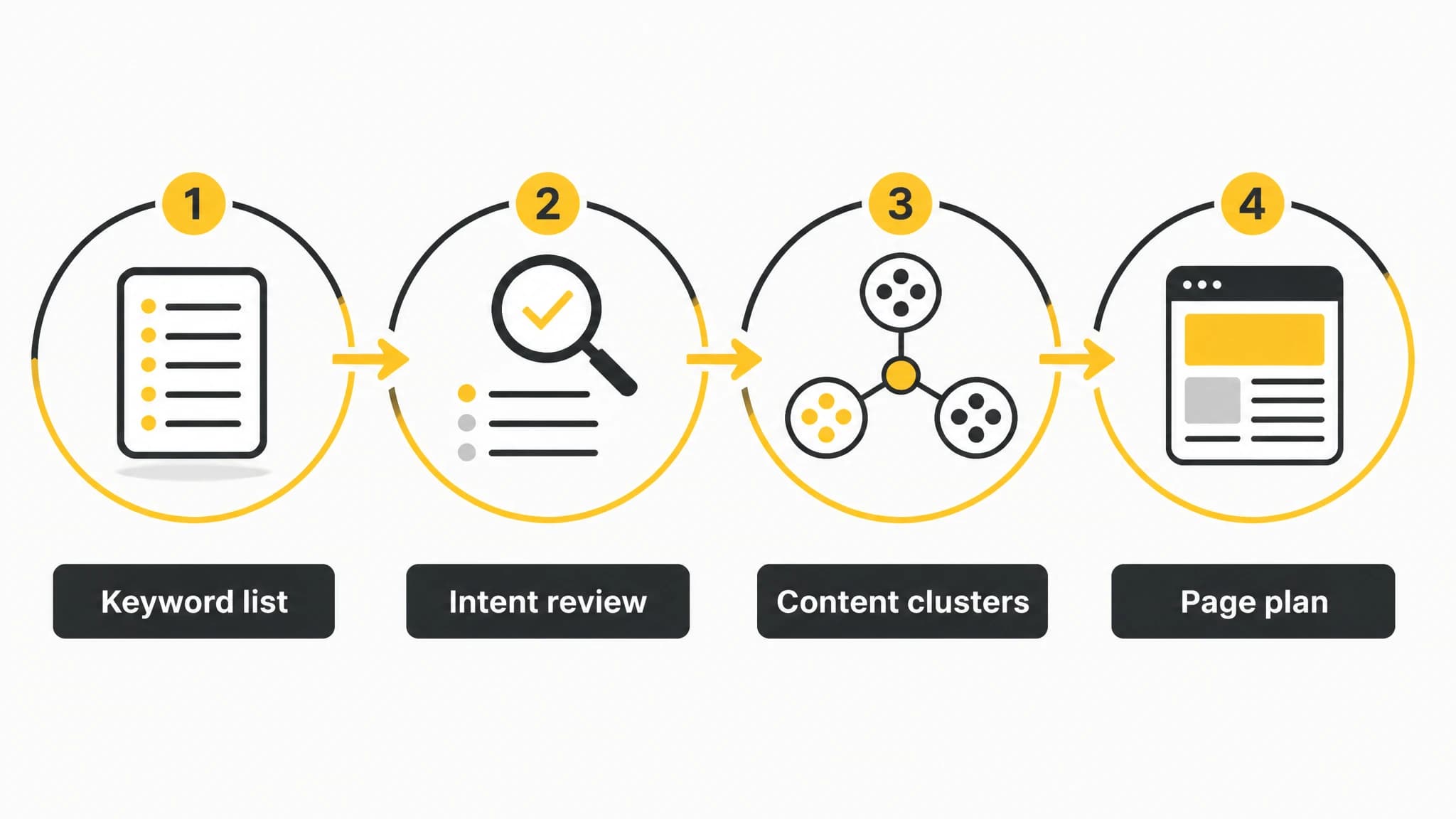
A practical clustering workflow connects keyword research with page-level content decisions.
How to Cluster Keywords for SEO: A Practical Workflow
Use the following process when creating or reviewing keyword groups.
Step 1: Start with a defined business topic
Do not begin with an unrestricted list of every keyword your market could possibly target. Start with a business area, audience, product category, or customer problem.
For example, a website selling project management software might focus on keywords related to task tracking for small teams. A focused starting point makes irrelevant clusters easier to identify.
Step 2: Separate intent before judging similarity
Ask what the searcher wants to accomplish. Common intent categories include:
- Learn about a topic
- Compare solutions
- Find a specific brand or page
- Buy or sign up
- Solve a problem
Two keywords can share words but have different intent. A definition query and a software comparison query should not automatically be placed on the same page.
Step 3: Review the proposed primary topic
For each cluster, choose a clear topic label. It should be understandable to a writer, editor, and reader. Avoid labels that are just a string of keywords.
A useful topic label might be “keyword clustering software evaluation criteria,” while a weak label might be “keyword cluster tool AI keywords group.”
Step 4: Check existing content
Search your site for pages that already address the cluster. Then decide whether the opportunity calls for a new page, a refresh, a consolidation, or additional internal links.
Review the page's current role, not only its title. A page may need a new section rather than a completely new article.
Step 5: Assign a content format
Not every cluster should become a blog post. Depending on intent, the right format could be:
- Product or feature page
- Comparison page
- Glossary or definition page
- Tutorial
- Case-based guide
- Landing page
- Supporting FAQ section
Choosing the format early improves the quality of your brief and reduces unnecessary rewriting.
Step 6: Prioritize the cluster
A practical priority model can include:
- Relevance to your business
- Strength of search intent
- Existing authority on the topic
- Potential customer value
- Content effort
- Overlap with existing pages
You do not need a complicated scoring system. A simple high, medium, or low rating is enough to create a more deliberate publishing sequence.
Step 7: Create the brief and link plan
Once the cluster is approved, define the page's primary topic, supporting terms, search intent, audience, outline, unique angle, conversion goal, and internal-link opportunities.
This is the point where keyword clustering becomes content production. For a broader comparison of research, planning, generation, and publishing workflows, read our guide to choosing AI SEO software.
What to Look For in Keyword Clustering Software
The best keyword clustering software is not necessarily the tool with the longest feature list. Look for a workflow that produces decisions you can use.
Clear clustering logic
You should be able to understand why terms were grouped together. If the tool provides no useful context, review process, or way to adjust groups, you may spend as much time correcting the output as you would have spent grouping terms manually.
Intent-aware organization
Semantic similarity is helpful, but intent is essential. Look for a system that helps distinguish informational, commercial, navigational, and transactional opportunities.
Flexible editing
Clusters are recommendations, not permanent truths. You should be able to rename groups, move keywords, split a cluster, merge related groups, and exclude irrelevant terms.
Existing-content awareness
A useful workflow should help you compare new opportunities with pages already on your site. This is important for reducing duplication and deciding when to refresh rather than publish.
Connection to content planning
Clustering has more value when it leads directly to article ideas, briefs, content calendars, and topic relationships. Otherwise, you may end up exporting another spreadsheet that nobody uses.
Support for the full workflow
If your team researches in one tool, plans in another, drafts somewhere else, and publishes manually, the handoffs can become the main source of delay. Consider whether the platform supports the next steps after clustering, including content planning, article generation, metadata, scheduling, and publishing.
With RankWorker, we connect keyword planning and content clustering with the rest of the SEO content workflow. That can help founders and small teams move from keyword opportunities to planned and publishable content without rebuilding the same process in separate tools.
Common Keyword Clustering Mistakes
Treating every cluster as a separate article
A cluster is an analytical grouping, not an automatic publishing instruction. Some groups belong on one comprehensive page, while others need to be separated by intent or audience.
Relying only on keyword similarity
Words that look alike can represent different needs. Always review the problem behind the query and the type of result the searcher expects.
Ignoring existing URLs
Creating a new page without checking current content can increase overlap. Include URL review in the clustering process from the start.
Choosing topics only by estimated demand
High-demand terms are not always the best opportunities for your business. Relevance, conversion potential, authority, and realistic effort also matter.
Publishing clusters without differentiation
If several pages are necessary, define how each one is different. Give each page a distinct audience, intent, question, format, or stage in the customer journey.
How to Measure Whether Clustering Is Helping
Evaluate the process at both the planning and performance levels.
Planning indicators include:
- Fewer duplicate article ideas
- Clearer primary topics
- More consistent briefs
- Better internal-link plans
- Less time spent organizing keyword lists
- More deliberate content priorities
Performance indicators may include improvements in relevant organic visibility, engagement with target pages, conversions from organic visitors, and the proportion of published content connected to a defined topic strategy.
Avoid judging clustering by rankings alone. The process is designed to improve decisions and reduce waste. Rankings still depend on content quality, technical SEO, competition, authority, intent alignment, and many other factors.
The Role of Keyword Clustering in an Automated SEO Workflow
Automation is most useful when it removes repetitive coordination while keeping strategic review in place. Keyword clustering can become the bridge between research and production.
A repeatable workflow might look like this:
- Find relevant keyword opportunities.
- Group related terms by topic and intent.
- Review overlap with existing pages.
- Approve page opportunities and priorities.
- Turn approved groups into content plans.
- Generate and review articles.
- Add metadata, links, and images.
- Schedule and publish through your chosen workflow.
- Monitor results and refresh the strategy.
Our keyword targeting workflow helps connect target keywords with focused article ideas and content plans. The practical advantage is not simply faster grouping. It is keeping the relationship between search demand, editorial decisions, and published pages visible.
Final Takeaway
Keyword clustering software helps you move from isolated phrases to a structured SEO strategy. It can reveal overlapping topics, reduce unnecessary pages, improve content briefs, and make it easier to build connected coverage around important themes.
To choose the right tool, look beyond automatic grouping. Prioritize intent-aware organization, editable clusters, existing-content review, content planning, and a workflow that supports production after the research stage.
For busy founders and website owners, the most useful system is the one that turns keyword research into consistent, focused publishing. With RankWorker, we bring keyword planning and content clustering into a broader workflow that can support article creation, SEO metadata, scheduling, and automated publishing.