

 Veselin Stoyanov11 min read
SEO Content Roadmap Generator: Turn Keyword Opportunities Into a Prioritized Plan
Turn keyword opportunities into a prioritized SEO content roadmap with a reusable template, practical scoring method, and clear next steps.

Keyword research gives you opportunities. A roadmap tells you which ones to pursue, why they matter, and what to do next. An SEO content roadmap generator should turn a keyword list into a prioritized, workable plan, not just produce more topic ideas.
You can build one with a spreadsheet or a planning workflow. The important part is to assess each opportunity consistently, group related topics, and choose work your team can realistically complete. This guide walks through the process and includes a reusable SEO roadmap template with a filled example.
What an SEO content roadmap should include
A roadmap is a decision-making tool that connects search opportunities to business goals and publishing capacity. It is more useful than a list of keywords because it records the reasoning behind each proposed article and its place in the plan.
Start with these fields:
| Field | What to record |
|---|---|
| Topic or working title | The reader-focused subject of the planned page |
| Primary keyword | The main query the page is intended to address |
| Cluster | The broader subject this opportunity belongs to |
| Search intent | What the searcher appears to need: information, evaluation, or a next step |
| Audience and business fit | Who the page serves and how the subject relates to your offer |
| Existing coverage | Relevant pages you already have, or a note that the topic appears uncovered |
| Opportunity score | A consistent rating based on your chosen criteria |
| Priority and rationale | Why this belongs in the roadmap now, later, or not at all |
| Format and next action | The likely content type and the next step to move it forward |
| Owner and status | Who is responsible and where the work stands |
| Review note | What to check after publication, without assuming a specific outcome |
Use the SEO content planner guide if you want a broader look at how a roadmap connects to clusters, intent, and publishing cadence. This article focuses on the decisions that turn opportunities into a prioritized queue.
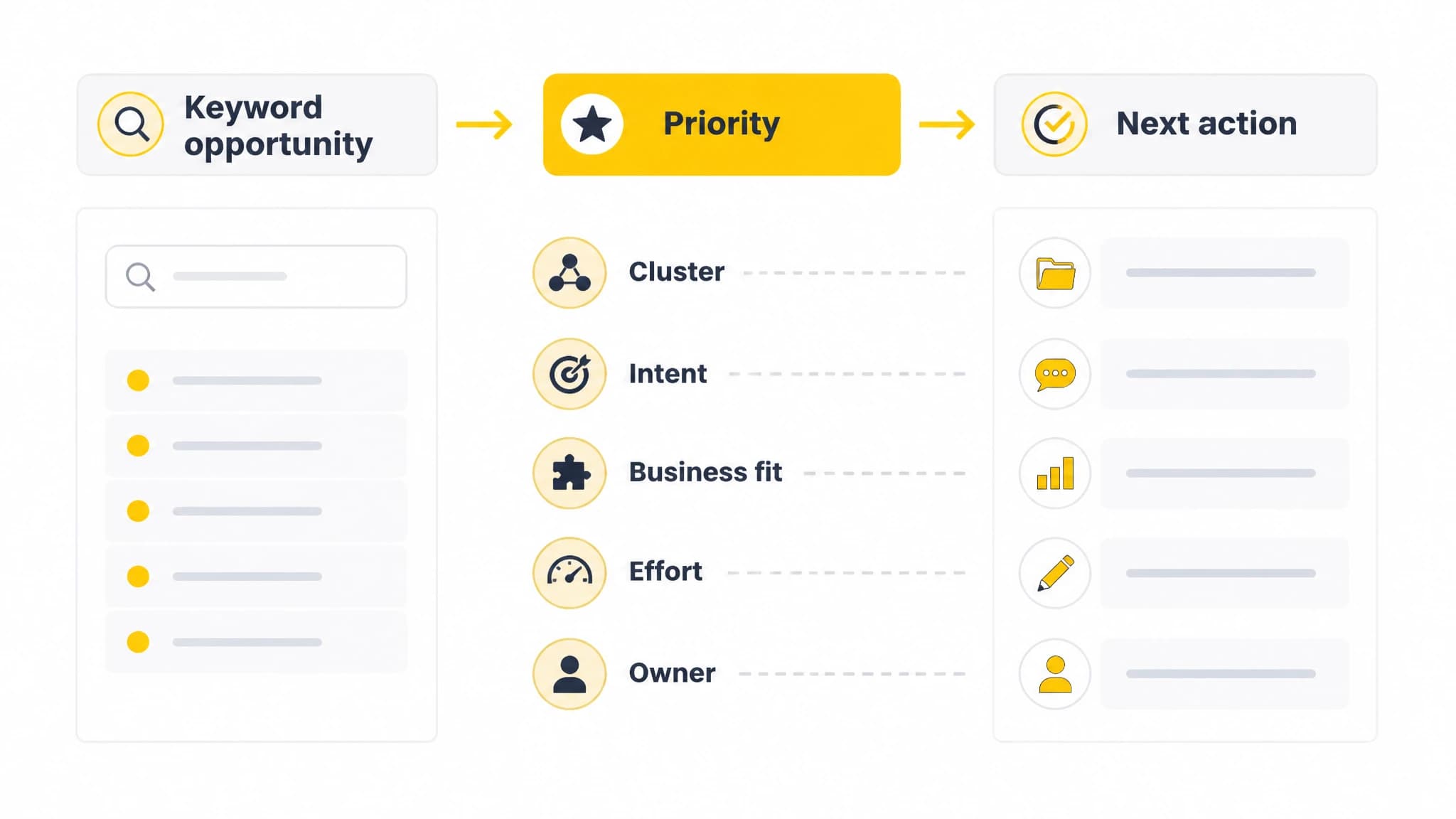
Record the context and rationale behind each roadmap decision.
How to prioritize keyword opportunities
A useful score makes trade-offs visible. It does not make the decision for you, and it should not be treated as a precise prediction of traffic or revenue. Use a small scale, such as 1 to 5, and define what a low, middle, and high rating mean for your business before scoring a large batch.
Rate each opportunity against four criteria:
- Business fit: Does the topic connect to the people you serve and the problem your business addresses?
- Search intent fit: Can you create a page that directly satisfies what a searcher seems to want?
- Opportunity evidence: Do your research notes suggest a meaningful reason to consider the query, such as relevant demand, a clear question, or a gap in your existing coverage? Record the evidence rather than relying on the score alone.
- Execution effort: Can you produce a useful, credible page with the time and expertise available? A high-effort topic may still be worthwhile, but the effort should be visible.
One simple model is to rate business fit, intent fit, and opportunity evidence from 1 to 5, then subtract an effort rating from 1 to 5. For example: priority score = business fit + intent fit + opportunity evidence - effort. The number is a sorting aid, not a universal SEO formula. Keep the individual ratings and a short explanation so that someone else can understand the decision.
Then apply two checks before assigning a priority:
- Can this page be distinct? Compare it with existing pages and other planned topics. If two ideas would answer substantially the same question, consider combining them or clarifying their different audiences and intents.
- Does the cluster make sense? A keyword can look attractive on its own but still be a poor fit for the subjects your site wants to cover. Prioritize coherent groups rather than adding disconnected topics just to make the roadmap longer.
A reusable SEO roadmap template
Copy these column headings into a spreadsheet or your planning system. Adapt the labels to your workflow, but keep the criteria consistent across opportunities.
| Topic / working title | Primary keyword | Cluster | Intent | Business fit (1-5) | Intent fit (1-5) | Opportunity evidence (1-5) | Effort (1-5) | Score | Priority | Rationale / next action |
|---|---|---|---|---|---|---|---|---|---|---|
| Build a keyword-to-roadmap process | SEO content roadmap generator | Content planning | Informational | 5 | 5 | 4 | 2 | 12 | Now | Strong fit; draft the template and explain the scoring method |
| Choose a content planning tool | content planning tools for SEO | Content operations | Evaluation | 4 | 4 | 3 | 3 | 8 | Next | Compare required workflow needs before selecting a tool |
| Create a production workflow | SEO content production workflow | Content operations | Informational | 4 | 4 | 3 | 4 | 7 | Later | Map stages and review responsibilities before outlining |
This example is illustrative. Its scores and priorities are not keyword research results or a recommendation for every business. Replace them with your own research, audience knowledge, current site coverage, and capacity. In particular, a high score should not override a weak intent match or a lack of expertise to create a genuinely useful page.
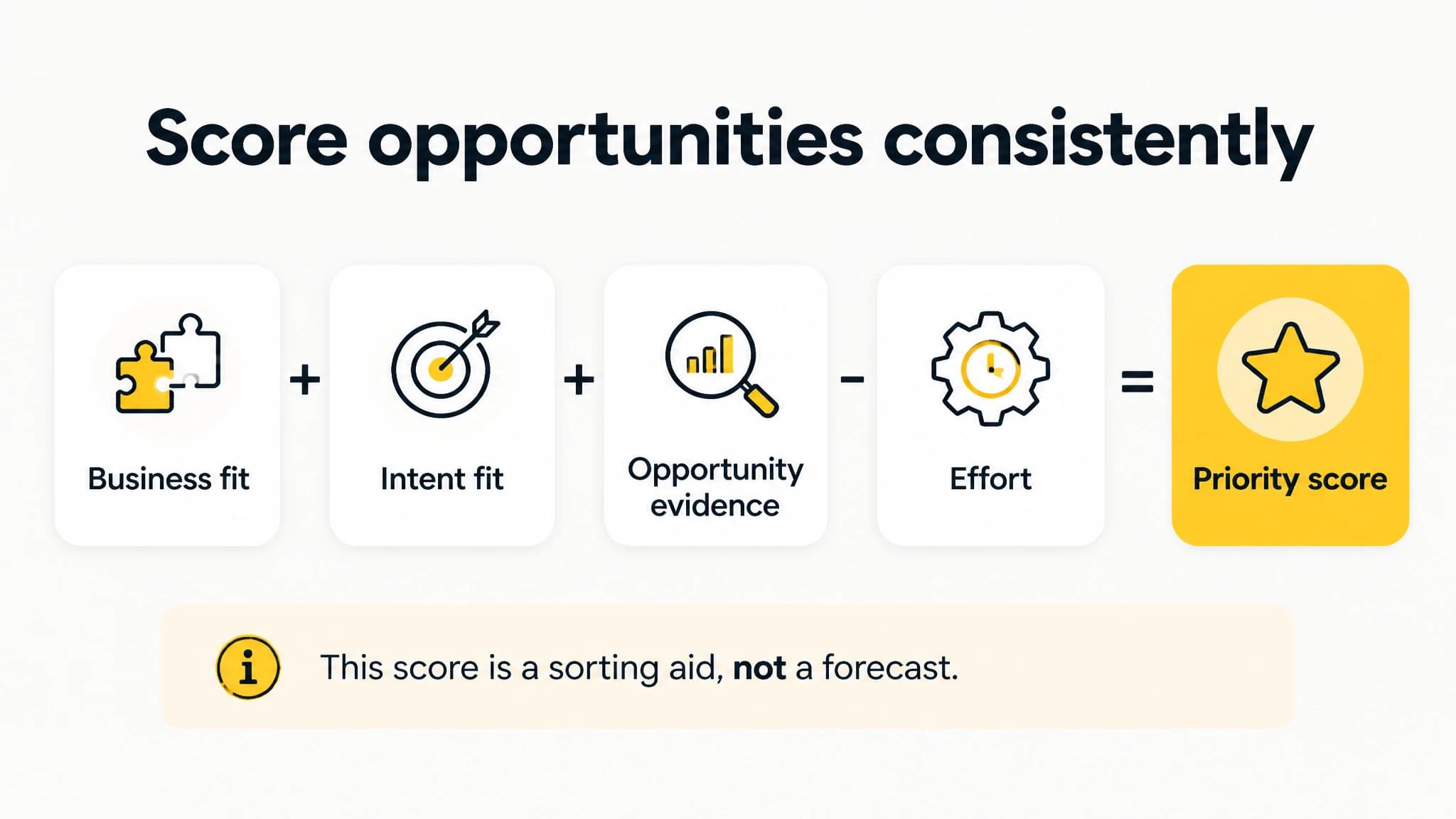
Use consistent criteria to compare opportunities, then apply editorial judgment.
From keyword list to prioritized roadmap: a five-step workflow
1. Clean and group your opportunities
Combine duplicates, spelling variations, and queries that appear to ask for the same answer. Group the remaining ideas into clusters based on shared subject and audience need. Do not force every keyword into a cluster just because it contains similar wording.
2. Check the search intent and existing coverage
Review the results and your own site to understand what a useful page would need to do. Note the likely intent in plain language, such as “learn how to plan articles” or “compare planning tools.” Look for existing pages that already serve that need. If you have an appropriate page, updating or improving it may be a better next action than creating a near-duplicate.
3. Score, explain, and sort
Apply the same scale to every opportunity. Add a short note explaining unusual scores or important evidence. Sort by score to help review the list, but make the final priority decision using business fit, intent, cluster value, existing coverage, and effort together.
4. Choose a realistic sequence
Mark opportunities as Now, Next, Later, or Do not pursue. Then check that the sequence fits your actual production capacity. A roadmap is not more useful because it contains more topics; it is useful when the team can understand and act on it. Add owners and statuses only when they help clarify responsibility or handoffs.
5. Turn the next opportunity into production work
For each topic you select, define the next concrete action: validate the query, prepare a brief, draft the page, review it, or schedule publication. Keep the roadmap focused on selection and sequencing, then use a repeatable production process to move the selected item forward. Our SEO production workflow explains how to connect keyword research with the stages of creating and publishing an article.
Example: make the plan useful in practice
Imagine a small business has collected opportunities across three clusters: product education, comparisons, and publishing operations. Instead of immediately assigning a date to every idea, the owner checks the existing site, notes the intended reader and intent, scores each opportunity, and records the next action.
The roadmap might put a directly relevant educational topic in Now, a comparison topic in Next, and a more demanding operations guide in Later. The order is not determined by search volume alone. It reflects how well each page fits the audience, whether the site can answer the query distinctly, what research is still needed, and how much work the team can take on.
Review the roadmap when your priorities or capacity change, and after you learn something that affects a topic’s fit. Avoid changing scores just to make a preferred idea rise to the top. If you revise a rating, update the rationale too. This keeps the plan understandable and makes future decisions easier.
When a generator or planning tool helps
A spreadsheet is often enough when one person is managing a short list. A tool or structured workflow becomes more useful when you need to keep keyword research, clusters, priorities, article creation, and publishing steps connected. Before choosing one, decide which parts of the process are causing repeated work: collecting ideas, comparing opportunities, maintaining the plan, or handing selected topics into production. Our content planning tool guide offers a checklist for evaluating planning needs.
With RankWorker, we support keyword planning, keyword research, content opportunities, clustering, and content planning, alongside article generation, metadata, scheduling, and automated publishing. That gives founders and small teams a way to work through research and planning without repeatedly coordinating the same information across separate manual steps. It does not remove the need to check intent, confirm business fit, or use editorial judgment.
A practical example: collect and organize keyword opportunities, group related topics, assess which ones belong in the plan, then select a topic for article creation and the next publishing steps. The roadmap remains yours to review and prioritize. If you already use a spreadsheet, keeping it is a reasonable starting point; you do not need to migrate everything before deciding whether a connected workflow would help. Our content planning tools guide can help you compare what to look for.
Common roadmap mistakes to avoid
- Sorting only by search volume: A query can attract attention but still be a poor match for your audience or offer. Consider intent and business fit too.
- Treating scores as forecasts: A score helps compare ideas using your chosen criteria. It does not guarantee rankings, visits, or conversions.
- Planning topics without checking existing pages: Review your site before creating a new page so that you can spot overlap and possible refresh opportunities.
- Ignoring effort and capacity: Include research and production effort in the discussion, then choose a sequence your team can realistically maintain.
- Building a plan that nobody updates: Assign a review moment or owner if the roadmap is shared. Keep the process light enough that it remains useful.
Build a roadmap you can act on
A strong SEO content roadmap is a prioritized set of decisions: which audience needs to serve, which opportunity to pursue, why it fits, and what action comes next. Start with a small set of well-researched topics, use consistent criteria, and make your rationale visible. Then adjust the plan as your site, business priorities, and available capacity change.
If you want to reduce repeated coordination between keyword research and content planning, with RankWorker we can help organize opportunities and carry selected topics toward content production and publishing. Start by bringing a focused group of keyword ideas into a workflow, reviewing the fit, and choosing the next article to plan.