

 Veselin Stoyanov10 min read
Content Marketing Automation for Startups: A Workflow From Topic to Publication
Build a startup content marketing workflow from topic selection to publication and follow-up. Learn what to automate and what to keep human.

Startups can automate content marketing by turning repeatable tasks into a clear workflow, while keeping people responsible for strategy, accuracy, and final approval. The goal is not to publish more content at any cost. It is to move useful ideas from topic selection to publication and follow-up without losing sight of the audience or the business.
A workable process connects six steps: choose a goal, select a topic, plan the content, create and review it, publish and distribute it, then assess what happened. Automation can reduce repetitive handoffs, but it cannot decide on its own what your customers need to hear or whether a draft represents your company accurately.
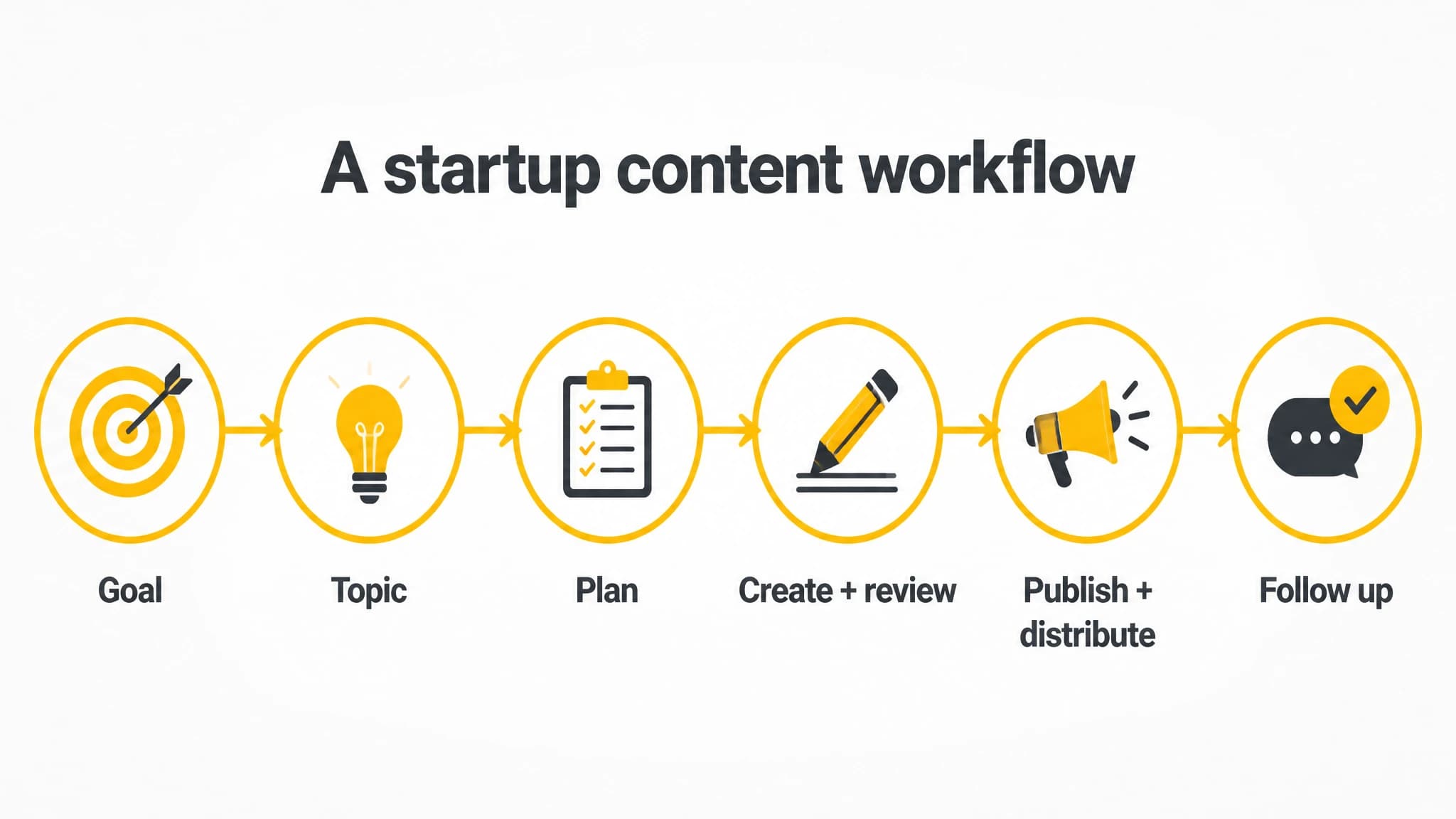
A clear sequence makes content ownership and handoffs easier to see.
What content marketing automation should do for a startup
Content marketing includes more than SEO articles. A startup might publish blog posts, email updates, social content, videos, product education, or sales materials. Automating the operation means making the recurring steps easier to manage, not assuming one tool can create and distribute every format.
A useful workflow helps your team:
- Keep topics connected to audience needs and business priorities.
- Assign clear owners for planning, review, and publication.
- Reduce repeated administrative work, such as moving a draft through the same steps every time.
- Repurpose a published idea for other channels when it makes sense.
- Review performance and use what you learn to improve the next piece.
Decide what success means before automating. For one article, the immediate goal might be answering a common customer question. For another, it might be explaining a product category or attracting readers searching for a relevant solution. Choose a measure that fits the goal, such as qualified visits, newsletter sign-ups, or conversations with prospective customers. Do not assume that publishing volume alone proves the workflow is working.
A six-step startup content marketing workflow
1. Start with a business and audience goal
Write down who the content is for, what they need help with, and what useful next step the content should support. Keep the brief specific enough to guide decisions. For example: “Help operations leads at early-stage software companies compare approaches to onboarding new customers” gives a writer more direction than “write about onboarding.”
Also set boundaries. Identify claims that need verification, sensitive topics that need specialist review, and product details that must be confirmed before publication. These instructions become useful review criteria later.
2. Choose a topic that earns a place in the plan
Collect ideas from customer questions, sales conversations, support requests, product education needs, and search research. Then assess each idea against your audience, current priorities, available expertise, and ability to produce something genuinely useful.
For an SEO blog, validate that a proposed topic fits a real search need and has a clear angle. A keyword tool can help surface opportunities, but its suggestions are inputs for editorial judgment, not a substitute for it. Our guide to SEO automation for startups explains how to make a repeatable SEO process work alongside shifting startup priorities.
Keep the initial plan small enough to maintain. A short queue of well-defined topics with owners and review dates is more useful than a large list no one can act on.
3. Turn the topic into a brief and channel plan
Before drafting, capture the essentials in a short brief:
- Audience: Who is the intended reader or viewer?
- Need: What question, task, or decision should the content address?
- Format: Is this a blog article, email, social post, video, or another format?
- Angle: What should make this piece useful and specific?
- Evidence: Which facts, examples, or product details must be checked?
- Owner: Who drafts, reviews, approves, and publishes it?
- Next step: What should a reader be able to do after consuming it?
A single topic may support more than one channel, but plan each adaptation deliberately. A blog article, newsletter summary, and short social post have different formats and jobs. Automation can help keep the work organized; channel-specific writing and posting still need an owner and a suitable process.
4. Create the content and keep review in the workflow
Use automation where it reduces predictable effort, such as organizing an SEO article workflow, preparing a first draft, or handling repeatable publishing tasks. Keep humans responsible for context-heavy decisions: whether the topic matters, whether claims are supported, whether advice is complete, and whether the piece sounds like your company.
For SEO-blog production, we built RankWorker to support the workflow from keyword research and planning through article generation, images, metadata, scheduling, and automated publishing. That makes it a practical option for startups that want a repeatable SEO publishing process, rather than a general-purpose system for every marketing channel. Our guide to building an automated SEO content workflow covers how to connect those production steps.
Treat a generated draft as work to review, not as a final authority. Check important claims against reliable sources or internal subject-matter experts. Confirm that examples are relevant, recommendations are clear, and the article answers the reader’s question. A named reviewer and a consistent checklist are more reliable than an informal “looks good” handoff.
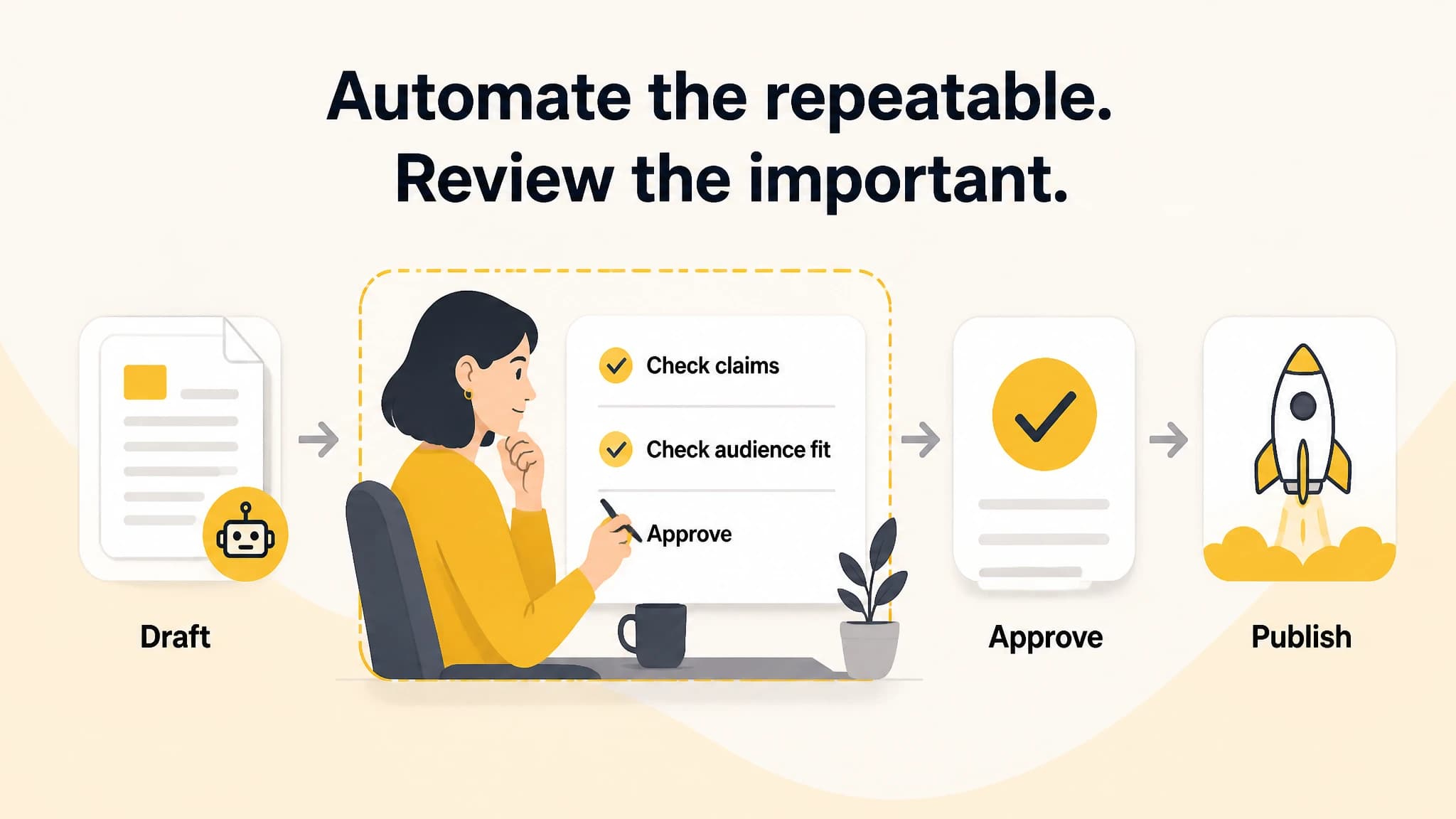
Automation can move repeatable work forward while reviewers remain accountable for quality.
5. Publish, then handle distribution separately
Once content passes review, publish it in the appropriate channel and make sure the next steps are assigned. For an SEO article, that can include checking the title and metadata, confirming the page renders correctly, and sharing it with the people who should know it is available.
Distribution is not the same as publication. If you want to share the article through email, social platforms, a community, or a sales team, include those channel-specific tasks in your plan. Assign an owner, select an appropriate format, and confirm each channel’s requirements. Do not assume that publishing a blog post automatically completes those steps.
If content moves through too many disconnected tools or manual handoffs, document the process before adding more automation. Our guide to automating content creation without losing quality offers practical ways to retain editorial control as recurring work becomes more efficient.
6. Follow up and improve the next piece
Set a follow-up date and decide what you will review. Depending on the original goal, you might check whether the piece reached its intended audience, whether readers took a useful next step, whether it answered recurring questions, or whether the content needs an update.
Record the lesson in a simple way: keep the topic, revise the angle, improve the distribution plan, or update the piece when information changes. Avoid treating one result as a universal verdict on a whole content strategy. Startups often change priorities; the workflow should make it possible to adjust the plan without losing track of work already in progress.
What to automate, and what to keep human
A useful rule is to automate a task when its steps are predictable, its inputs are clear, and its output can be checked. Keep a person responsible when the task depends on judgment, context, or accountability.
| Workflow area | Good automation candidate | Keep a person responsible for |
|---|---|---|
| Planning | Organizing topics, stages, and publishing dates | Choosing priorities and audience needs |
| SEO production | Research support, article workflow, metadata, and scheduling | Validating the angle, facts, and final draft |
| Publishing | Repeatable steps in a supported publishing workflow | Checking the live page and channel fit |
| Distribution | Reminders and task assignment | Adapting content for each channel |
| Follow-up | Scheduling a review and collecting observations | Interpreting results and changing direction |
This division addresses a common adoption concern: “Will automation make our content generic or inaccurate?” It can if a team removes review and gives a system vague instructions. A better setup uses clear briefs, agreed standards, accountable reviewers, and a way to correct or update published work.
How to start without creating another complicated system
Begin with one content type and one recurring workflow. For many startups, an SEO blog is a sensible place to start because the process can be broken into visible steps: research, topic selection, planning, drafting, review, metadata, scheduling, and publication.
Write down the current handoffs, then choose one or two repetitive steps to simplify. Set a realistic publishing cadence based on your team’s ability to review and distribute the work. Run the process for a few pieces before adding more channels or automation. If a handoff is unclear, fix ownership or the instructions first; automating a confusing process can make confusion happen faster.
With RankWorker, we recommend starting with an SEO topic that fits your audience and editorial priorities, then using the platform’s supported research, planning, article, metadata, scheduling, and publishing workflow. Your team still sets direction and reviews the work. This is a good fit if you want to make SEO-blog production more repeatable; it is not a replacement for planning your email, social, video, or other channel-specific work.
Conclusion
Content marketing automation for startups works best when it removes unnecessary manual steps without removing editorial responsibility. Set a goal, choose a useful topic, create a clear brief, automate predictable production work, review the content, publish it, plan channel-specific distribution, and follow up on what you learn.
Start small, make ownership visible, and improve the workflow as your needs change. For SEO articles, RankWorker can support the recurring path from keyword opportunity to published content, while your team remains responsible for strategy, accuracy, and final approval.